

Best Preparations of F5CAB2 Exam 2026 F5-CA Unlimited 68 Questions
Focus on F5CAB2 All-in-One Exam Guide For Quick Preparation.
F5 F5CAB2 Exam Syllabus Topics:
| Topic | Details |
|---|---|
| Topic 1 |
|
| Topic 2 |
|
| Topic 3 |
|
| Topic 4 |
|
NEW QUESTION # 40
The diagram below shows the TCP connection setup for an application.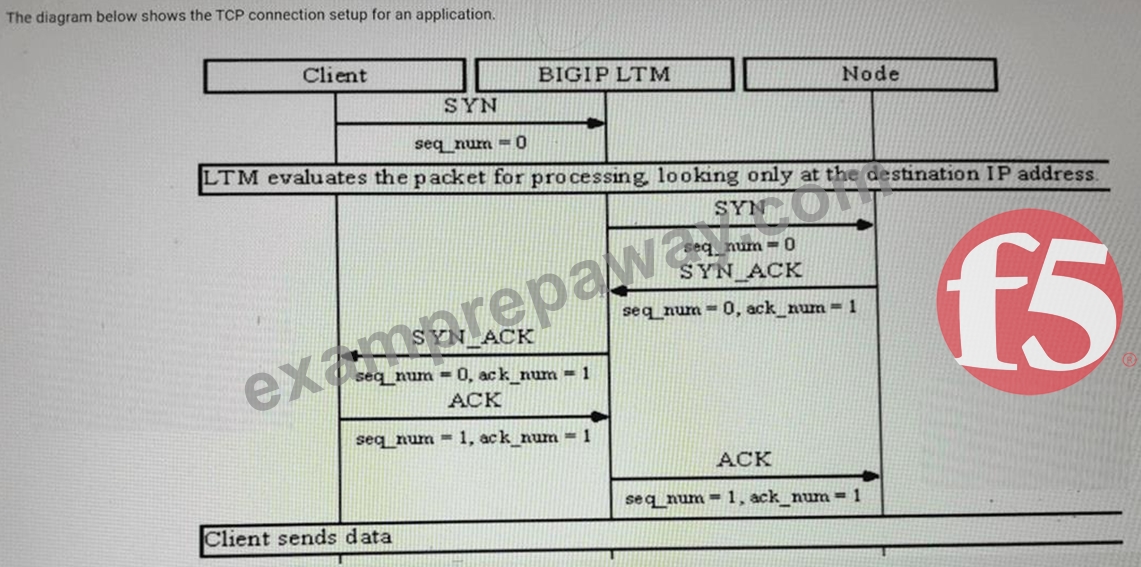
Which of the following virtual server types applies? (Choose one answer)
- A. Forwarding IP virtual server
- B. Standard virtual server
- C. Stateless virtual server
Answer: A
Explanation:
Comprehensive and Detailed Explanation From BIG-IP Administration Data Plane Concepts documents:
The diagram illustrates a specific TCP handshake sequence where the BIG-IP system acts as a transparent forwarder rather than a full proxy. The key indicators that identify this as a Forwarding (IP) virtual server are as follows:
Initial Packet Processing: The diagram explicitly states that the LTM evaluates the packet looking only at the destination IP address. This is the fundamental characteristic of a Forwarding IP virtual server, which uses the system's routing table to make forwarding decisions instead of load balancing to a pool of members.
Handshake Sequence: Unlike a Standard virtual server, which completes the three-way handshake with the client (SYN, SYN-ACK, ACK) before initiating a separate connection to the server, the Forwarding IP virtual server passes the client's original SYN packet directly to the destination node.
Response Timing: The BIG-IP system waits for the SYN-ACK from the destination node before it sends a SYN-ACK back to the client. It essentially "passes through" the handshake signals while still maintaining a state entry in the connection table to track the flow.
Packet-by-Packet Logic: While it tracks the state, it does not perform address translation (unless SNAT is specifically configured) or deep packet inspection like a full proxy would.
Why other options are incorrect:
Standard virtual server: A Standard virtual server is a "full proxy." It would finish the handshake with the client first and only then open a second, independent TCP connection to the backend server.
Stateless virtual server: A stateless virtual server does not track connections in the connection table. The diagram shows the system meticulously passing sequence numbers ($seq\_num$) and acknowledgment numbers ($ack\_num$) between the two sides, which requires stateful tracking of the TCP flow.
NEW QUESTION # 41
A BIG-IP Administrator has a cluster of devices.
What should the administrator do after creating a new Virtual Server on device 1? (Choose one answer)
- A. Create a new virtual server on device 2
- B. Synchronize the settings of the group to device 1
- C. Synchronize the settings of device 1 to the group
- D. Create a new cluster on device 1
Answer: C
NEW QUESTION # 42
The BIG-IP Administrator wants to provide quick failover between the F5 LTM devices that are configured as an HA pair with a single Self IP using the MAC Masquerade feature. The administrator configures MAC masquerade for traffic-group-1 using the following command:
`tmsh modify /cm traffic-group traffic-group-1 mac 02:12:34:56:00:00`
However, the Network Operations team identifies an issue with using the same MAC address across multiple VLANs. As a result, the administrator enables Per-VLAN MAC Masquerade to ensure a unique MAC address per VLAN by running:
`tmsh modify /sys db tm.macmasqaddr_per_vlan value true`
What would be the resulting MAC address on a tagged VLAN with ID 1501? (Choose one answer)
- A. 02:12:34:56:05:dd
- B. 02:12:34:56:01:15
- C. 02:12:34:56:dd:05
- D. 02:12:34:56:15:01
Answer: A
Explanation:
In BIG-IP high availability (HA) configurations, MAC Masquerade is used to speed up failover by allowing traffic-group-associated Self IPs to retain the same MAC address when moving between devices. This prevents upstream switches and routers from having to relearn ARP entries during a failover event, resulting in near-instant traffic recovery.
By default, MAC masquerade applies one MAC address per traffic group, regardless of how many VLANs the traffic group spans. This can create problems in some network designs because the same MAC address appearing on multiple VLANs may violate network policies or confuse switching infrastructure.
To address this, BIG-IP provides Per-VLAN MAC Masquerade, enabled by the database variable:
`tm.macmasqaddr_per_vlan = true`
When this feature is enabled:
BIG-IP derives a unique MAC address per VLAN
The base MAC address configured on the traffic group remains the first four octets The last two octets are replaced with the VLAN ID expressed in hexadecimal The VLAN ID is encoded in network byte order (high byte first, low byte second)
### VLAN ID Conversion:
VLAN ID: 1501 (decimal)
Convert to hexadecimal:
1501## = 0x05DD
High byte: 05
Low byte: DD
### Resulting MAC Address:
Base MAC: `02:12:34:56:00:00`
Per-VLAN substitution # last two bytes = `05:DD`
Final MAC address:
`02:12:34:56:05:dd`
### Why the Other Options Are Incorrect:
A (01:15) - Incorrect hexadecimal conversion of 1501
B (dd:05) - Byte order reversed (little-endian, not used by BIG-IP)
D (15:01) - Uses decimal values instead of hexadecimal
### Key BIG-IP HA Concept Reinforced:
Per-VLAN MAC Masquerade ensures Layer 2 uniqueness per VLAN while preserving the fast failover benefits of traffic groups, making it the recommended best practice in multi-VLAN HA deployments.
NEW QUESTION # 43
The network architecture for a BIG-IP consists of an external VLAN and an internal VLAN with two interfaces connected to the upstream switch. The design requires fault tolerance in the case that one of the interfaces is down. Which deployment architecture meets these requirements? (Choose one answer)
- A. One network trunk with both VLANs and LACP enabled, and both VLANs configured as untagged
- B. Two network trunks each with one VLAN and LACP disabled, and one VLAN configured as tagged and one VLAN configured as untagged
- C. One network trunk with both VLANs and LACP enabled, and both VLANs configured as tagged
- D. Two network trunks each with one VLAN and LACP enabled, and both VLANs configured as tagged
Answer: C
Explanation:
To meet the requirement of fault tolerance when one interface goes down, BIG-IP must use link aggregation so that loss of a single physical link does not isolate the VLAN(s).
How the objects relate (data plane view)
* Interfaces = physical links.
* Trunk (LACP) = bundles multiple interfaces into one logical link that provides redundancy (and possibly bandwidth aggregation).
* VLANs are assigned to interfaces or trunks. If you need multiple VLANs on the same trunk, they must use 802.1Q tagging (because you can only have one untagged VLAN per interface/trunk).
* Self IPs are then placed on the VLANs to provide BIG-IP presence and routing/ARP functions, but self IPs are not what provides link resiliency-the trunk does.
Why Option D is correct
* You have two physical interfaces and you want resiliency if one fails # put both interfaces into one trunk with LACP enabled.
* You need both external and internal VLANs on those same two links # both VLANs should be configured as tagged on that trunk, so they can coexist on the same aggregated link.
* If either physical interface fails, the trunk remains up via the remaining interface, keeping both VLANs operational.
Why the other options are incorrect
* A: Two VLANs cannot both be untagged on the same trunk/interface. Only one untagged VLAN is possible; additional VLANs must be tagged.
* B: Two trunks "each with one VLAN" would typically mean splitting VLANs across separate trunks.
With only two interfaces total, that becomes one interface per trunk-if one interface goes down, the VLAN on that interface is down (no redundancy for that VLAN).
* C: Same redundancy problem as B, and disabling LACP removes the negotiated aggregation behavior expected when the switch engineer specifically requested LACP.
NEW QUESTION # 44
When using the setup utility to configure a redundant pair, you are asked to provide a "Failover Peer IP".
Which address is this?
- A. an address on the current system used to initiate mirroring and network failover heartbeat messages
- B. an address of the other system in a redundant pair configuration
- C. an address on the current system used to listen for failover messages from the partner BIG-IP
- D. an address of the other system in its management network
Answer: B
Explanation:
When establishing a redundant pair, each device must know where to send its health heartbeats and sync data.
* The Peer IP:TheFailover Peer IPis the IP address belonging to theotherBIG-IP device in the HA pair.
This is typically a34Self-IP on a dedicated "HA" or "Internal" VLAN, or the Management IP.
* Purpose:It identifies the destination for the "Heartbeat" (the "Are you alive?" check).
* Setup Context:During the initial setup, you tell Device A to look for Device B at its "Failover Peer IP," and you tell Device B to look for Device A at its respective "Failover Peer IP."
NEW QUESTION # 45
A BIG-IP Administrator makes a configuration change to a Virtual Server on the Standby device of an HA pair. The HA pair is currently configured with Auto-Sync enabled. What effect will the change have on the HA pair configuration? (Choose one answer)
- A. The change will be propagated next time a configuration change is made on the Active device.
- B. The change will be undone when Auto-Sync propagates the config to the Standby device.
- C. The change will be undone next time a configuration change is made on the Active device.
- D. The change will take effect when Auto-Sync propagates the config to the HA pair.
Answer: B
Explanation:
Comprehensive and Detailed Explanation From BIG-IP Administration Data Plane Concepts documents:
In a BIG-IP high availability (HA) configuration, Auto-Sync is a device trust feature that automatically synchronizes configuration changes from the Active device to the Standby device within a Sync-Failover device group.
Key principles from BIG-IP Administration Data Plane Concepts:
The Active device is always the authoritative source of configuration
Configuration changes are intended to be made only on the Active device With Auto-Sync enabled, any time the Active device configuration changes, the system automatically pushes the configuration to all Standby members of the device group Configuration changes made directly on a Standby device are not preserved In this scenario:
The administrator modifies a Virtual Server on the Standby device
That change is local only and does not alter the device group's synchronized configuration When Auto-Sync next runs (triggered by a change on the Active device or an internal sync event), the Active device configuration overwrites the Standby configuration As a result, the configuration change made on the Standby device is undone.
Why the Other Options Are Incorrect:
A - The change is not undone only when another change is made; it is undone during the next Auto-Sync operation B - Changes made on the Standby device are never propagated to the Active device D - Auto-Sync does not merge or promote Standby changes into the HA pair configuration Best Practice Reinforced:
Always perform configuration changes on the Active BIG-IP device when Auto-Sync is enabled to ensure consistent and predictable HA behavior.
NEW QUESTION # 46
A BIG-IP Administrator needs to apply a health monitor for a pool of database servers named DB_Pool that uses TCP port 1521. Where should the BIG-IP Administrator apply this monitor?
- A. Local Traffic > Nodes > Default Monitor
- B. Local Traffic > Pools > DB_Pool > Members
- C. Local Traffic > Profiles > Protocol > TCP
- D. Local Traffic > Pools > DB_Pool > Properties
Answer: D
Explanation:
In the BIG-IP system object hierarchy, health monitors can be applied at three levels: Node, Pool, and Pool Member.
* Pool Level (Properties): Applying a monitor at the Pool > Properties level is the most common and efficient administrative practice. When applied here, the monitor is inherited by all members of that pool. If the monitor fails for a specific member, that member is marked "down" specifically for that pool.
* Node Level: If a monitor is applied at the Node level (Local Traffic > Nodes), it checks the health of the physical IP address itself. If it fails, that node (and all pool members associated with it) is marked down globally across the entire system.
* Member Level: Applying a monitor at the Pool > Members level allows for specific "per-member" monitoring, which is usually only done if different members in the same pool require different health checks.
* The Specific Case: For a standard database pool like DB_Pool, the administrator should navigate to Local Traffic > Pools > DB_Pool > Properties and select the appropriate monitor (e.g., a custom TCP or Oracle monitor) from the "Health Monitors" configuration section.
NEW QUESTION # 47
An ecommerce company is experiencing latency issues with online shops during Black Friday's peak season. The BIG-IP Administrator detects an overall high CPU load on the BIG-IP device and wants to move the top utilized Virtual Servers to a dedicated BIG-IP device. Where should the BIG-IP Administrator determine the problematic Virtual Servers? (Choose one answer)
- A. System > Platform
- B. Local Traffic > Network Map
- C. Local Traffic > Virtual Servers > Virtual Server List
- D. Statistics > Module Statistics > Local Traffic > Virtual Servers
Answer: D
Explanation:
Comprehensive and Detailed Explanation From BIG-IP Administration Data Plane Concepts documents:
When troubleshooting performance and latency issues on BIG-IP, especially under peak load conditions, it is critical to identify which Virtual Servers are consuming the most resources. This is a core data plane analysis task.
BIG-IP provides multiple views of configuration and status, but only certain areas expose real-time and historical traffic statistics that correlate directly with CPU usage and throughput.
Why Option C Is Correct:
Statistics > Module Statistics > Local Traffic > Virtual Servers provides:
Real-time and cumulative statistics per Virtual Server
Metrics such as:
Bits in / Bits out
Packets in / Packets out
Current connections
Connection rate
Total requests
The ability to identify high-traffic or high-connection Virtual Servers, which are the most likely contributors to elevated CPU utilization These statistics allow the administrator to objectively determine which Virtual Servers are the top consumers of system resources and therefore good candidates for migration to a dedicated BIG-IP device.
Why the Other Options Are Incorrect:
A . Local Traffic > Virtual Servers > Virtual Server List
Primarily a configuration view
Does not provide sufficient performance or utilization statistics to identify CPU-heavy Virtual Servers B . System > Platform Displays hardware-level information such as CPU cores, memory, disk, and platform type Does not break down utilization by Virtual Server D . Local Traffic > Network Map Provides a logical topology view of Virtual Servers, pools, and pool members Useful for understanding relationships, but not for identifying high-utilization Virtual Servers Key Data Plane Concept Reinforced:
To diagnose performance problems and plan traffic redistribution, BIG-IP administrators must rely on Module and object-level statistics, not configuration screens. The Virtual Server statistics view is the authoritative location for identifying traffic hotspots that directly impact CPU and latency during peak events such as Black Friday.
NEW QUESTION # 48
Refer to the exhibit.
During a planned upgrade to a BIG-IP HA pair running Active/Standby, an outage to application traffic is reported shortly after the Active unit is forced to Standby. Reverting the failover resolves the outage. What should the BIG-IP Administrator modify to avoid an outage during the next failover event? (Choose one answer)
- A. The Tag value on the Standby device
- B. The Tag value on the Active device
- C. The Interface on the Standby device to 1.1
- D. The interface on the Active device to 1.1
Answer: C
Explanation:
In an Active/Standby BIG-IP design, application availability during failover depends on both units having equivalent data-plane connectivity for the networks that carry application traffic. Specifically:
* VLANs are bound to specific interfaces (and optionally VLAN tags).
* Floating self IPs / traffic groups move to the new Active device during failover.
* For traffic to continue flowing after failover, the new Active device must have the same VLANs available on the correct interfaces that connect to the upstream/downstream networks.
What the symptom tells you:
* Traffic works when Device A is Active
* Traffic fails when Device B becomes Active
* Failback immediately restores traffic
This pattern strongly indicates the Standby unit does not have the VLAN connected the same way (wrong physical interface assignment), so when it becomes Active, it owns the floating addresses but cannot actually pass traffic on the correct network segment.
Why Interface mismatch is the best match:
* If the Active unit is already working, its interface mapping is correct.
* The fix is to make the Standby unit's VLAN/interface assignment match the Active unit.
* That corresponds to changing the Standby device interface to 1.1.
Why the Tag options are less likely here (given the choices and the exhibit intent):
* Tag issues can also break failover traffic, but the question/options are clearly driving toward the classic HA requirement: consistent VLAN-to-interface mapping on both devices so the data plane remains functional after the traffic group moves.
Conclusion: To avoid an outage on the next failover, the BIG-IP Administrator must ensure the Standby device uses the same interface (1.1) for the relevant VLAN(s) that carry the application traffic, so when it becomes Active it can forward/receive traffic normally.
NEW QUESTION # 49
What type of virtual server should be used to load balance UDP traffic without considering previous connections?
- A. Standard
- B. Forwarding
- C. Stateless
- D. Reject
Answer: C
NEW QUESTION # 50
A standard virtual server has been associated with a pool with multiple members. Assuming all other settings are left at their defaults, which statement is always true concerning traffic processed by the virtual server?
- A. The server IP address is unchanged between the client-side connection and the server-side connection.
- B. The IP addresses used in the client-side connection are the same as the IP addresses used in the server- side connection.
- C. The client IP address is unchanged between the client-side connection and the server-side connection.
- D. The TCP ports used in the client-side connection are the same as the TCP ports server-side connection.
Answer: C
Explanation:
Understanding the default behavior of a Standard Virtual Server regarding address and port translation is fundamental to BIG-IP administration.
* Source Address Translation (SNAT): By default, the BIG-IP system does not perform Source Address Translation (SNAT). This means that the packet's source IP address (the Client IP) remains preserved as it passes through the BIG-IP to the pool member. This is critical for backend servers to identify the original client for logging and security purposes. Therefore, the client IP address is unchanged between the client-side and server-side connections.
* Destination Address Translation (DAT): By default, a Standard Virtual Server always performs Destination Address Translation. The BIG-IP system changes the destination IP from the Virtual Server's IP address to the IP address of the specific Pool Member selected by the load balancing algorithm. Consequently, the server-side destination IP is different from the client-side destination IP.
* Port Translation: By default, Port Translation is enabled. If a Virtual Server is listening on port 80 and the selected pool member is configured for port 8080, the BIG-IP will translate the destination port.
Even if the ports happen to be the same, the setting allows for change, whereas the default SNAT setting (None) ensures the client IP remains static.
NEW QUESTION # 51
A BIG-IP Administrator needs to connect a BIG-IP system to two upstream switches to provide external network resilience. The network engineer instructs the administrator to configure interface binding with LACP. Which configuration should the administrator use? (Choose one answer)
- A. A Trunk listing the allowed VLAN IDs and MAC addresses configured on the switches.
- B. A virtual server with an LACP profile and the interfaces connected to the switches as pool members.
- C. A virtual server with an LACP profile and the switches' management IPs as pool members.
- D. A Trunk containing an interface connected to each switch.
Answer: D
Explanation:
In BIG-IP architecture, link aggregation and redundancy at Layer 2 are implemented using Trunks, not virtual servers or pools.
According to BIG-IP Administration Data Plane Concepts:
* Interfaces are the physical network ports on the BIG-IP device
* A Trunk is a logical grouping of multiple interfaces
* Trunks can be configured to use LACP (Link Aggregation Control Protocol) to:
* Provide link redundancy
* Increase aggregate bandwidth
* Allow automatic detection of link failures
* VLANs are then assigned to the trunk, not directly to individual interfaces, once aggregation is in place Correct Design for the Scenario:
To connect BIG-IP to two upstream switches with LACP:
* One physical interface from BIG-IP connects to Switch A
* Another physical interface from BIG-IP connects to Switch B
* Both interfaces are placed into the same trunk
* LACP is enabled on the trunk and on the switches
This configuration allows:
* Traffic to continue flowing if one interface or switch fails
* Proper LACP negotiation between BIG-IP and the upstream switches
* Clean separation of responsibilities (Layer 2 handled by trunking, Layer 4-7 by virtual servers) Why Option D Is Correct:
* A Trunk containing an interface connected to each switch is exactly how BIG-IP implements LACP- based interface binding
* The trunk handles link state, load distribution, and failover at the data plane Why the Other Options Are Incorrect:
* A & B - Virtual servers operate at Layers 4-7 and have nothing to do with physical link aggregation or LACP
* C - VLAN IDs and MAC addresses are not configured inside a trunk definition; trunks aggregate interfaces, and VLANs are applied to trunks Key Data Plane Concept Reinforced:
On BIG-IP systems, LACP is always configured on a Trunk, which aggregates physical interfaces to provide Layer 2 resiliency and bandwidth aggregation. Virtual servers and pools are not involved in physical interface binding.
NEW QUESTION # 52
Which statement is true concerning the default communication between a redundant pair of BIG-IP devices?
- A. Communication between the systems cannot be effected by port lockdown settings.
- B. Regardless of the configuration, some data is communicated between the systems at regular intervals.
- C. Connection mirroring data is shared through the serial fail over cable unless network failover is enabled.
- D. Data for both connection and persistence mirroring are shared through the same TCP connection.
Answer: D
NEW QUESTION # 53
A BIG-IP Administrator needs to connect a BIG-IP system to two upstream switches to provide external network resilience. The network engineer instructs the administrator to configure interface binding with LACP. Which configuration should the administrator use? (Choose one answer)
- A. A Trunk listing the allowed VLAN IDs and MAC addresses configured on the switches.
- B. A virtual server with an LACP profile and the interfaces connected to the switches as pool members.
- C. A virtual server with an LACP profile and the switches' management IPs as pool members.
- D. A Trunk containing an interface connected to each switch.
Answer: D
Explanation:
Comprehensive and Detailed Explanation From BIG-IP Administration Data Plane Concepts documents:
In BIG-IP architecture, link aggregation and redundancy at Layer 2 are implemented using Trunks, not virtual servers or pools.
According to BIG-IP Administration Data Plane Concepts:
Interfaces are the physical network ports on the BIG-IP device
A Trunk is a logical grouping of multiple interfaces
Trunks can be configured to use LACP (Link Aggregation Control Protocol) to:
Provide link redundancy
Increase aggregate bandwidth
Allow automatic detection of link failures
VLANs are then assigned to the trunk, not directly to individual interfaces, once aggregation is in place Correct Design for the Scenario:
To connect BIG-IP to two upstream switches with LACP:
One physical interface from BIG-IP connects to Switch A
Another physical interface from BIG-IP connects to Switch B
Both interfaces are placed into the same trunk
LACP is enabled on the trunk and on the switches
This configuration allows:
Traffic to continue flowing if one interface or switch fails
Proper LACP negotiation between BIG-IP and the upstream switches
Clean separation of responsibilities (Layer 2 handled by trunking, Layer 4-7 by virtual servers) Why Option D Is Correct:
A Trunk containing an interface connected to each switch is exactly how BIG-IP implements LACP-based interface binding The trunk handles link state, load distribution, and failover at the data plane Why the Other Options Are Incorrect:
A & B - Virtual servers operate at Layers 4-7 and have nothing to do with physical link aggregation or LACP C - VLAN IDs and MAC addresses are not configured inside a trunk definition; trunks aggregate interfaces, and VLANs are applied to trunks Key Data Plane Concept Reinforced:
On BIG-IP systems, LACP is always configured on a Trunk, which aggregates physical interfaces to provide Layer 2 resiliency and bandwidth aggregation. Virtual servers and pools are not involved in physical interface binding.
NEW QUESTION # 54
A BIG-IP Administrator wants to add a new Self IP to the BIG-IP device. Which item should be assigned to the new Self IP being configured?
- A. VLAN
- B. Trunk
- C. Route
- D. Interface
Answer: A
Explanation:
ASelf IPis an IP address on the BIG-IP system that you associate with a specificVLAN.
* VLAN Association:A Self IP cannot exist independently; it must be bound to a VLAN to define which network segment the BIG-IP can communicate with.
* Layer 2 to Layer 3 Mapping:While a VLAN is associated with physical interfaces or trunks (Layer 2), the Self IP provides the Layer 3 identity for the BIG-IP on that VLAN.
* Traffic Processing:Self IPs are used by the BIG-IP for health checking backend servers, acting as a default gateway for servers, and for HA heartbeat communication.
NEW QUESTION # 55
......
Guaranteed Success with F5CAB2 Dumps: https://www.examprepaway.com/F5/braindumps.F5CAB2.ete.file.html
Pass F5 F5CAB2 Exam – Experts Are Here To Help You: https://drive.google.com/open?id=1nZiW-YnTyYYc2aXw6Q2I3PYBpcT-a0nw