

Check the Available CTAL-TM-001 Exam Dumps with 232 QA's UPDATED 2025
Download CTAL-TM-001 Exam Dumps Questions to get 100% Success in ISTQB
NEW QUESTION # 80
An old stock control system is being decommissioned and replaced with a new system that has been running successfully in the live environment for the last few months. The stakeholders would like to -
* retain historical information held in the database to comply with their data retention policy (which requires order information to be retained for 7 years)
* query the historical information by running pre-written SQL queries.
* all commands must be invoked by keyboard as one of the end users is unable to use a mouse The pre-written SQL queries will be designed, developed and tested by the developers who are decommissioning the system and writing the data migration routine.
As the system to be decommissioned is integrated to other systems that will remain operational, the stakeholders have requested that testing incorporates all systems that are part of the stock control suite.
The stakeholders and project manager have identified the following risks, in priority order -
* 1st - Data has not been successfully migrated to an archived data store, resulting in the inability to query past stock levels and re-order details.
* 2nd - Historical data for the last 7 years is unavailable, resulting in the failure to meet the data retention policy.
* 3rd - Failure of existing systems within the stock control suite, adversely affecting the operational running of the business The risks are to form the basis of the test objectives. Which three of the following test activities, work products and/or resources achieves the test objectives?
a. Use of the live database to test the data migration does not corrupt or lose data b. A test plan detailing the test approach for ST. SIT & OT test levels c. Accessibility testing of the pre-defined SQL queries d. Security and Penetration testing of the archived database e Performance testing of the data migration exercise to ensure it completes in the time specified by the stakeholders f. Functional testing of the pre-defined SQL queries g. Regression testing of the end to end process for maintaining specified stock levels.
- A. a, b and d.
- B. a, c and g.
- C. b, d and f.
- D. a, e and g.
Answer: A
NEW QUESTION # 81
Which of the following describes the Failure Mode and Effect Analysis (FMEA) risk analysis technique?
SELECT ONE OPTION
- A. FMEA is a risk mitigation process that involves determining every possible type of failure, and designing tests to cover each one.
- B. FMEA is an analytical process upstream, that attempts to identify the hazards for each risk.
- C. FMEA is a quality risk management technique concerned with quality risks that arise from an incorrect understanding of the customer requirements.
- D. FMEA is where quality risks, their potential causes and their likely effects are identified and then severity, priority and detection ratings are assigned.
Answer: D
NEW QUESTION # 82
Which of the following best describes the appraisal costs in the cost of quality'
- A. The cost for fixing defects
- B. The cost for performing dynamic testing
- C. The cost for lawyers to deal with a lawsuit over a defect
- D. The cost spent preventing defects from occurring in the first place
Answer: B
Explanation:
Definition of Appraisal Costs:
Appraisal costs include expenses related to evaluating and testing the product to detect defects before release.
These include costs for dynamic testing, reviews, inspections, and validation activities.
Evaluation of Options:
A refers to prevention costs, not appraisal.
B is correct because dynamic testing is an appraisal activity.
C refers to failure costs (internal/external), not appraisal.
D relates to legal failure costs.
Reference and Syllabus Alignment:
Appraisal costs are outlined under "Cost of Quality" in ISTQB syllabus (TM-2.1.1).
NEW QUESTION # 83
You are the Test Manager for a critical system and are using a risk-based approach for this project.
Which of the following would most clearly convey the current status to project stakeholders? [3]
- A. A Pareto graph showing requirements coverage
- B. A scatter chart showing test execution status
- C. A pie chart showing residual risk
- D. A bar graph showing defect density
Answer: C
Explanation:
The most clear way to convey the current status to project stakeholders is to use a pie chart showing residual risk. This is because a risk-based approach focuses on identifying, analyzing, and prioritizing the risks that may affect the quality of the system, and allocating testing resources accordingly. A pie chart can visually represent the proportion of each risk category (such as high, medium, or low) in the overall risk profile, and show how much risk has been reduced or remains after testing. This can help the stakeholders to understand the current level of confidence in the system, and the potential impact of any remaining risks. Reference: Certified Tester Advanced Level Test Manager (CTAL-TM) - ISTQB not-for-profit association, ISTQB Test Manager Certification - ISTQB Exams Worldwide - ISTQB Official Registration, Managing the Test Team - ISTQB not-for-profit association
NEW QUESTION # 84
Which classification information would be most useful to capture for newly identified defects?
- A. The number of test steps in the test script that found the defect
- B. The priority that the business assigned to the project that the defect was found in
- C. The name of the configuration manager who built the system
- D. The system build that the defect was found in
Answer: D
Explanation:
Capturing the system build information for newly identified defects is crucial as it helps in tracking the defect back to a specific state of the software. This information is essential for developers to understand the context of the defect and for testers to manage regression testing effectively. It allows for precise identification of when the defect was introduced, aiding in quicker resolution and ensuring that similar issues can be prevented in future builds.
References:
ISTQB Glossary, Distributed Testing1
Defect Report in ISTQB: Software Engineering - The Knowledge Academy
ISTQB Advanced Level Test Manager Syllabus, Section 3.2.1
Defect classification and prioritisation: ISTQB offers a standardised defect classification scheme The most useful classification information to capture for newly identified defects is the system build that the defect was found in. This is because the system build is the version of the software that is compiled, integrated, and tested together. By capturing the system build for each defect, the test team can track and manage the defects more effectively, and identify the root causes and impacts of the defects. The system build can also help to reproduce and verify the defects, and to measure the quality and progress of the software development. Defect Management - ISTQB not-for-profit association References: Certified Tester Advanced Level Test Manager (CTAL-TM) - ISTQB not-for-profit association, ISTQB Test Manager Certification - ISTQB Exams Worldwide - ISTQB Official Registration, Defect Management - ISTQB not-for-profit association
NEW QUESTION # 85
Model characteristics:
Which THREE of the below mentioned characteristics relate to TMMi? 1 credit
- A. Highly related to CMMI
- B. Continuous model
- C. Focussed on higher level testing
- D. 20 key areas
- E. Focussed on component and integration testing
- F. Staged model
- G. 5 maturity levels
- H. Is build around 12 critical testing processes
Answer: A,F,G
Explanation:
Explanation/Reference:
Explanation:
NEW QUESTION # 86
When scheduling performance testing, which of the following approaches would be most advisable? [1]
- A. Deferring the start of performance testing until all functional defects have been resolved
- B. Requiring all performance tests to pass before starting functional testing
- C. Leveraging end users to do unit-level performance testing and automated tools for system-level performance testing
- D. Starting the performance testing during unit and integration testing
Answer: D
Explanation:
Performance testing is the process of determining the speed, responsiveness, and stability of a system under a given workload1. Performance testing should be started as early aspossible in the software development lifecycle, preferably during unit and integration testing, to identify and resolve performance issues before they become costly or risky2. Starting performance testing early can also help to validate the performance requirements, design, and architecture of the system, as well as to optimize the performance testing strategy and scope3. Therefore, option A is the correct answer. Option B is incorrect because deferring the start of performance testing until all functional defects have been resolved can delay the detection and resolution of performance issues, increase the cost and effort of performance testing, and reduce the confidence and quality of the system4. Option C is incorrect because leveraging end users to do unit-level performance testing and automated tools for system-level performance testing can introduce inconsistency, bias, and inefficiency in the performance testing process, as well as compromise the reliability and validity of the performance test results. Option D is incorrect because requiring all performance tests to pass before starting functional testing can create unrealistic or unnecessary expectations, as well as hinder the progress and feedback of the functional testing activities. References: 1: ISTQB Glossary, Performance Testing 2: ISTQB Certified Tester
- Performance Testing (CT-PT)3 3: ISTQB Performance Testing - TesterYou4 4: Performance Testing - ISTQB not-for-profit association : ISTQB - PERFORMANCE TESTING : Performance Testing - ISTQB not-for-profit association
NEW QUESTION # 87
You are working on a project where the business part of the organization works traditionally with defined requirements, but the development team follows an Agile model Neither team plans to change their approach What is the proper name for this type of project approach''
- A. Agile
- B. Hybrid as a transition to Agile
- C. Sequential
- D. Hybrid as fit for purpose
Answer: D
Explanation:
Context Analysis:
The project described has teams using different methodologies (traditional vs. Agile) tailored to their needs.
The "fit for purpose" hybrid approach is explicitly designed to combine methodologies based on team and project requirements.
Evaluation of Options:
A . Sequential:
Incorrect. A sequential approach suggests a traditional waterfall-like model, not a hybrid.
B . Hybrid as a transition to Agile:
Incorrect. This term implies the entire project is transitioning to Agile, which is not the case here.
C . Agile:
Incorrect. Only the development team is Agile; the business team uses a traditional approach.
D . Hybrid as fit for purpose:
Correct. Combines the most effective aspects of both traditional and Agile methodologies to suit the project context.
Syllabus Alignment:
ISTQB defines hybrid models as combinations of methodologies tailored to specific project needs (TM-1.2.4).
Reference:
ISTQB Advanced Level Test Management Syllabus (TM-1.2.4)
NEW QUESTION # 88
You have directed one of your testers to construct a "smoke test" to execute against new builds prior to starting formal testing. This is an example of which software development lifecycle activity?
[1]
- A. Project management
- B. Technical support
- C. Change and configuration management
- D. Software development and maintenance
Answer: C
Explanation:
The correct answer is C. Change and configuration management. This is because a smoke test is a type of test that checks the basic functionality and stability of a new build before proceeding to more detailed testing. A smoke test is an example of change and configuration management, which is the activity of controlling and tracking the changes made to the software and its configuration items throughout the software development lifecycle. Reference: Certified Tester Advanced Level Test Manager (CTAL-TM) - ISTQB not-for-profit association, ISTQB Test Manager Certification - ISTQB Exams Worldwide - ISTQB Official Registration, Managing the Test Team - ISTQB not-for-profit association
NEW QUESTION # 89
The development manager is managing the review of the responses received from bidders, and has asked the in-house test manager to provide a review checklist for the test management aspects of the responses. Which of the following checkpoints would be appropriate? 2 credits
- A. The bidder's test policy should enforce that incident management fully conforms to IEEE 1044.
- B. The bidder's project test plan depicts a phased implementation with later delivery dates to be confirmed and states that test deliverables will be developed using IEEE 829 as a guide.
- C. The bidder's project strategy shows that the data content of all the test environments conforms to EU standards.
- D. The bidder's test plan shows that the application will be delivered for acceptance in six months time.
Answer: B
Explanation:
Explanation/Reference:
Explanation:
NEW QUESTION # 90
Risks have been identified for a project and they have been analysed using a quantitative method, with the following results for probability and impact.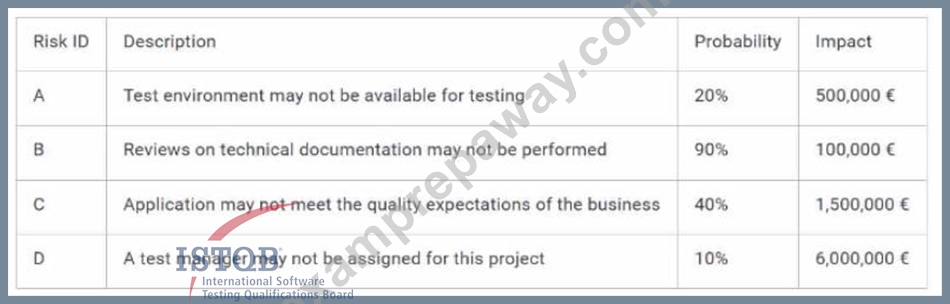
Which risk should the System Testing focus on mitigating first?
SELECT ONE OPTION
- A. Risk C
- B. Risk B.
- C. Risk A.
- D. Risk D
Answer: A
NEW QUESTION # 91
Which of the following is a typical use of risk analysis? [1]
- A. Deciding what personnel should be assigned to which tests
- B. Forecasting the product delivery date
- C. Determining the design of the tests used to mitigate each identified risk
- D. Identifying the appropriate depth of testing for each identified risk
Answer: D
Explanation:
Risk analysis is typically used to identify the appropriate depth of testing for each identified risk. This involves assessing the potential impact and likelihood of risks to prioritize testing efforts and ensure that high-risk areas are thoroughly tested.
References:The ISTQB Advanced Level Test Manager syllabus and e-learning materials emphasize the importance of organizing and leading risk identification and risk analysis sessions. The outcomes of these sessions are used for test estimation, planning, monitoring, and control, which includes determining the depth of testing based on the identified risks
NEW QUESTION # 92
Model characteristics:
Which THREE of the below mentioned characteristics relate to TMMi? 1 credit
- A. Highly related to CMMI
- B. Continuous model
- C. Focussed on higher level testing
- D. 20 key areas
- E. Focussed on component and integration testing
- F. Staged model
- G. 5 maturity levels
- H. Is build around 12 critical testing processes
Answer: A,F,G
NEW QUESTION # 93
Your company just won a contract to create a new sales application and has committed to a very aggressive delivery timeline. Due to the quick turnaround your primary stakeholder wants to be heavily involved in the design and is very anxious to see the outcome. Because of this, your company has decided to use a spiral development approach. You have a defined test policy and typically use an analytical approach to testing, however, this approach will not work with the development approach.
What test strategy should be utilized?
- A. Standard-compliant
- B. Model-based
- C. Reactive
- D. Methodical
Answer: C
Explanation:
A reactive test strategy is a test strategy that uses the actual behavior and results of the software under test to design and execute tests, without prior knowledge or documentation of the software1. A reactive test strategy should be utilized for a project that uses a spiral development approach, which is a type of iterative
/incremental approach that adds risk analysis and prototyping activities to each iteration2. A reactive test strategy is suitable for a spiral development approach because it allows for flexibility, adaptability, and creativity in the testing process, as well as for early feedback, risk reduction, and continuous improvement in the software development process3. Therefore, option D is the correct answer. Option A is incorrect because a model-based test strategy is a test strategy that uses models to represent the desired behavior and structure of the software under test, and to derive test cases, test data, test procedures, and test oracles. A model-based test strategy may not work well with a spiral development approach, as it requires the availability and stability of the models, which may not be the case in a spiral development approach that involves frequent changes and refinements of the software under test. Option B is incorrect because a methodical test strategy is a test strategy that uses predefined test methods, techniques, and procedures to design and execute tests, such as equivalence partitioning, boundary value analysis, or decision table testing. A methodical test strategy may not work well with a spiral development approach, as it requires the availability and stability of the test basis, such as the requirements, specifications, or design documents, which may not be the case in a spiral development approach that involves frequent changes and refinements of the software under test. Option C is incorrect because a standard-compliant test strategy is a test strategy that follows a predefined set of standards, guidelines, or regulations to design and execute tests, such as ISO, IEEE, or CMMI. A standard- compliant test strategy may not work wellwith a spiral development approach, as it requires the compliance and consistency of the testing process, which may not be the case in a spiral development approach that involves frequent changes and refinements of the software under test. References: 1: ISTQB Glossary, Reactive Test Strategy 2: ISTQB Glossary, Spiral Model 3: ISTQB Advanced Level Test Manager Syllabus, Section 1.1.1 : Spiral Model in Software Development Life Cycle - Software Testing Material : Spiral Model
- Tools QA : Strategic Test Management - ISTQB not-for-profit association : ISTQB Glossary, Model-Based Testing : ISTQB Glossary, Methodical Test Strategy : ISTQB Glossary, Standard-Compliant Test Strategy ISTQB Foundation Level #39 - Test Approach and Strategy - Software Testing Mentor
NEW QUESTION # 94
Your last project was released three months ago and used a risk-based approach. In production, a number of serious failures in low risk areas have occurred.
What is the most important lesson to be learned from this information? [2]
- A. The project manager should have set stakeholder expectations for serious failures.
- B. Future projects should test the lower risk areas first.
- C. A broader cross-functional team should contribute to the risk analysis.
- D. The "lessons learned" session should have been conducted prior to deployment.
Answer: C
Explanation:
The most important lesson to be learned from this information is that a broader cross-functional team should contribute to the risk analysis. This is because the risk analysis is the process of identifying, assessing, and prioritizing the risks that may affect the quality of the system, and allocating testing resources accordingly. A broader cross-functional team can provide different perspectives, expertise, and experience to the risk analysis, and help to identify and evaluate the risks more accurately and comprehensively. This can reduce the likelihood of overlooking or underestimating some risks, and improve the effectiveness and efficiency of the risk-based testing approach. Risk Analysis - ISTQB not-for-profit association Reference: Certified Tester Advanced Level Test Manager (CTAL-TM) - ISTQB not-for-profit association, ISTQB Test Manager Certification - ISTQB Exams Worldwide - ISTQB Official Registration, Risk Analysis - ISTQB not-for-profit association
NEW QUESTION # 95
What occurs In the retrospective closing?
- A. Everyone shakes hands
- B. The data collection methods are reviewed
- C. The strengths and opportunities for improvement in the retrospectives are discussed
- D. A brainstorming session is held to discuss the solutions to the root causes of the most significant issues
Answer: C
Explanation:
* Purpose of Retrospectives:
* Retrospectives are team meetings aimed at reflecting on the work process to identify what went well (strengths) and areas that can be improved (opportunities).
* This aligns with continuous process improvement practices.
* Evaluation of Options:
* A(Everyone shakes hands) is trivial and not a core activity.
* B(Reviewing data collection methods) may be part of broader discussions but is not the primary focus.
* Cis correct because it directly reflects retrospective goals.
* D(Brainstorming solutions) typically occurs in follow-up sessions, not during the retrospective itself.
References and Syllabus Alignment:
* Retrospective practices are emphasized in "Improving the Test Process" (TM-1.5.4) in the syllabus.
NEW QUESTION # 96
You have been seeing a high number of rejections of defect reports The developers are complaining that they do not understand what the problem is. even though they have been supplied with screenshots. You have checked a number of the 'problem' defect reports and have not found any information that is missing. The descriptions are very detailed and include all the necessary information in a long descriptive paragraph.
What change should you recommend that should help with the developer s problems?
- A. instruct your team to make all defects high priority so the developers have more urgency behind making the fixes
- B. Separate out the steps to reproduce the defect in the description so it is clearer for the developers and easier to find
- C. With the problem reports highlight all the information and then walk through it with the developers so they see it is all there
- D. In addition to attaching the screenshots to the defect report, ask the testers to also email them to the developer
Answer: B
Explanation:
* Context Analysis:
* Long descriptive paragraphs are difficult to parse, even if they contain all necessary information.
Developers need concise, structured information for quick understanding.
* Evaluation of Options:
* A. Instruct your team to make all defects high priority:
* Incorrect. Changing priority does not address the clarity issue in defect reports.
* B. Highlight all the information and walk through it with the developers:
* Incorrect. This is time-consuming and not scalable as a general solution.
* C. Email screenshots to developers in addition to attaching them to defect reports:
* Incorrect. Duplication of information does not solve the clarity problem.
* D. Separate out the steps to reproduce the defect in the description so it is clearer for the developers and easier to find:
* Correct. Structuring defect reports improves clarity and makes them easier to process.
* Syllabus Alignment:
* ISTQB recommends clear and concise defect reports to facilitate understanding and resolution (TM-2.3.5).
References:
ISTQB Advanced Level Test Management Syllabus (TM-2.3.5)
NEW QUESTION # 97
Which ONE of the following is considered to be the LEAST independent form of testing for an organisation?
SELECT ONE OPTION
- A. Testing is performed by a tester who is part of the development team.
- B. Testing is performed by an organisation external to the company that has developed the code.
- C. Testing is performed by specialists from the business organisation.
- D. Testing is performed by a tester who is part of an independent test team.
Answer: A
NEW QUESTION # 98
Your organisation has decided to move from using the V-model software development lifecycle to Agile Scrum. Due to inexperience in Agile methodologies and to mitigate risk, the next project will use a hybrid model, beginning with a traditional requirement definition phase and transitioning to an Agile Scrum approach for development and testing.
Which would be an appropriate test management task to perform FIRST for this next project?
- A. Ensure the team is adept at combining structured processes with Agile flexibility
- B. Enroll the testers on an online User Story development course to better understand the test basis
- C. Track and review test efforts within the sprints to ensure they align with Agile practices
- D. Produce a detailed test estimate for each test level that will be used in each sprint
Answer: A
Explanation:
The hybrid approach demands alignment between traditional and Agile practices. The Test Manager mustfirst ensure the team is capable of combining structured process with Agile adaptability. This aligns with the guidance that in hybrid models, one must balance flexibility with formal test planning and risk management strategies, especially during the transition phase .
NEW QUESTION # 99
Your company just won a contract to create a new sales application and has committed to a very aggressive delivery timeline. Due to the quick turnaround your primary stakeholder wants to be heavily involved in the design and is very anxious to see the outcome. Because of this, your company has decided to use a spiral development approach. You have a defined test policy and typically use an analytical approach to testing, however, this approach will not work with the development approach.
What test strategy should be utilized? [3]
- A. Standard-compliant
- B. Model-based
- C. Reactive
- D. Methodical
Answer: C
Explanation:
A reactive test strategy is a test strategy that uses the actual behavior and results of the software under test to design and execute tests, without prior knowledge or documentation of the software1. A reactive test strategy should be utilized for a project that uses a spiral development approach, which is a type of iterative/incremental approach that adds risk analysis and prototyping activities to each iteration2. A reactive test strategy is suitable for a spiral development approach because it allows for flexibility, adaptability, and creativity in the testing process, as well as for early feedback, risk reduction, and continuous improvement in the software development process3. Therefore, option D is the correct answer. Option A is incorrect because a model-based test strategy is a test strategy that uses models to represent the desired behavior and structure of the software under test, and to derive test cases, test data, test procedures, and test oracles. A model-based test strategy may not work well with a spiral development approach, as it requires the availability and stability of the models, which may not be the case in a spiral development approach that involves frequent changes and refinements of the software under test. Option B is incorrect because a methodical test strategy is a test strategy that uses predefined test methods, techniques, and procedures to design and execute tests, such as equivalence partitioning, boundary value analysis, or decision table testing. A methodical test strategy may not work well with a spiral development approach, as it requires the availability and stability of the test basis, such as the requirements, specifications, or design documents, which may not be the case in a spiral development approach that involves frequent changes and refinements of the software under test. Option C is incorrect because a standard-compliant test strategy is a test strategy that follows a predefined set of standards, guidelines, or regulations to design and execute tests, such as ISO, IEEE, or CMMI. A standard-compliant test strategy may not work well with a spiral development approach, as it requires the compliance and consistency of the testing process, which may not be the case in a spiral development approach that involves frequent changes and refinements of the software under test. References: 1: ISTQB Glossary, Reactive Test Strategy 2:
ISTQB Glossary, Spiral Model 3: ISTQB Advanced Level Test Manager Syllabus, Section 1.1.1 : Spiral Model in Software Development Life Cycle - Software Testing Material : Spiral Model - Tools QA : Strategic Test Management - ISTQB not-for-profit association : ISTQB Glossary, Model-Based Testing : ISTQB Glossary, Methodical Test Strategy : ISTQB Glossary, Standard-Compliant Test Strategy : ISTQB Foundation Level #39 - Test Approach and Strategy - Software Testing Mentor
NEW QUESTION # 100
In addition to risk, identify TWO other components of a testing strategy. 1 credit
- A. Test performance indicators
- B. The test schedule
- C. Test training needs for the project resources
- D. The entry and exit criteria for each test phase
- E. The test design techniques to be used
Answer: D,E
NEW QUESTION # 101
Evaluate the status of the project against the defined exit criteria. Which of the following options shows the correct status? 2 credits
- A. Criteria A = NOT OK, criteria B = NOT OK, criteria C = NOT OK
- B. Criteria A = OK, criteria B = NOT OK, criteria C = NOT OK
- C. Criteria A = NOT OK, criteria B = NOT OK, criteria C = OK
- D. Criteria A = OK, criteria B = OK, criteria C = OK
Answer: C
Explanation:
Explanation/Reference:
Explanation:
NEW QUESTION # 102
What is a "depth-first" risk-based testing technique? [1]
- A. Non-functional test cases are executed first
- B. All risk items are tested at least once
- C. Lowest risk test cases are executed first
- D. Highest risk test cases are executed first
Answer: D
Explanation:
A depth-first risk-based testing technique is a method of prioritizing and executing test cases based on the risk level of the features or functions to be tested. In this technique, the test cases with the highest risk are executed first, followed by the test cases with lower risks. This ensures that the most critical and likely areas of failure are tested thoroughly and early in the testing process. Risk Based Testing: Approach, Matrix, Process & Examples - Guru99 Reference: Certified Tester Advanced Level Test Manager (CTAL-TM) - ISTQB not-for-profit association, ISTQB Test Manager Certification - ISTQB Exams Worldwide - ISTQB Official Registration, [Analytical Test Strategy: A Comprehensive Guide - LambdaTest]
NEW QUESTION # 103
Which of the following metrics is MOST LIKELY to trigger a control directive to increase test execution resources?
- A. Percentage of test environment availability during scheduled hours, showing that this is less than planned
- B. Percentage of test cases that have been automated, showing that this is less than planned
- C. Percentage of test cases by their execution status, showing that the number of failures is greater than expected
- D. Percentage of manual test cases by their execution status, showing that the number of tests run is less than planned
Answer: D
Explanation:
The most direct trigger forresource adjustmentis evidence thattest execution is behind schedule.
"Test control... includes re-prioritizing tests... or changing the test schedule due to availability of resources."
- ISTQB-CTFL_Syllabus_2018_V3.1, section 5.3
Option A points directly to under-execution relative to plan, suggesting a need to scale up resources.
NEW QUESTION # 104
Your manager has decided that your team of manual testers should all become test automation engineers Your team is much stronger in analysis than In technical testing so you are concerned about their ability to adapt. What tool capabilities could help with this transition?
- A. Good reporting
- B. Low license costs
- C. Remote storage of the test automation scripts
- D. High usability with Al-assisted object capture
Answer: D
Explanation:
Challenges for Manual Testers Transitioning to Automation:
Manual testers often lack strong technical skills required for scripting. Tools with high usability and AI-assisted features simplify script creation and reduce the technical expertise needed.
Evaluation of Options:
A (Low license costs) is unrelated to aiding testers' technical capabilities.
B (Remote storage) is beneficial but does not address skill gaps.
C (High usability with AI-assisted object capture) directly helps by simplifying automation tasks.
D (Good reporting) is valuable but not relevant to skill transition.
Reference and Syllabus Alignment:
This matches tool evaluation criteria outlined in the ISTQB syllabus under "Test Tools" (TM-1.6.1).
NEW QUESTION # 105
......
Best Value Available! 2025 Realistic Verified Free CTAL-TM-001 Exam Questions: https://www.examprepaway.com/ISTQB/braindumps.CTAL-TM-001.ete.file.html
100% Accurate Answers! CTAL-TM-001 Actual Real Exam Questions: https://drive.google.com/open?id=1EcJFD4cPRxdCdOpjtGu2rlfK9c6w9i5l