

FCSS_SDW_AR-7.4 Exam Study Guide Free Practice Test LAST UPDATED DATE Dec 19, 2025
The New FCSS_SDW_AR-7.4 2025 Updated Verified Study Guides & Best Courses
Fortinet FCSS_SDW_AR-7.4 Exam Syllabus Topics:
| Topic | Details |
|---|---|
| Topic 1 |
|
| Topic 2 |
|
| Topic 3 |
|
NEW QUESTION # 24
Refer to the exhibits. The exhibits show the source NAT (SNAT) global setting. port2 interface settings, and the routing table on FortiGate.
The administrator increases the member priority on port2 to 20. Upon configuration changes and the receipt of new packets, which two actions does FortiGate perform on existing sessions established over port2? (Choose two.)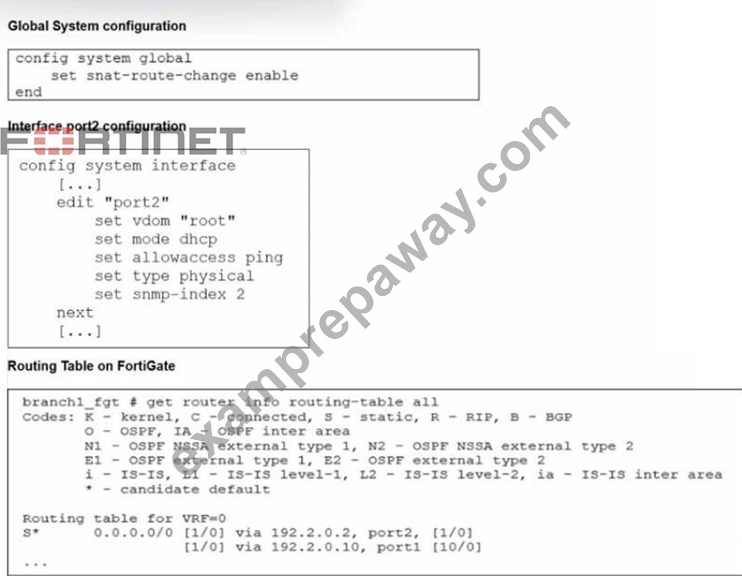
- A. FortiGate routes only new sessions over port2.
- B. FortiGate continues routing all existing sessions over port2.
- C. FortiGate updates the gateway information of the sessions with SNAT so that they use port1 instead of port2.
- D. FortiGate flags the sessions as dirty.
- E. FortiGate flags the SNAT session as dirty only if the administrator has assigned an IP pool to the firewall policies with NAT.
Answer: C,D
NEW QUESTION # 25
Refer to the exhibits.
Exhibit A
Exhibit B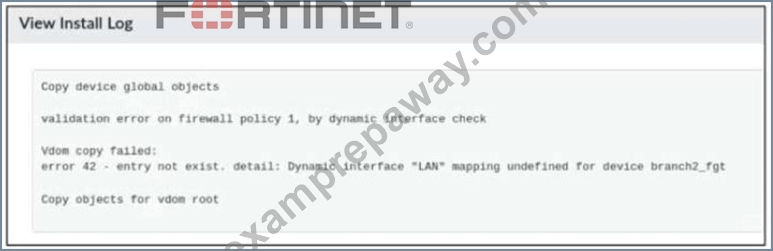
Exhibit A shows a policy package definition. Exhibit B shows the install log that the administrator received when he tried to install the policy package on FortiGate devices.
Based on the output shown in the exhibits, what can the administrator do to solve the issue?
- A. Use a metadata variable instead of a dynamic interface to define the firewall policy.
- B. Create dynamic mapping for the LAN interface for all devices in the installation target list.
- C. Policies can refer to only one LAN source interface. Keep only the D-LAN, which is the dynamic LAN interface.
- D. Dynamic mapping should be done automatically. Review the LAN interface configuration for branch2_fgt.
Answer: B
NEW QUESTION # 26
You are planning a new SD-WAN deployment with the following criteria:
- Two regions
- Most of the traffic is expected to remain within its region
- No requirement for inter-region ADVPN
To remain within the recommended best practices, which routing protocol should you select for the overlays?
- A. IBGP within each region and between the regions.
- B. OSPF for the routing within each region and EBGP between the regions.
- C. IBGP with BGP per overlays within each region and IBGP with BGP on loopback between the regions.
- D. IBGP with BGP on loopback within each region and EBGP between the regions.
Answer: D
NEW QUESTION # 27
Which three characteristics apply to provisioning templates available on FortiManager? (Choose three.)
- A. A CLI template group can contain CLI templates of both types.
- B. CLI templates are applied in order, from top to bottom
- C. A template group can include a system template and an SD-WAN template.
- D. A CLI template can be of type CLI script or Perl script.
- E. Each template group can contain up to three IPsec tunnel templates.
Answer: A,B,C
NEW QUESTION # 28
Refer to the exhibits.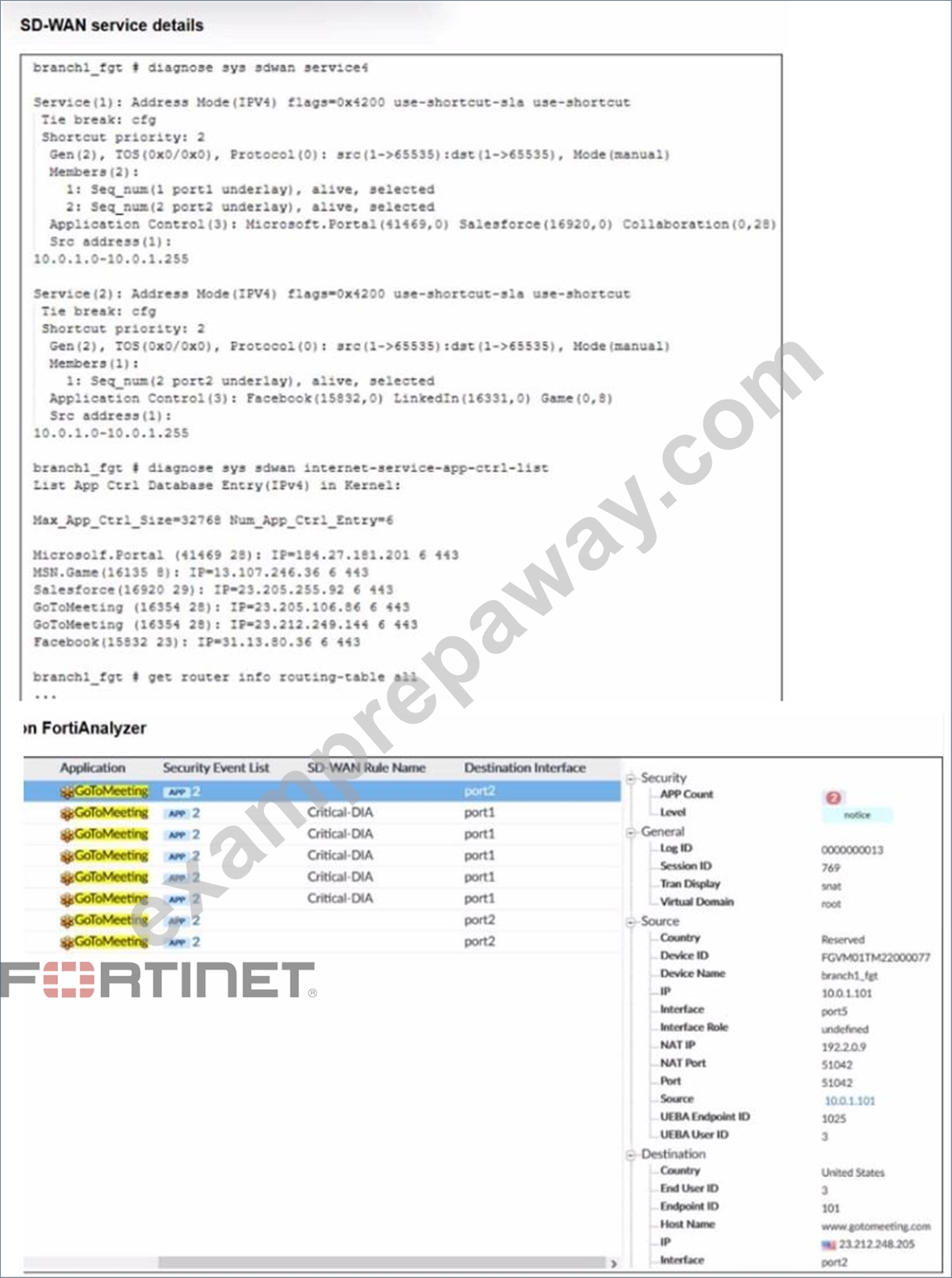
An administrator is testing application steering in SD-WAN. Before generating test traffic, the administrator collected the information shown in the first exhibit. After generating GoToMeeting test traffic, the administrator examined the corresponding traffic log on FortiAnalyzer, which is shown in the second exhibit.
The administrator noticed that the traffic matched the implicit SD-WAN rule, but they expected the traffic to match rule ID 1.
Which two reasons explain why some log messages show that the traffic matched the implicit SD-WAN rule? (Choose two.)
- A. FortiGate could not refresh the routing information on the session after the application was detected.
- B. No configured SD-WAN rule matches the traffic related to the collaboration application GoToMeeting
- C. The session 3-tuple did not match any of the existing entries in the ISDB application cache.
- D. Full SSL inspection is not enabled on the matching firewall policy.
Answer: A,C
NEW QUESTION # 29
Refer to the exhibit. The exhibit shows output of the command diagnose sys adwan aervice4 collected on a FortiGate device.
The administrator wants to know through which interface FortiGate will steer traffic from local users on subnet 10.0.1.0/255.255.255.192 and with a destination of the social media application Facebook. Based on the exhibits, which two statements are correct? (Choose two.)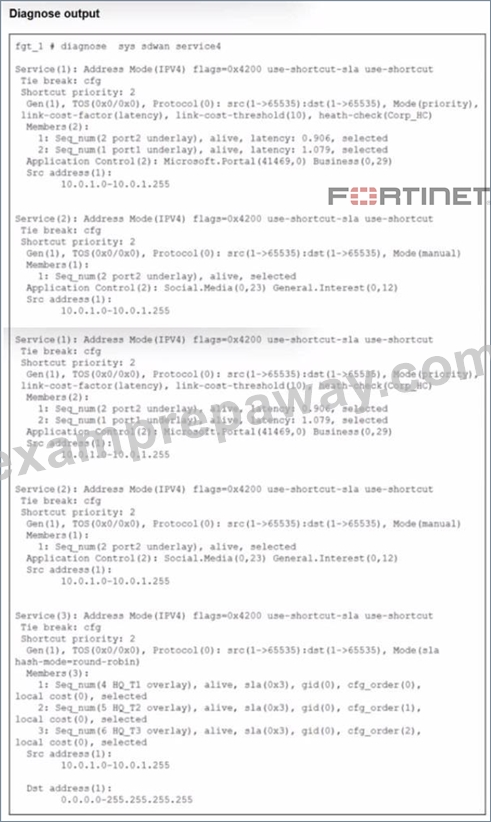
- A. When FortiGate cannot recognize the application of the flow, it steers the traffic through the preferred member of rule 3, HQ_T1.
- B. There is no service defined for the Facebook application, so FortiGate appliesservice rule 3 and directs the traffic to headquarters.
- C. When FortiGate cannot recognize the application of the flow, it load balances the traffic through the tunnels HQ_T1, HQ_T2, HQ_T3.
- D. FortiGate steers traffic for social media applications according to the service rule 2 and steers traffic through port2.
Answer: C,D
NEW QUESTION # 30
Refer to the exhibit. An administrator is troubleshooting SD-WAN on FortiGate. A device behind branch1_fgt generates traffic to the 10.0.0.0/8 network.
The administrator expects the traffic to match SD-WAN rule ID 1 and be routed over HUB1- VPN1.
However, the traffic is routed over HUB1-VPN3.
Based on the output shown in the exhibit, which two reasons, individually or together, could explain the observed behavior? (Choose two.)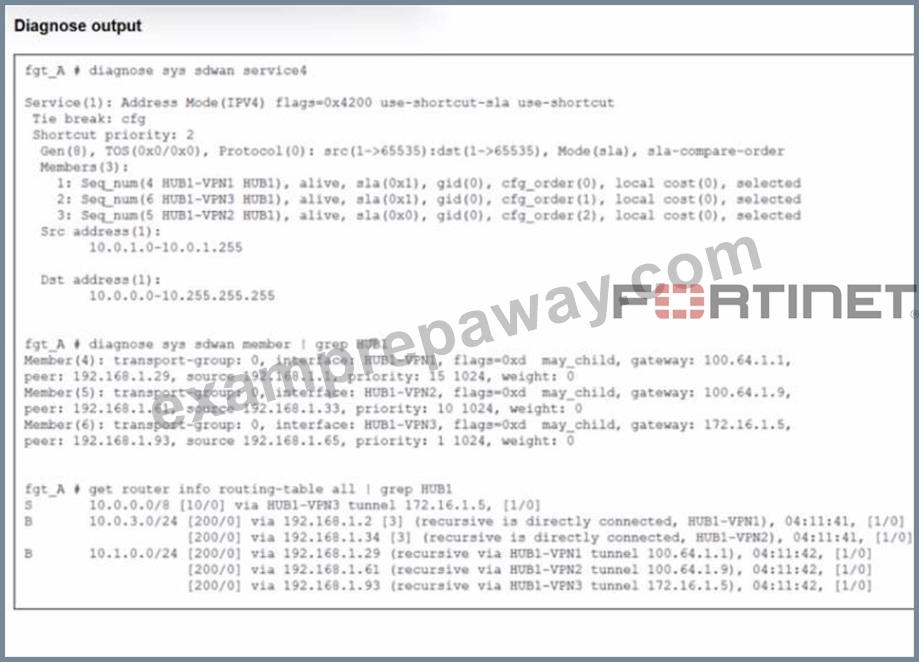
- A. HUB1-VPN3 has a lower route priority value (higher priority) than HUB1-VPN1.
- B. The traffic matches a regular policy route configured with HUB1-VPN3 as the outgoing device
- C. HUB1-VPN3 has a higher member configuration priority than HUB1-VPN1.
- D. HUB1-VPN1 does not have a valid route to the destination
Answer: A,C
NEW QUESTION # 31
Refer to the exhibit.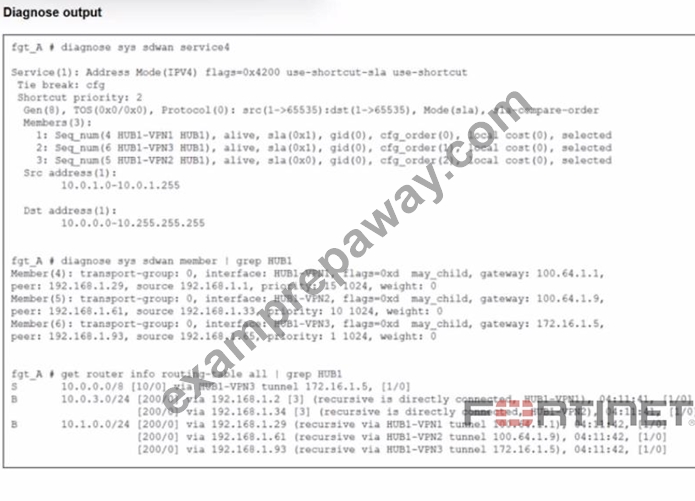
An administrator is troubleshooting SD-WAN on FortiGate. A device behind branch1_fgt generates traffic to the 10.0.0.0/8 network.
The administrator expects the traffic to match SD-WAN rule ID 1 and be routed over HUB1-VPN1. However, the traffic is routed over HUB1-VPN3.
Based on the output shown in the exhibit, which two reasons, individually or together, could explain the observed behavior? (Choose two.)
- A. HUB1-VPN3 has a lower route priority value (higher priority) than HUB1-VPN1.
- B. The traffic matches a regular policy route configured with HUB1-VPN3 as the outgoing device
- C. HUB1-VPN3 has a higher member configuration priority than HUB1-VPN1.
- D. HUB1-VPN1 does not have a valid route to the destination
Answer: A,C
NEW QUESTION # 32
What is true about SD-WAN multiregion topologies?
- A. Each region has its own SD-WAN topology.
- B. It is not compatible with ADVPN.
- C. Regions must correspond to geographical areas.
- D. Routing between the hub and spokes must be BGP.
Answer: A
NEW QUESTION # 33
Exhibit.
For your ZTP deployment, you review the CSV file shown in exhibit and note that it is missing important information. Which two elements must you change before you can import it into FortiManager? (Choose two.)
- A. You must define a name for each device
- B. You must define a value for each device and each metadata variable that defines an IP address.
- C. You must define a value for each device and each user-defined metadata variable.
- D. You must associate a device blueprint with each device
Answer: A,D
NEW QUESTION # 34
Refer to the exhibits. You use FortiManager to manage the branch devices and configure the SD- WAN template. You have configured direct internet access (DIA) for the IT department users.
Now. you must configure secure internet access (SIA) for all local LAN users and have set the firewall policies as shown in the second exhibit.
Then, when you use the install wizard to install the configuration and the policy package on the branch devices, FortiManager reports an error as shown in the third exhibit. Which statement describes why FortiManager could not install the configuration on the branches?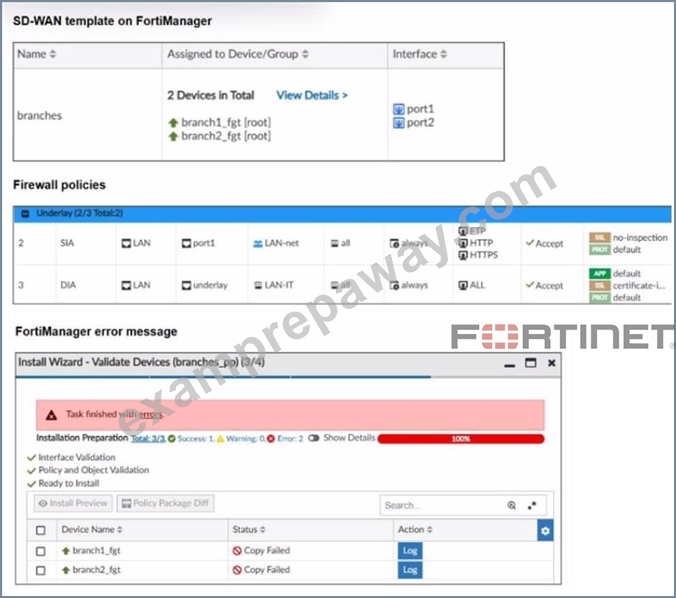
- A. You cannot install firewall policies that reference an SD-WAN member.
- B. You must direct SIA traffic to a VPN tunnel.
- C. You cannot install SIA and DIA rules on the same device.
- D. You cannot install firewall policies that reference an SD-WAN zone.
Answer: A
NEW QUESTION # 35
Refer to the exhibit.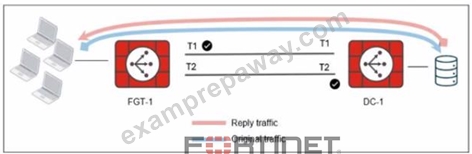
The administrator analyzed the traffic between a branch FortiGate and the server located in the data center, and noticed the behavior shown in the diagram.
When the LAN clients located behind FGT1 establish a session to a server behind DC-1, the administrator observes that, on DC-1, the reply traffic is routed overT2. even though T1 is the preferred member in the matching SD-WAN rule.
What can the administrator do to instruct DC-1 to route the reply traffic through the member with the best performance?
- A. FortiGate route lookup for reply traffic only considers routes over the original ingress interface.
- B. Enable reply-session under config system sdwan.
- C. Enable snat-route-change under config system global.
- D. Enable auxiliary-session under config system settings.
Answer: D
NEW QUESTION # 36
Exhibit.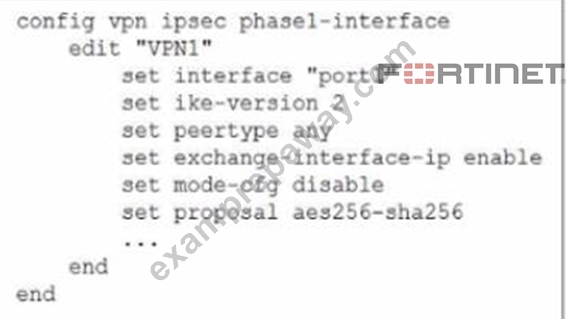
The administrator configured the IPsec tunnel VPN1 on a FortiGate device with the parameters shown in exhibit.
Based on the configuration, which three conclusions can you draw about the characteristics and requirements of the VPN tunnel? (Choose three.)
- A. The remote end must support IKEv2.
- B. The tunnel interface IP address on the spoke side is provided by the hub.
- C. The administrator must manually assign the tunnel interface IP address on the hub side
- D. This configuration allows user-defined overlay IP addresses.
- E. The remote end can be a third-party IPsec device.
Answer: C,D,E
NEW QUESTION # 37
Which two statements are correct when traffic matches the implicit SD-WAN rule? (Choose two.)
- A. Traffic does not match any of the entries in the policy route table.
- B. Traffic is load balanced using the algorithm set for the v4-ecmp-mode setting.
- C. All SD-WAN rules have the default and gateway setting enabled.
- D. The session information output displays no SD-WAN-specific details.
Answer: A,D
NEW QUESTION # 38
Refer to the exhibit, which shows the SD-WAN rule status and configuration. Based on the exhibit, which change in the measured packet loss will make HUB1-VPN3 the new preferred member?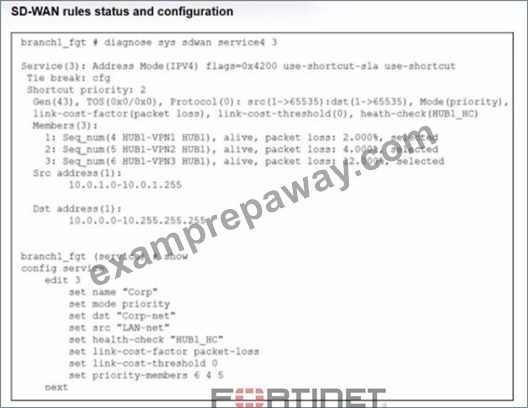
- A. When all three members have the same packet loss
- B. When HUB1-VPN1 has 4% packet loss
- C. When HUB1-VPN1 has 12% packet loss
- D. When HUB1-VPN3 has 4% packet loss
Answer: A
NEW QUESTION # 39
Refer to the exhibit.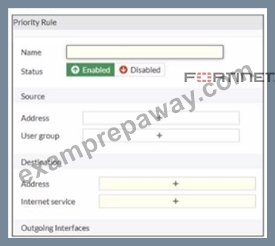
An administrator configures SD-WAN rules for a DIA setup using the FortiGate GUI. The page to configure the source and destination part of the rule looks as shown in the exhibit. The GUI page shows no option to configure an application as the destination of the SD-WAN rule Why?
- A. You must enable the feature first using the GUI menu System > Feature Visibility.
- B. FortiGate allows the configuration of applications as the destination of SD-WAN rules only on the CLI.
- C. You cannot use applications as the destination when FortiGate is used for a DIA setup.
- D. You must enable the feature on the CLI.
Answer: C
NEW QUESTION # 40
Refer to the exhibits.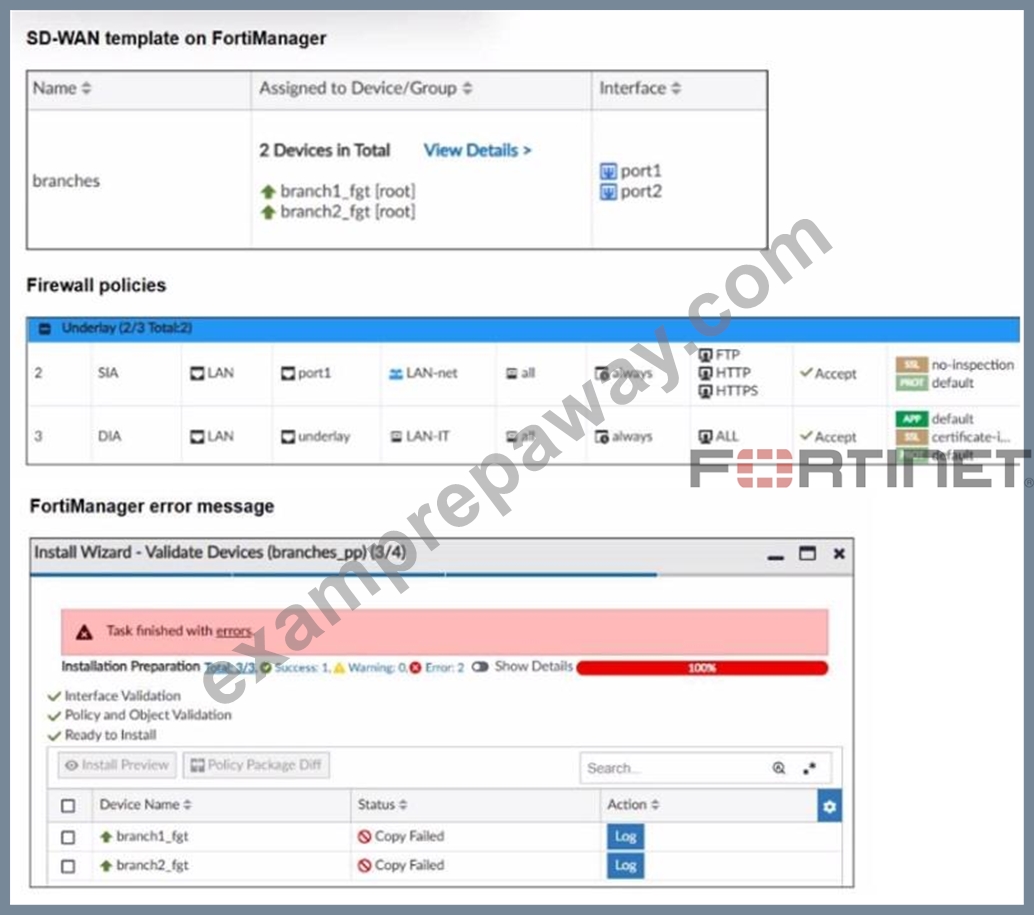
You use FortiManager to manage the branch devices and configure the SD-WAN template. You have configured direct internet access (DIA) for the IT department users. Now. you must configure secure internet access (SIA) for all local LAN users and have set the firewall policies as shown in the second exhibit.
Then, when you use the install wizard to install the configuration and the policy package on the branch devices, FortiManager reports an error as shown in the third exhibit.
Which statement describes why FortiManager could not install the configuration on the branches?
- A. You cannot install firewall policies that reference an SD-WAN member.
- B. You must direct SIA traffic to a VPN tunnel.
- C. You cannot install SIA and DIA rules on the same device.
- D. You cannot install firewall policies that reference an SD-WAN zone.
Answer: A
NEW QUESTION # 41
Refer to the exhibit.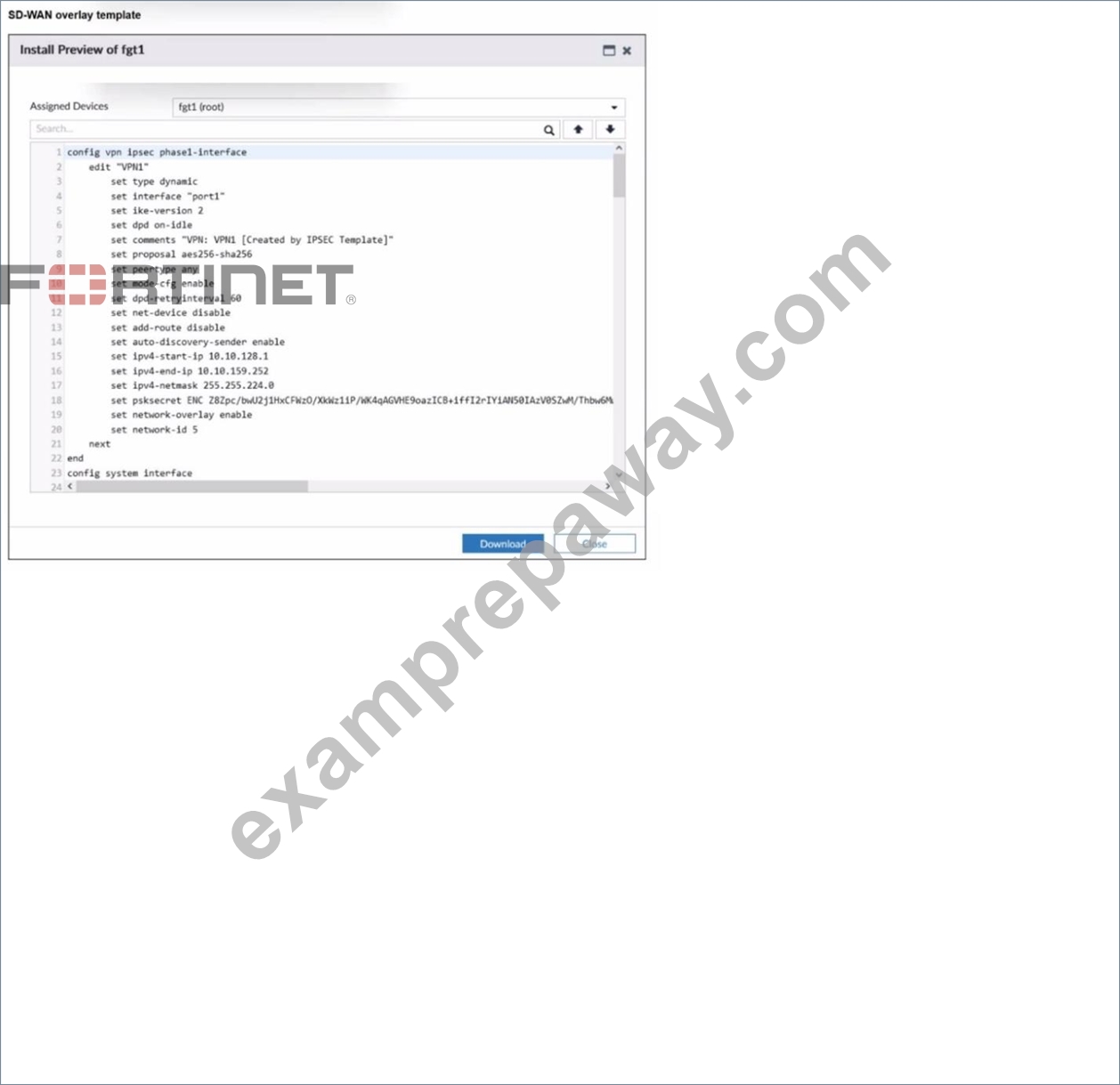
The administrator used the SD-WAN overlay template to prepare an IPsec tunnels configuration for a hub-and-spoke SD-WAN topology. The exhibit shows the FortiManager installation preview for one FortiGate device.
Based on the exhibit, which statement best describes the configuration applied to the FortiGate device?
- A. It is a spoke device that establishes dynamic IPsec tunnels to the hub. The local subnet range is 10.10.128.0/23.
- B. It is a hub device. It will automatically discover the spoke devices and add them to the SD-WAN topology.
- C. It is a spoke device that establishes dynamic IPsec tunnels to the hub It can send ADVPN shortcut requests.
- D. It is a hub device. It can send ADVPN shortcut offers.
Answer: D
NEW QUESTION # 42
Refer to the exhibit. The administrator used the SD-WAN overlay template to prepare an IPsec tunnels configuration for a hub-and-spoke SD-WAN topology. The exhibit shows the FortiManager installation preview for one FortiGate device.
Based on the exhibit, which statement best describes the configuration applied to the FortiGate device?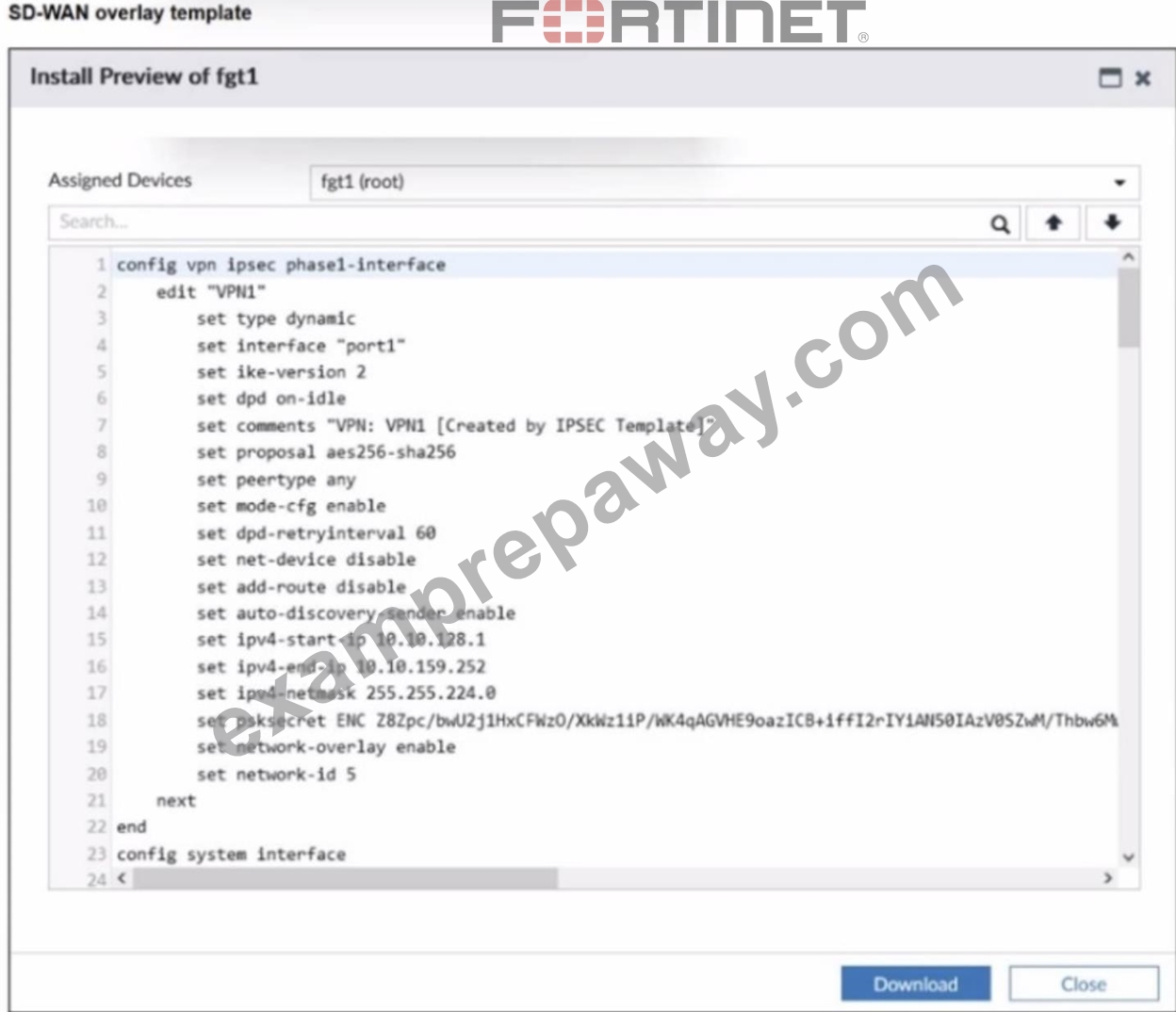
- A. It is a spoke device that establishes dynamic IPsec tunnels to the hub. The local subnet range is
10.10.128.0/23. - B. It is a hub device. It will automatically discover the spoke devices and add them to the SD-WAN topology.
- C. It is a spoke device that establishes dynamic IPsec tunnels to the hub It can send ADVPN shortcut requests.
- D. It is a hub device. It can send ADVPN shortcut offers.
Answer: D
NEW QUESTION # 43
Exhibit.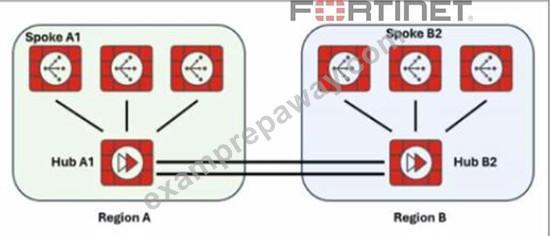
Two hub-and-spoke groups are connected through redundant site-to-site IPsec VPNs between Hub 1 and Hub 2 Which two configuration settings are required for the spoke A1 to establish an ADVPN shortcut with the spoke B2? (Choose two.)
- A. On hubs, auto-discovery-receiver must be enabled on the IPsec VPNs to spokes.
- B. On hubs, auto-diacovery-sender must be enabled on the IPsec VPNs to spokes
- C. On hubs, auto-discovery-forwarder must be enabled on the IPsec VPNs to hubs.
- D. On hubs, auto-discovery-forwarder must be enabled on the IPsec VPNs to spokes.
Answer: B,C
NEW QUESTION # 44
......
Get Prepared for Your FCSS_SDW_AR-7.4 Exam With Actual 51 Questions: https://www.examprepaway.com/Fortinet/braindumps.FCSS_SDW_AR-7.4.ete.file.html
Authentic FCSS_SDW_AR-7.4 Exam Dumps PDF - 2025 Updated: https://drive.google.com/open?id=1tuP-u2L-HRRiSKsuR0weGCGHonke79hT