

Obtain the WRT PDF Dumps Get 100% Outcomes Exam Questions For You To Pass
WRT Exam Dumps Contains FREE Real Quesions from the Actual Exam
NEW QUESTION # 24
In order to maximize electrical safety, what shall mitigation equipment include?
- A. Water-resistant motor windings
- B. A grounded electrical plug
- C. HEPA filters to trap contaminants
- D. Rubber feet to insulate mechanical components
Answer: B
Explanation:
The IICRC WRT body of knowledge emphasizes that electrical safety is a critical concern during water damage restoration due to the presence of moisture, conductive surfaces, and temporary power distribution systems. To minimize the risk of electrical shock, fire, or equipment failure, mitigation equipment must include agrounded electrical plug.
Grounding provides a controlled path for electrical current in the event of a fault, preventing the buildup of dangerous voltage on equipment housings. The WRT curriculum aligns with OSHA electrical safety principles, which require grounding for portable electrical equipment used in wet or damp locations. This requirement is particularly relevant for air movers, dehumidifiers, and other powered drying equipment routinely deployed during mitigation.
While rubber feet and water-resistant motor windings may improve durability or reduce incidental exposure, they do not replace the fundamental safety function of grounding. HEPA filters address airborne particulate control and are unrelated to electrical safety.
The WRT manual reinforces that restorers must inspect electrical equipment prior to use, ensure proper grounding, and use GFCI-protected circuits where required. These measures collectively reduce the likelihood of electrical incidents and demonstrate compliance with accepted safety standards.
NEW QUESTION # 25
What should a restorer do when a carpet is affected by Category 3 water and a materially interested party disagrees with removal?
- A. Stop work until the conflict has been resolved
- B. Clean and save the carpet if possible
- C. Double the number of antimicrobials applied
- D. Call the health department for approval to proceed
Answer: A
Explanation:
The IICRC WRT body of knowledge states thatcarpet affected by Category 3 water is not restorableand must be removed and discarded due to gross contamination. However, when a materially interested party disputes this requirement, the restorer muststop work until the conflict is resolved.
Proceeding against the expressed objection of an owner, occupant, or insurer exposes the restorer to legal and financial liability. The WRT manual emphasizes that restorers must not perform disputed work without proper authorization, even when technical standards clearly indicate removal is required.
Cleaning, saving, or applying additional antimicrobials does not make Category 3-affected carpet safe or compliant with IICRC standards. Antimicrobials cannot neutralize sewage-level contamination embedded within porous materials.
Stopping work allows time for consultation, documentation, expert input, or formal dispute resolution. This approach protects all parties and maintains professional integrity while adhering to health and safety principles.
NEW QUESTION # 26
Which is typically a result of introducing warm, dry air movement into wall cavities?
- A. Increased rate of evaporation
- B. Decreased rate of evaporation
- C. Decreased temperature within the chamber
- D. Negative pressure within the chamber wall
Answer: A
Explanation:
The IICRC WRT body of knowledge explains that introducingwarm, dry air movement into wall cavities typically results in anincreased rate of evaporation. Warm air raises the temperature of wet materials, increasing vapor pressure within those materials, while dry air lowers ambient vapor pressure-together creating a strong vapor pressure differential.
This differential accelerates moisture movement from materials into the air. The WRT manual notes that cavity drying systems, including inter-air drying, are designed to deliver controlled airflow and low-humidity air directly to concealed wet surfaces, where natural evaporation would otherwise be limited.
Negative pressure may occur in certain containment setups, but it is not the primary outcome of warm, dry airflow into cavities. Temperature reduction contradicts the drying mechanism, and decreased evaporation would indicate system failure rather than expected performance.
The WRT curriculum emphasizes that controlled cavity airflow is an effective technique when materials are restorable and contamination conditions allow, reinforcing evaporation as the intended result.
NEW QUESTION # 27
As the humidity ratio and dew point increase or decrease, what other psychrometric measurement also increases or decreases proportionally?
- A. Temperature
- B. Vapor pressure
- C. Dehumidification rate
- D. Permeability
Answer: B
Explanation:
The IICRC WRT body of knowledge explains thathumidity ratio, dew point, and vapor pressure are directly related psychrometric measurements. When humidity ratio increases or decreases, both dew point and vapor pressure change proportionally.
Vapor pressure represents the energy exerted by water vapor molecules in the air. As more moisture is added to the air (higher humidity ratio), vapor pressure increases; when moisture is removed, vapor pressure decreases. Dew point follows the same pattern because it reflects the temperature at which that vapor pressure results in saturation.
Temperature and permeability are not directly proportional to humidity ratio, and dehumidification rate is a performance outcome rather than a psychrometric property.
Because vapor pressure governs moisture movement between materials and air, its proportional relationship to humidity ratio and dew point makes it one of the most important measurements in WRT drying science.
NEW QUESTION # 28
How shall a restorer dispose of wastewater?
- A. As required by AHAM
- B. In accordance with OSHA 29 CFR
- C. Per applicable laws and regulations
- D. As defined in the ANSI/IICRC S520
Answer: C
Explanation:
The IICRC WRT body of knowledge states that wastewater generated during water damage restoration must be disposed ofin accordance with applicable local, state, and federal laws and regulations. Wastewater may contain contaminants, sediments, microorganisms, or chemical residues, and improper disposal can create environmental and public health risks.
The WRT manual emphasizes that restorers are responsible for understanding disposal requirements within the jurisdiction where work is performed. These requirements may regulate where wastewater can be discharged (e.g., sanitary sewer systems) and prohibit disposal into storm drains, onto soil, or into surface waters. Disposal practices may also vary depending on contamination category, such as sewage or chemically contaminated water.
OSHA regulations focus on worker safety, not wastewater disposal. AHAM standards apply to appliance performance testing, not environmental disposal. ANSI/IICRC S520 addresses mold remediation, not wastewater handling. Therefore, none of those documents define wastewater disposal requirements.
By following applicable laws and regulations, restorers ensure environmental compliance, protect public infrastructure, and reduce legal liability. This requirement reflects the WRT emphasis on regulatory awareness and responsible professional conduct.
NEW QUESTION # 29
What term best describes the amount or weight of water vapor within a given weight of dry air?
- A. Humidity ratio
- B. Saturation factor
- C. Moisture content
- D. Relative humidity
Answer: A
Explanation:
The IICRC WRT body of knowledge defineshumidity ratioas theamount (or weight) of water vapor contained in a given weight of dry air. It is typically expressed as grains per pound (GPP) or grams per kilogram and represents an absolute measurement of moisture in the air.
Unlike relative humidity, humidity ratio does not change with temperature unless moisture is added or removed. This makes it one of the most reliable psychrometric measurements for evaluating drying potential and comparing indoor and outdoor air conditions.
The WRT manual emphasizes that humidity ratio is critical for determining vapor pressure, dew point, and the suitability of ventilation drying. Restorers frequently rely on humidity ratio to decide whether introducing outdoor air will improve or hinder drying.
Moisture content applies to materials, not air, and relative humidity is a percentage comparison rather than a mass measurement. Therefore, humidity ratio is the correct and precise term under WRT psychrometric science.
NEW QUESTION # 30
What is the most likely result when the rate of evaporation is greater than the rate of dehumidification?
- A. An increased potential for secondary damage
- B. An increased rate of drying hygroscopic materials
- C. A reduction of the vapor pressure in the air
- D. A reduction of the ambient humidity ratio
Answer: A
Explanation:
When evaporation outpaces dehumidification, the IICRC WRT body of knowledge explains that moisture accumulates in the air, increasing humidity ratio, vapor pressure, and relative humidity. This condition can stall drying and significantly increase the risk ofsecondary damage.
Excess moisture in the air can migrate into unaffected hygroscopic materials, cause condensation on cooler surfaces, and promote microbial growth. The WRT manual stresses that evaporation and dehumidification must be balanced so that moisture removed from materials is promptly removed from the air.
Rather than reducing humidity or vapor pressure, insufficient dehumidification leads to moisture saturation of the air, undermining the drying process. Monitoring psychrometric conditions allows restorers to correct imbalances before secondary damage occurs.
NEW QUESTION # 31
What is a likely outcome when the vapor pressure in a drying chamber is lower than the vapor pressure of the wet materials?
- A. Moisture can move from the air into the materials
- B. Moisture can move from the materials into the air
- C. The category of water may degrade
- D. The class of intrusion will increase
Answer: B
Explanation:
The IICRC WRT body of knowledge explains that moisture movement is governed byvapor pressure differentials. When the vapor pressure within wet materials is higher than the vapor pressure of the surrounding air, moisture naturally migrates from the materials into the air. This condition is essential for effective drying.
A drying chamber with lower vapor pressure than the wet materials creates the necessary driving force for evaporation. The WRT manual emphasizes that this differential is achieved by reducing humidity ratio through dehumidification and increasing temperature and airflow at the material surface.
If the opposite condition exists-where air vapor pressure is higher than material vapor pressure-moisture can migrate into materials, causing secondary wetting. Therefore, maintaining lower vapor pressure in the air than in the materials is a core objective of restoration drying systems.
The class or category of water does not change due to vapor pressure alone; those are classification concepts based on absorption and contamination. The correct outcome under WRT science is moisture migration from materials into the air.
NEW QUESTION # 32
SCENARIO: Use the diagram and information below to answer this question.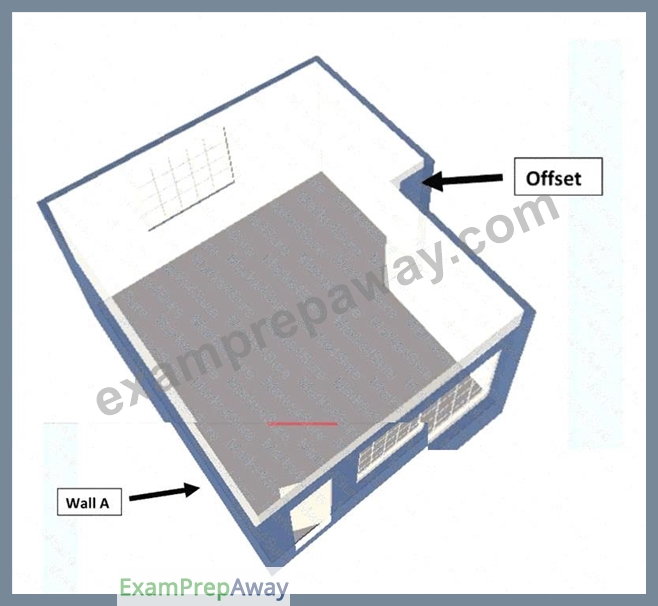
. The living room measures 20 feet x 16 feet, with an offset measuring 10 feet x 2 feet.
. The ceiling height is 8 feet.
. The entire floor area is wet, and moisture has been detected as high as 21 inches on all walls except Wall A.
. Water escaped from a broken pipe located behind Wall A. The entire area of wall A is wet.
. The ceiling is not affected.
Important information:
. The total square footage of the floor, including the offset, is 340 square feet
. The total square footage of Wall A after deducting the bottom 2 feet is 120 square feet (USE THE SCENARIO) What is the total number of airmovers a restorer should install?
- A. Low Range 8, High Range 11
- B. Total of 12
- C. Low Range 5, High Range 8
- D. Low Range 7, High Range 10
Answer: D
Explanation:
Based on IICRC WRT initial air mover placement guidelines:
* Floor area:340 sq ft # typically1 air mover per 50-70 sq ft
* Low range # 5-7
* High range # 7-9
* Wall drying required:
* All walls affected up to 21 inchesexcept Wall A
* Wall A fully wet(above 2 ft deduction = 120 sq ft requiring full wall drying)
* Offsets and irregular geometryincrease airflow demand.
When combining:
* Floor drying requirement
* Additional air movers forsignificantly wet walls
* One fully saturated wall (Wall A)
* One offset area
NEW QUESTION # 33
Before a technician wears a respirator, what is an employer required to provide?
- A. Have the owner check out available masks to the employees
- B. Nothing else is needed if the employee has no medical restrictions
- C. Select the proper color based on relative humidity levels
- D. Medical evaluation, fit-testing, and proper training
Answer: D
Explanation:
The IICRC WRT body of knowledge aligns with OSHA respiratory protection standards, which require that employers provide a medical evaluation, fit-testing, and proper training before an employee wears a respirator. These requirements ensure that respirator use does not endanger the worker and that the equipment provides effective protection.
A medical evaluation determines whether the employee can safely wear a respirator without compromising health. Fit-testing ensures the respirator forms an effective seal to the user's face, which is essential for respiratory protection. Training educates workers on proper use, limitations, maintenance, and storage of respiratory equipment.
The WRT manual emphasizes that respirators are ineffective without proper fit and training, and improper use can create a false sense of security. Color selection or informal distribution of masks does not meet regulatory or professional standards.
Compliance with these requirements is mandatory when respirators are required due to airborne contaminants, sewage exposure, or mold conditions. This reinforces the WRT priority of worker safety and regulatory compliance.
NEW QUESTION # 34
What documentation should the restorer use to support that drying goals were met upon completion of the job?
- A. A signed work authorization contract and customer satisfaction document
- B. Electrical usage of the equipment records for the customer
- C. Moisture content or level records, a moisture map, and drying conditions
- D. An IEP remediation protocol and post-remediation testing results
Answer: C
Explanation:
The IICRC WRT body of knowledge states that verification of drying completion must be supported by objective, measurable documentation. This includesmoisture content or moisture level records,moisture maps, anddocumented drying conditionssuch as temperature, relative humidity, humidity ratio, and dew point.
These records demonstrate that affected materials were dried to established drying goals, typically based on comparison with unaffected reference materials. The WRT manual emphasizes that documentation must show trends over time, not just final readings, to confirm effective drying.
Electrical usage records, contracts, or remediation protocols alone do not verify drying success. While they may be relevant administratively, they do not demonstrate moisture removal.
Comprehensive drying documentation is essential for transparency, defensibility, and compliance with the ANSI/IICRC S500 Standard and is a cornerstone of professional restoration practice.
NEW QUESTION # 35
Which of the following describes water originating from a sanitary water source and does not pose a substantial risk from exposure?
- A. Category 2
- B. Category 1
- C. Class 2
- D. Class 1
Answer: B
Explanation:
The IICRC WRT body of knowledge definesCategory 1 wateras water originating from a sanitary source that doesnot pose a substantial risk from dermal, ingestion, or inhalation exposure. Examples include broken water supply lines, tub or sink overflows without contaminants, and appliance malfunctions involving clean water.
The WRT manual distinguishescategory(contamination level) fromclass(degree of absorption). Category 1 describes water quality, not the extent of wetting.
Category 2 and 3 water involve increasing contamination risk, while Class 1 and Class 2 describe absorption characteristics rather than water cleanliness.
Correct classification during initial inspection is essential for determining appropriate safety controls, material restorability, and drying strategy under the IICRC standard of care.
NEW QUESTION # 36
If indoor conditions are 90°F (32°C) and 60% relative humidity, at what surface temperature does condensation begin to occur?
- A. 58°F (14°C)
- B. 88°F (31°C)
- C. 52°F (11°C)
- D. 74°F (23°C)
Answer: D
Explanation:
Condensation occurs when a surface temperature reaches or drops below thedew point temperatureof the surrounding air. The IICRC WRT body of knowledge emphasizes that dew point-not relative humidity alone-determines when condensation will form.
At90°F and 60% RH, the corresponding dew point is approximately74°F. Any surface at or below this temperature will experience condensation as water vapor changes phase from gas to liquid.
This principle is critical in restoration drying because unintended condensation can re-wet materials and cause secondary damage. The WRT curriculum trains restorers to monitor both air dew point and material surface temperatures to prevent this condition.
Lower temperature options listed would represent colder surfaces but condensation would already occur once the surface reaches the dew point. Therefore, 74°F is the correct threshold.
NEW QUESTION # 37
When performing the initial inspection, which of the following could help determine the perimeter of wet carpet and cushion (pad, underlay)?
- A. Disengage the installation
- B. Feel the area for moisture
- C. Use an IR camera or moisture sensor
- D. Use a borescope or anemometer
Answer: C
Explanation:
The IICRC WRT body of knowledge recommends usinginfrared (IR) cameras and moisture sensorsto help determine the perimeter of wet carpet and cushion during the initial inspection. These tools allow restorers to quickly and non-destructively identify moisture patterns across large areas.
IR cameras can highlight temperature anomalies caused by evaporative cooling, while moisture sensors provide confirmation of moisture presence beneath carpet surfaces. The WRT manual stresses that IR imaging must always be verified with moisture detection instruments to avoid false positives.
Disengaging carpet or relying on touch is invasive, time-consuming, and unreliable. Borescopes and anemometers are not designed for carpet moisture detection.
Using appropriate detection tools supports accurate scoping, efficient drying design, and defensible documentation-core principles of professional restoration practice under the IICRC WRT standard.
NEW QUESTION # 38
Why are multiple extractions of carpet and cushion (pad, underlay) performed?
- A. To eliminate microbial growth
- B. To increase the need for dehumidification
- C. To eliminate antimicrobial application
- D. To decrease drying time
Answer: D
Explanation:
The IICRC WRT body of knowledge explains thatmultiple extractionsof carpet and cushion are performed to reduce moisture content and decrease drying time. Initial extraction removes bulk water, but additional extractions-particularly after capillary movement redistributes moisture-can significantly reduce the remaining moisture load.
Repeated extraction lowers the amount of water that must be removed through evaporation, allowing dehumidification and airflow to work more efficiently. The WRT manual emphasizes that effective extraction is one of the most cost-effective and impactful steps in minimizing overall drying duration.
Multiple extractions do not eliminate microbial growth directly and do not replace proper drying or antimicrobial use when appropriate. Instead, they reduce moisture availability, which indirectly limits microbial amplification.
The WRT curriculum reinforces extraction as a critical early-stage drying strategy that supports faster, more controlled restoration.
NEW QUESTION # 39
A home has a drying chamber that is 7,500 cubic feet, the loss is a Class 3, and LGR dehumidifiers are used.
How many should be installed initially if the AHAM rating of each dehumidifier is 100 pints per day?
- A. 0
- B. 1
- C. 2
- D. 3
Answer: B
Explanation:
The IICRC WRT body of knowledge provides initial LGR dehumidification recommendations based oncubic footage and class of water. ForClass 3 water intrusions, a commonly taught starting guideline is approximatelyone LGR dehumidifier (#100-150 PPD) per 3,000 cubic feetof affected space.
In this scenario, the drying chamber volume is 7,500 cubic feet. Dividing 7,500 by 3,000 yields 2.5 units.
Because dehumidifiers cannot be fractionally deployed and WRT guidance supports roundingupto ensure adequate moisture removal, the initial recommendation isthree LGR dehumidifiers.
The WRT manual emphasizes that this is an initial placement subject to adjustment after monitoring confirms drying progress. Insufficient dehumidification can increase ambient humidity, slow drying, and elevate secondary damage risk-particularly in Class 3 losses where evaporation rates are high.
Placing three units provides adequate capacity to manage evaporated moisture while allowing later downsizing as drying goals are achieved.
NEW QUESTION # 40
Which of the following documents should be obtained for a water mitigation project?
- A. Detailed history of previous restoration projects
- B. Documents to validate the drying and completion
- C. Permission from local and state law enforcement
- D. Dehumidifier manufacturer's AHAM certificate
Answer: B
Explanation:
The IICRC WRT body of knowledge stresses thatdocumentation is a critical component of professional water damage restoration, and restorers are expected to obtain and maintain documents that validate drying progress and project completion. These records demonstrate that drying goals were properly established, monitored, and achieved in accordance with the ANSI/IICRC S500 Standard.
Drying documentation typically includes moisture content or moisture level readings, moisture maps, psychrometric data (temperature, relative humidity, humidity ratio, and dew point), equipment placement records, and daily monitoring logs. Together, these documents form a defensible record that shows the restorer followed an appropriate standard of care.
The WRT manual explains that such documentation is necessary not only for communication with materially interested parties (owners, occupants, insurers) but also for dispute resolution, quality assurance, and potential legal proceedings. Without validated drying documentation, it is difficult to prove that materials were returned to a dry standard or that secondary damage was prevented.
AHAM certificates may be useful for understanding equipment performance, but they are not required project documents. Law enforcement permission and historical restoration records are unrelated to the drying verification process. Therefore, obtaining documents that validate drying and completion is the correct and required practice under WRT guidance.
NEW QUESTION # 41
Who should a technician get documented authorization from before applying an antimicrobial (biocide)?
- A. The primary physician
- B. The reconstruction contractor
- C. The primary adjuster
- D. The owner or occupant
Answer: D
Explanation:
The IICRC WRT body of knowledge clearly states that before applying an antimicrobial (biocide), a technician must obtaindocumented authorization from the owner or occupant, or another legally authorized representative of the property. This requirement exists because antimicrobial application involves introducing regulated chemical agents into an occupied environment, which carries potential health, legal, and liability implications.
The WRT manual emphasizes informed consent as a professional and ethical obligation. Owners or occupants must be made aware of the purpose, limitations, and potential risks associated with antimicrobial use.
Documented authorization protects all materially interested parties by confirming that the decision to apply a biocide was disclosed, understood, and approved.
Insurance adjusters do not have authority over health decisions within a structure, reconstruction contractors do not represent occupancy interests, and physicians are not responsible for property treatment approvals. The responsibility lies with the property owner or occupant.
This requirement aligns with EPA pesticide regulations and the ANSI/IICRC S500 Standard, reinforcing transparency, safety, and defensibility in restoration practices.
NEW QUESTION # 42
Which product provides the least amount of reduction in microorganisms?
- A. A disinfectant
- B. A fungicide
- C. A sanitizer
- D. A sterilizer
Answer: C
Explanation:
The IICRC WRT body of knowledge distinguishes antimicrobial products based on their intended level of microbial reduction. Asanitizerprovides theleast reduction in microorganisms, lowering microbial populations to levels considered acceptable by public health standards but not eliminating most organisms.
Disinfectants provide a higher level of reduction by killing or inactivating many microorganisms, fungicides specifically target fungi, and sterilizers destroy all forms of microbial life, including spores. Sanitizers are therefore the lowest tier in terms of antimicrobial effectiveness.
The WRT manual emphasizes that sanitizers are not appropriate for significant contamination scenarios such as Category 2 or Category 3 water losses. Using insufficient antimicrobial controls can result in persistent contamination and liability exposure.
Understanding these distinctions ensures restorers select appropriate products based on contamination level and regulatory guidance, reinforcing professional and compliant practice.
NEW QUESTION # 43
How many gallons (liters) are present in a 20-foot by 25-foot basement with standing water at a depth of 4 feet 6 inches (1.37 meters)?
- A. 18,765 gallons (71,033 liters)
- B. 15,750 gallons (59,620 liters)
- C. 16,830 gallons (63,713 liters)
- D. 2,250 gallons (8,517 liters)
Answer: A
Explanation:
The IICRC WRT body of knowledge stresses the importance of accurately estimating the volume of standing water to support proper extraction planning, equipment selection, and safety evaluation. This question requires a volumetric calculation using length, width, depth, and standard water conversion factors.
First, calculate the cubic volume of water:
20 ft × 25 ft × 4.5 ft =2,250 cubic feetof water.
According to WRT reference tables,1 cubic foot of water equals approximately 8.34 gallons. Multiplying:
2,250 cubic feet × 8.34 gallons/cu ft =18,765 gallons(rounded).
This calculation confirms option D as correct. The WRT curriculum includes these conversions to help restorers assess extraction time, pump capacity, disposal logistics, and safety hazards such as hydrostatic pressure or structural loading.
Understanding water volume is not merely academic. Large volumes of standing water significantly affect drying timelines, contamination potential, and classification decisions. The ANSI/IICRC S500 Standard emphasizes prompt and adequate bulk water removal as a critical first step in mitigation.
Accurate water-volume estimation also supports documentation and communication with materially interested parties, ensuring that restoration actions are technically justified and defensible.
NEW QUESTION # 44
Which material loses most of its structural integrity when wet but regains its strength when dry?
- A. Hardwood flooring
- B. Plywood
- C. Concrete
- D. Gypsum board (drywall)
Answer: D
Explanation:
Gypsum board (drywall) is identified in the WRT body of knowledge as highly vulnerable to moisture exposure, yet capable of recovering strength when dried-provided it has not sustained irreversible primary damage. The WRT manual explains that gypsum wallboard is among the most moisture-sensitive common building materials, showing rapid and dramatic change with elevated moisture levels. However, it also states that gypsum has a greater ability to recover than many other engineered products.
Critically, the WRT guidance distinguishes between primary damage (immediate structural failure) and recoverable wetting. For example, overhead or horizontally installed gypsum that becomes wet can lose structural integrity, sag, and create a significant safety concern; this sagging is considered permanent damage and requires removal.
In contrast, when gypsum board installed vertically on walls is wet but has not experienced primary damage (e.g., not structurally compromised, not severely deteriorated, and appropriate contamination considerations are addressed), the WRT manual notes that it can restore: during the drying process, gypsum's original strength is restored, and after drying it may even be slightly stronger (though sometimes more brittle). This recovery characteristic is what makes gypsum board the best match to the question's description-losing structural integrity when wet yet regaining strength when properly dried.
This material behavior is central to WRT decision-making: whether to dry in place, perform limited disruption (e.g., baseboard removal and cavity airflow), or remove materials for safety/health reasons. The WRT body of knowledge treats gypsum as potentially restorable depending on installation orientation, degree of damage, and contamination risk, which is why it is specifically described as losing integrity when wet and regaining strength when dry.
NEW QUESTION # 45
......
Use Real IICRC Achieve the WRT Dumps - 100% Exam Passing Guarantee: https://www.examprepaway.com/IICRC/braindumps.WRT.ete.file.html
Free Test Engine Verified By IICRC Restoration Certified Experts: https://drive.google.com/open?id=1wfzwLKipFRLllJcj5pUsEU29kBEZ8kO8