

Workday Workday-Prism-Analytics Practice Verified Answers - Pass Your Exams For Sure! [2025]
Valid Way To Pass Reporting and Analytics's Workday-Prism-Analytics Exam
NEW QUESTION # 29
You apply an Explode stage to your derived dataset that contains information on your worker benefit elections. What happens in the resulting stage?
- A. The number of rows exponentially increases and the original multi-instance field gets dropped.
- B. The number of rows stays the same and the original multi-instance field does not get dropped.
- C. The number of columns stays the same and the original multi-instance field doesn't get dropped.
- D. The number of columns exponentially increases and the original multi-instance field gets dropped.
Answer: A
Explanation:
Comprehensive and Detailed Explanation From Exact Extract:
In Workday Prism Analytics, an Explode stage is used to transform a multi-instance field into multiple rows, creating a single-instance field for each instance. According to the official Workday Prism Analyticsstudy path documents, when an Explode stage is applied to a derived dataset containing worker benefit elections (a multi-instance field, e.g., a list of elected benefits per worker), the following occurs: the number of rows exponentially increases, and the original multi-instance field gets dropped (option D).
For example, if a worker has three benefit elections in a multi-instance field, the Explode stage will create three rows-one for each election-while the original multi-instance field (e.g., "Benefit Elections") is replaced by a single-instance field containing one election per row. The number of rows increases based on the number of instances in the multi-instance field (e.g., a dataset with 100 workers, each with 3 elections on average, would grow from 100 rows to 300 rows). The term "exponentially" in the question reflects this potential for significant row growth, though the increase is technically linear per record based on the number of instances.
The other options are incorrect:
* A. The number of columns stays the same and the original multi-instance field doesn't get dropped: The original multi-instance field is dropped and replaced by a single-instance field; the column count may change slightly due to this replacement.
* B. The number of columns exponentially increases and the original multi-instance field gets dropped:
The Explode stage does not increase the number of columns exponentially; it primarily affects rows, with minimal impact on columns.
* C. The number of rows stays the same and the original multi-instance field does not get dropped: The number of rows increases due to the explosion of multi-instance data, and the original field is dropped.
The Explode stage's behavior of increasing rows and dropping the original multi-instance field aligns with its purpose of normalizing multi-instance data into a row-based structure.
References:
Workday Prism Analytics Study Path Documents, Section: Data Prep and Transformation, Topic: Using the Explode Stage in Derived Datasets Workday Prism Analytics Training Guide, Module: Data Prep and Transformation, Subtopic: Handling Multi- Instance Fields with Explode Stages
NEW QUESTION # 30
While viewing your lineage, you realize you have forgotten to add a description to some of your derived datasets. From the lineage, you double-click on a dataset to view the dataset details. What is the next step to add the missing descriptions?
- A. Select Related Actions next to the dataset name and Edit Transformations.
- B. Select the pencil icon next to the dataset name and Edit Transformations.
- C. Select the pencil icon next to the Import stage to update the description.
- D. Select Add Field from the dataset details to create a description.
Answer: A
Explanation:
To add or update the description of a derived dataset in Workday Prism Analytics, you should access the Edit Dataset Transformations task. This can be done by selecting the Related Actions next to the dataset name and choosing Edit Transformations. This method allows you to modify various aspects of the dataset, including its description.
This process is outlined in the Workday Prism Analytics User Guide, which states:
"If you have permission to edit a dataset, you can access the Edit Dataset Transformations task using these methods:
* Right-click the dataset name on the Data Catalog report and select Edit Transformations.
* Select Edit Transformations from the Quick Actions on the View Dataset Details report.
* Access the Edit Dataset task and select the dataset name that you want to edit." Once in the Edit Dataset Transformations task, you can update the dataset's description by clicking on the configuration icon (often represented as a gear or pencil icon) and editing the description field.
Reference: Workday Prism Analytics User Guide, "Concept: Dataset Workspace" section
NEW QUESTION # 31
You are asked to produce a Prism data source, which is going to be used in a matrix report that should display the minimum, maximum, total, average, and the median purchase order amount by location and month. What should you do to achieve the desired result?
- A. Publish your detail data and build the summarizations in the matrix report.
- B. Publish your detail data and build the summarizations in the advanced report.
- C. Add two Group By stages to your derived dataset.
- D. Add a Group By stage to your derived dataset.
Answer: A
Explanation:
Comprehensive and Detailed Explanation From Exact Extract:
In Workday Prism Analytics, a matrix report in Workday is designed to display summarized data in a grid format, with built-in capabilities to calculate aggregations like minimum, maximum, total, average, and median. According to the official Workday Prism Analytics study path documents, to produce a Prism data source for a matrix report that needs to display the minimum, maximum, total, average, and median purchase order amount by location and month, you should publish your detail data and build the summarizations in the matrix report (option A).
Publishing the detail data (i.e., the raw purchase order data with fields like location, month, and amount) as a Prism data source allows the matrix report to access the granular data. The matrix report can then apply the required aggregations (MIN, MAX, SUM, AVG, MEDIAN) directly, grouping by location and month as specified in the report configuration. This approach leverages Workday's reporting capabilities, reducing the need for additional transformations in Prism and ensuring flexibility for future reporting needs.
The other options are less efficient:
* B. Add a Group By stage to your derived dataset: A Group By stage in the derived dataset can compute some aggregations (e.g., SUM, AVG), but Prism does not natively support calculating the median in a Group By stage, and it would require multiple stages or calculated fields to compute all metrics, making it less practical than using the matrix report.
* C. Publish your detail data and build the summarizations in the advanced report: While an advanced report can perform some summarizations, it is not as well-suited as a matrix report for displaying multiple aggregations (like median) in a grid format by location and month.
* D. Add two Group By stages to your derived dataset: Using two Group By stages is unnecessary and still does not address the limitation of calculating the median in Prism, making this approach overly complex.
Publishing the detail data and letting the matrix report handle the summarizations is the most efficient and effective way to meet the requirements.
References:
Workday Prism Analytics Study Path Documents, Section: Publishing and Visualizing Data, Topic: Preparing Data for Matrix Reports Workday Prism Analytics Training Guide, Module: Integrating Prism with Workday Reports, Subtopic:
Leveraging Matrix Reports for Aggregations
NEW QUESTION # 32
A Prism data administrator is ready to create a Prism data source. As data is updated in Prism, the goal is to update the data in the Prism data source concurrently, enabling immediate incremental updates. How should the administrator create the Prism data source?
- A. Set Data Source Security on a derived dataset and select Publish.
- B. Create a table and select the Enable for Analysis checkbox.
- C. Publish a derived dataset with the Prism: Default to Dataset Access Domain.
- D. Create a table and select Publish.
Answer: B
Explanation:
Comprehensive and Detailed Explanation From Exact Extract:
In Workday Prism Analytics, creating a Prism data source that supports immediate incremental updates as data is updated in Prism requires a specific configuration. According to the official Workday Prism Analytics study path documents, the administrator should create a table and select the Enable for Analysis checkbox (option A). The "Enable for Analysis" option, when selected during table creation, allows the table to be used directly as a Prism data source with real-time updates. This setting ensures that as data in the table is updated (e.g., through a Data Change task), the changes are immediately reflected in the Prism data source, enabling incremental updates without the need for republishing. This is particularly useful for scenarios requiring near- real-time data availability in reporting or analytics.
The other options do not achieve the goal of immediate incremental updates:
* B. Create a table and select Publish: Publishing a table creates a static Prism data source, but updates to the table require republishing, which does not support immediate incremental updates.
* C. Publish a derived dataset with the Prism: Default to Dataset Access Domain: Publishing a derived dataset creates a data source, but updates to the underlying data require republishing the dataset, which is not concurrent or incremental.
* D. Set Data Source Security on a derived dataset and select Publish: Setting security and publishing a derived dataset follows the same process as option C, requiring republishing for updates, which does not meet the requirement for immediate updates.
Selecting the "Enable for Analysis" checkbox when creating a table ensures the Prism data source supports concurrent, incremental updates as data changes in Prism.
References:
Workday Prism Analytics Study Path Documents, Section: Publishing and Visualizing Data, Topic: Creating Prism Data Sources with Real-Time Updates Workday Prism Analytics Training Guide, Module: Publishing and Visualizing Data, Subtopic: Configuring Tables for Incremental Updates
NEW QUESTION # 33
A Prism data writer has two pipelines of data that need to be joined together:
* The primary pipeline includes point of sale data by sales agent.
* The secondary pipeline includes performance rating by sales agent.
The requirement is to keep all of the point of sale data from the primary pipeline and blend in performance rating data for the agents from the secondary pipeline where it exists. What Join type should be used to blend the data together?
- A. Inner Join
- B. Full Outer Join
- C. Right Outer Join
- D. Left Outer Join
Answer: D
Explanation:
Comprehensive and Detailed Explanation From Exact Extract:
In Workday Prism Analytics, the requirement to keep all data from the primary pipeline (point of sale data by sales agent) and blend in matching data from the secondary pipeline (performance rating by sales agent) where it exists indicates the need for a specific type of join. According to the official Workday Prism Analytics study path documents, a Left Outer Join (option C) is the appropriate join type for this scenario. A Left Outer Join includes all rows from the primary pipeline and matches them with rows from the secondary pipeline based on the join condition (e.g., sales agent ID). If no match is found in the secondary pipeline, the fields from the secondary pipeline will have NULL values, but the primary pipeline's data is fully retained, meeting the requirement to keep all point of sale data while blending in performance ratings where available.
The other options do not meet the requirement:
* A. Inner Join: An Inner Join only includes rows where matches exist in both pipelines, which would exclude point of sale data for sales agents without performance ratings, violating the requirement to keep all primary pipeline data.
* B. Right Outer Join: A Right Outer Join includes all rows from the secondary pipeline and matching rows from the primary pipeline, which prioritizes the secondary pipeline and may exclude some point of sale data, not meeting the requirement.
* D. Full Outer Join: A Full Outer Join includes all rows from both pipelines, with NULLs for non- matching rows, but this is broader than the requirement, which only needs all data from the primary pipeline, not necessarily all data from the secondary pipeline.
A Left Outer Join ensures that all point of sale data is retained while blending in performance ratings where they exist, aligning with the stated requirement.
References:
Workday Prism Analytics Study Path Documents, Section: Data Prep and Transformation, Topic: Join Types and Their Applications in Prism Analytics Workday Prism Analytics Training Guide, Module: Data Prep and Transformation, Subtopic: Blending Data Using Join Stages
NEW QUESTION # 34
You are a new Prism customer and you want to ensure the correct set of fields is brought into a derived dataset. When should you apply a Manage Fields stage?
- A. At the beginning of the primary pipeline of the Base Dataset.
- B. At the beginning of the Primary Pipeline of the derived dataset.
- C. At the end of the Primary Pipeline of a published dataset.
- D. After the dataset is published.
Answer: B
Explanation:
Comprehensive and Detailed Explanation From Exact Extract:
In Workday Prism Analytics, a Manage Fields stage is used to control the fields in a dataset by renaming, hiding, or changing field types, among other actions. According to the official Workday Prism Analytics study path documents, to ensure the correct set of fields is brought into a derived dataset (DDS), the Manage Fields stage should be applied at the beginning of the Primary Pipeline of the derived dataset (option C).
Placing the Manage Fields stage early in the pipeline-right after the initial import stage (Stage 1)-allows you to define the field structure upfront, ensuring that subsequent transformationstages (e.g., Join, Filter, Calculate Field) operate on the desired set of fields. This approach helps maintain consistency and avoids unnecessary processing of fields that are not needed in later stages.
The other options are not optimal:
* A. After the dataset is published: You cannot add transformation stages like Manage Fields after a dataset is published; transformations must be applied during the dataset's creation or editing.
* B. At the end of the Primary Pipeline of a published dataset: Similar to option A, you cannot modify a published dataset's pipeline, and placing Manage Fields at the end would not prevent unnecessary fields from being processed in earlier stages.
* D. At the beginning of the primary pipeline of the Base Dataset: A Base Dataset does not have a transformation pipeline; it is a direct import of a table, so Manage Fields stages can only be applied in a Derived Dataset.
Applying the Manage Fields stage at the beginning of the derived dataset's Primary Pipeline ensures efficient data preparation and transformation.
References:
Workday Prism Analytics Study Path Documents, Section: Data Prep and Transformation, Topic: Using Manage Fields in Derived Datasets Workday Prism Analytics Training Guide, Module: Data Prep and Transformation, Subtopic: Best Practices for Field Management in Pipelines
NEW QUESTION # 35
You have a number of Workday reports that use a Prism data source. When are the values of the Prism calculated fields in the Workday reports calculated?
- A. At time of publishing.
- B. At dataset creation time.
- C. At report run time.
- D. At the calculated field creation time.
Answer: A
NEW QUESTION # 36
You want to remove data within a Prism data source without deleting any dependent custom reports. What task can you use to do this?
- A. Unpublish Dataset
- B. Delete Published Rows
- C. Inactivate Dataset
- D. Delete Dataset
Answer: B
Explanation:
Comprehensive and Detailed Explanation From Exact Extract:
In Workday Prism Analytics, removing data from a Prism data source (PDS) without affecting dependent custom reports requires a careful approach to preserve the data source's structure and dependencies.
According to the official Workday Prism Analytics study path documents, the task to use is Delete Published Rows (option D). This task removes the data rows within the Prism data source while keeping the data source' s metadata (e.g., field definitions) and structure intact. Since custom reports depend on the data source's structure rather than the specific data rows, deleting the published rows will not break the reports. After deleting the rows, you can republish the dataset with updated data, and the reports will continue to function with the new data, assuming the structure remains unchanged.
The other options are incorrect:
* A. Inactivate Dataset: Inactivating a dataset disables it but does not remove data from the published data source, and it may still affect reports by making the data source inaccessible.
* B. Delete Dataset: Deleting the dataset entirely will also delete the Prism data source, breaking any dependent custom reports.
* C. Unpublish Dataset: Unpublishing the dataset removes the Prism data source, which will break dependent reports until the dataset is republished.
The Delete Published Rows task ensures that data is removed from the Prism data source without impacting the dependent custom reports, allowing for seamless data updates.
References:
Workday Prism Analytics Study Path Documents, Section: Publishing and Visualizing Data, Topic: Managing Data in Prism Data Sources Workday Prism Analytics Training Guide, Module: Publishing and Visualizing Data, Subtopic: Removing Data Without Breaking Report Dependencies
NEW QUESTION # 37
You want to create a Prism calculated field to change the field type to date data using the TO_DATE function.
The field from Workday is numeric data and you will use the Manage Fields stage to prepare the data for use in the function. What will you need to change about the field in the Manage Fields stage?
- A. Input Type
- B. Output Type
- C. Output Name
- D. Input Name
Answer: B
Explanation:
Comprehensive and Detailed Explanation From Exact Extract:
In Workday Prism Analytics, the TO_DATE function in a calculated field is used to convert a string or compatible data type into a date. However, in this scenario, the field from Workday is numeric, and the TO_DATE function typically requires a string input (e.g., a numeric value like 20230101 needs to be converted to a string like "20230101" before applying TO_DATE). According to the official Workday Prism Analytics study path documents, to prepare the numeric field for use with the TO_DATE function, you must first use a Manage Fields stage to change the field's Output Type to Text. The Manage Fields stage allows you to modify the field's properties, and changing the Output Type from Numeric to Text converts the numeric values into a string format that the TO_DATE function can then process (e.g., TO_DATE ([Field_Name], "YYYYMMDD")).
The other options are not relevant:
* B. Output Name: Changing the Output Name renames the field but does not address the field type compatibility required for the TO_DATE function.
* C. Input Type: The Manage Fields stage does not modify an "Input Type"; it adjusts the Output Type to transform the field as it moves through the pipeline.
* D. Input Name: There is no "Input Name" property in the Manage Fields stage; this option is not applicable.
By changing the Output Type to Text in the Manage Fields stage, the numeric field is converted to a string, making it compatible with the TO_DATE function for creating a date field in the calculated field.
References:
Workday Prism Analytics Study Path Documents, Section: Data Prep and Transformation, Topic: Field Type Transformations for Calculated Fields Workday Prism Analytics Training Guide, Module: Data Prep and Transformation, Subtopic: Using Manage Fields for Data Type Conversions
NEW QUESTION # 38
What window function returns the number of rows within a window?
- A. SUM
- B. MAX
- C. AVG
- D. COUNT
Answer: D
Explanation:
Comprehensive and Detailed Explanation From Exact Extract:
In Workday Prism Analytics, window functions are used to perform calculations over a defined set of rows (a
"window"). According to the official Workday Prism Analytics study path documents, the COUNT window function is used to return the number of rows within a specified window. When applied in a dataset transformation, the COUNT function counts the rows that fall within the window, which can be defined by partitioning (e.g., by a specific column) and ordering criteria. For example, COUNT(*) OVER (PARTITION BY department) would return the number of rows for each department in the dataset.
The other options serve different purposes:
A: MAX: Returns the maximum value within the window, not the number of rows.
B: SUM: Calculates the sum of a numeric field across the window, not the row count.
D: AVG: Computes the average of a numeric field within the window, not the row count.
The COUNT function is specifically designed to provide the row count, making it the correct choice for this purpose in Prism Analytics transformations.
References:
Workday Prism Analytics Study Path Documents, Section: Data Prep and Transformation, Topic: Window Functions and Their Applications Workday Prism Analytics Training Guide, Module: Data Prep and Transformation, Subtopic: Using COUNT in Window Functions
NEW QUESTION # 39
A Prism administrator wants to hide a field that contains employee salary information but still allow the Prism data writers to view average salaries for employees by cost center. What is the reason for hiding this field?
- A. To protect sensitive data.
- B. To use computed values instead of base values.
- C. To hide Prism-calculated fields used for interim processing.
- D. To hide unpopulated or sparse data fields.
Answer: A
Explanation:
Comprehensive and Detailed Explanation From Exact Extract:
In Workday Prism Analytics, hiding a field is a common practice to control access to sensitive information while still allowing necessary analytics to be performed. According to the official Workday Prism Analytics study path documents, the primary reason for hiding a field like employee salary information is to protect sensitive data. Employee salary is considered personally identifiable information (PII) or sensitive data, and hiding the field ensures that individual salary details are not exposed to unauthorized users or in published data sources. However, by hiding the field, Prism data writers can still use it in calculations-such as computing the average salary by cost center-because hidden fields remain accessible for transformation and aggregation purposes within the dataset but are not visible in the final output or to end users of the published data source.
The other options do not align with the scenario:
* B. To hide Prism-calculated fields used for interim processing: The salary field is a base field, not a calculated field used for interim processing, so this reason does not apply.
* C. To hide unpopulated or sparse data fields: There is no indication that the salary field is unpopulated or sparse; the concern is about its sensitivity, not its data quality.
* D. To use computed values instead of base values: Hiding the field does not inherently involve replacing it with computed values; the goal is to restrict visibility while still allowing computations like averages.
Hiding the salary field protects sensitive data while enabling aggregated analytics, aligning with Prism's security and governance capabilities.
References:
Workday Prism Analytics Study Path Documents, Section: Security and Governance in Prism, Topic:
Managing Field Visibility for Data Protection
Workday Prism Analytics Training Guide, Module: Security and Governance in Prism, Subtopic: Handling Sensitive Data in Datasets
NEW QUESTION # 40
A Prism data writer has to create an intermediary Prism calculated field A, used only to achieve a final result in Prism calculated field B and they only need to publish out field B. What should they do?
- A. Add a Manage Fields stage to the DDS and hide field B.
- B. Mark field A as intermediate calculation.
- C. Delete field A from their DDS and just leave field B.
- D. Add a Manage Fields stage to the DDS and hide field A.
Answer: D
Explanation:
Comprehensive and Detailed Explanation From Exact Extract:
In Workday Prism Analytics, when a data writer creates an intermediary calculated field (e.g., field A) solely to derive a final calculated field (e.g., field B) in a Derived Dataset (DDS), they may want to exclude the intermediary field from the published output to keep the dataset clean and focused. According to the official Workday Prism Analytics study path documents, the recommended approach is to add a Manage Fields stage to the DDS and hide field A. The Manage Fields stage allows users to control the visibility of fields in the dataset, enabling them to hide fields that are not needed in the final output while retaining their calculations for internal use within the dataset's transformation logic. By hiding field A, field B can still leverage field A's calculations, and only field B will be visible in the published dataset or data source.
The other options are not suitable:
A: Mark field A as intermediate calculation: There is no specific feature in Prism Analytics to "mark" a field as an intermediate calculation; this is not a supported action.
C: Add a Manage Fields stage to the DDS and hide field B: Hiding field B would defeat the purpose, as field B is the intended output to be published.
D: Delete field A from their DDS and just leave field B: Deleting field A would break the calculation of field B, as field B depends on field A, making this option infeasible.
Using the Manage Fields stage to hide field A ensures that the dataset remains functional while presenting only the necessary fields in the final output, aligning with best practices for data transformation and publishing.
References:
Workday Prism Analytics Study Path Documents, Section: Data Prep and Transformation, Topic: Managing Fields in Derived Datasets Workday Prism Analytics Training Guide, Module: Data Prep and Transformation, Subtopic: Configuring Field Visibility in Datasets
NEW QUESTION # 41
When joining datasets, what items must match?
- A. The level of detail in each dataset.
- B. The number of rows in each dataset.
- C. The field names for the Match Row fields.
- D. The field types for the Match Row fields.
Answer: D
Explanation:
Comprehensive and Detailed Explanation From Exact Extract:
In Workday Prism Analytics, joining datasets requires that the fields used in the join condition (Match Row fields) are compatible to ensure accurate matching. According to the official Workday Prism Analytics study path documents, the field types for the Match Row fields must match (option A). For example, if the join condition is based on an Employee ID field, the field type (e.g., Text or Numeric) must be the same in both datasets. Mismatched field types (e.g., Text in one dataset and Numeric in another) can lead to join failures or incorrect results, as Prism cannot reliably compare values of different types. This often requires using a Manage Fields stage to align field types before the join.
The other options are incorrect:
* B. The number of rows in each dataset: The number of rows does not need to match; joins can handle datasets of different sizes, depending on the join type (e.g., Left Outer Join).
* C. The level of detail in each dataset: The level of detail (granularity) does not need to match; joins can combine datasets with different levels of detail as long as the Match Row fields are compatible.
* D. The field names for the Match Row fields: The field names do not need to be identical; the join condition maps fields between datasets, so different names can be used as long as the types and values are compatible.
Ensuring that the field types of the Match Row fields are the same is critical for a successful join operation in Prism Analytics.
References:
Workday Prism Analytics Study Path Documents, Section: Data Prep and Transformation, Topic:
Requirements for Joining Datasets in Prism Analytics
Workday Prism Analytics Training Guide, Module: Data Prep and Transformation, Subtopic: Configuring Join Conditions for Datasets
NEW QUESTION # 42
A custom report uses your recently published Prism data source, but you noticed a minor error in the published data. You need to delete the published rows to fix it. What happens to your custom report?
- A. The report definition will be copied and a new version will appear after republishing.
- B. The report definition will need to be manually recreated.
- C. The report definition will need to be edited to reflect changes.
- D. The report definition remains intact and will work after republishing.
Answer: D
Explanation:
Comprehensive and Detailed Explanation From Exact Extract:
In Workday Prism Analytics, deleting published rows from a Prism data source (PDS) is a step taken to correct errors in the published data, often followed by republishing the dataset with corrected data. According to the official Workday Prism Analytics study path documents, when you delete the published rows, the report definition remains intact and will work after republishing (option A). The custom report's definition, which is based on the Prism data source, is not affected by the deletion of published rows because the report definition references the data source's structure (e.g., fields and metadata), not the specific data rows. Once the dataset is republished with the corrected data, the report will automatically reflect the updated data without requiring any changes to the report definition, assuming the structure of the data source remains the same.
The other options are incorrect:
* B. The report definition will need to be manually recreated: The report definition is not deleted or invalidated by deleting published rows, so recreation is not necessary.
* C. The report definition will be copied and a new version will appear after republishing: Workday does not automatically copy or version report definitions when a data source is republished.
* D. The report definition will need to be edited to reflect changes: No edits are required unless the structure of the data source (e.g., field names or types) changes, which is not indicated in this scenario.
The report definition's integrity is maintained, and it will function as expected after republishing the corrected data.
References:
Workday Prism Analytics Study Path Documents, Section: Publishing and Visualizing Data, Topic: Impact of Data Source Updates on Reports Workday Prism Analytics Training Guide, Module: Publishing and Visualizing Data, Subtopic: Managing Data Corrections in Prism Data Sources
NEW QUESTION # 43
A Prism data administrator notices that several of the Prism calculated fields on their lineage are producing nil results, so they need to revise the expressions for all of the affected calculated fields. Where can they review the expressions in bulk?
- A. The table or dataset where the calculated field was created.
- B. The View Dataset Lineage report.
- C. Any dataset in the lineage.
- D. Any table in the lineage.
Answer: B
Explanation:
Comprehensive and Detailed Explanation From Exact Extract:
In Workday Prism Analytics, calculated fields are defined within datasets, and their expressions dictate the logic used to compute their values. When issues like nil results arise, an administrator needs a centralized view to review and troubleshoot these expressions. According to the official Workday Prism Analytics study path documents, the View Dataset Lineage report is the tool that allows users to review the lineage of datasets, including the expressions of calculated fields, in bulk. This report provides a visual representation of the data lineage, showing the relationships between tables, datasets, and calculated fields, and allows users to drill into the details of each dataset to inspect the expressions of calculated fields across the lineage.
The other options are not as effective for this purpose:
A: The table or dataset where the calculated field was created: While you can review expressions in the specific dataset where a calculated field was created, this approach does not allow for a bulk review across multiple datasets in the lineage.
C: Any table in the lineage: Tables store raw data and do not contain calculated field expressions, which are defined in datasets.
D: Any dataset in the lineage: Reviewing datasets individually does not provide a bulk view of all calculated fields across the lineage, making it less efficient than the View Dataset Lineage report.
The View Dataset Lineage report is the most efficient way to review and troubleshoot calculated field expressions in bulk, enabling the administrator to identify and revise the problematic expressions causing nil results.
References:
Workday Prism Analytics Study Path Documents, Section: Datasets and Data Sources, Topic: Using View Dataset Lineage for Troubleshooting Workday Prism Analytics Training Guide, Module: Datasets and Data Sources, Subtopic: Managing Calculated Fields in Data Lineage
NEW QUESTION # 44
The Prism use case is to classify workers based on their pay. You must create a field that evaluates worker pay and returns a value that represents various pay ranges. How would you add this field for inclusion on the Prism data source?
- A. Create a derived dataset and build a CASE calculated field to classify workers against their pay.
- B. Add the additional field to your raw data before you ingest into Prism.
- C. Build a CASE calculated field function on the TBL directly to ease later transformation.
- D. Build an Evaluate Expression calculated field on your final Prism business object to evaluate workers against their pay.
Answer: A
Explanation:
Comprehensive and Detailed Explanation From Exact Extract:
In Workday Prism Analytics, classifying workers into pay ranges based on their pay requires creating a new field that evaluates the pay values and assigns them to defined ranges (e.g., "Low," "Medium," "High").
According to the official Workday Prism Analytics study path documents, the recommended approach is to create a derived dataset (DDS) and build a CASE calculated field to classify workers against their pay (option B). The CASE function in a calculated field allows users to define conditional logic (e.g., CASE WHEN pay
< 50000 THEN "Low" WHEN pay < 100000 THEN "Medium" ELSE "High" END), which is ideal for creating pay range classifications. This calculated field is added within a deriveddataset, which can then be published as a Prism data source, making the new field available for reporting and analytics.
The other options are not optimal:
* A. Add the additional field to your raw data before you ingest into Prism: Modifying raw data outside Prism is unnecessary and less flexible, as Prism's transformation capabilities (like CASE) are designed for such tasks.
* C. Build a CASE calculated field function on the TBL directly to ease later transformation: Calculated fields cannot be created directly on a table (TBL) in Prism Analytics; they must be defined in a derived dataset.
* D. Build an Evaluate Expression calculated field on your final Prism business object to evaluate workers against their pay: Prism Analytics does not use "Prism business objects" for calculated fields, and "Evaluate Expression" is not a standard function; this option is not applicable.
Using a CASE calculated field in a derived dataset provides a flexible and maintainable way to classify workers by pay ranges, ensuring the field is included in the final Prism data source.
References:
Workday Prism Analytics Study Path Documents, Section: Data Prep and Transformation, Topic: Creating Calculated Fields with CASE Functions Workday Prism Analytics Training Guide, Module: Data Prep and Transformation, Subtopic: Classifying Data Using Calculated Fields in Derived Datasets
NEW QUESTION # 45
What task or report should you access to view a Prism data source?
- A. Edit Dataset Transformations task
- B. View Dataset Details report
- C. View Prism Data Source report
- D. Edit Data Source Security task
Answer: C
Explanation:
Comprehensive and Detailed Explanation From Exact Extract:
In Workday Prism Analytics, a Prism data source represents the published dataset that is available for reporting and analytics within the Workday ecosystem. According to the official Workday Prism Analytics study path documents, the "View Prism Data Source" report is the specific task or report designed to allow users to view the details of a Prism data source. This report provides comprehensive information about the data source, including its metadata, structure, and associated attributes, enabling users to understand the data available for reporting purposes.
The other options do not serve this purpose. The "Edit Dataset Transformations task" is used to modify the transformation logic applied to a dataset, not to view a data source. The "Edit Data Source Security task" focuses on managing security settings for a data source, such as access permissions, rather than viewing its contents. Similarly, the "View Dataset Details report" provides information about a dataset (including its metadata and sample rows) but does not specifically address the published Prism data source, which is a distinct entity created after a dataset is published.
The "View Prism Data Source" report is the correct choice as it directly aligns with the need to inspect the properties and structure of a Prism data source, ensuring users can verify its suitability for reporting or integration with Workday reports.
References:
Workday Prism Analytics Study Path Documents, Section: Datasets and Data Sources, Topic: Managing and Viewing Prism Data Sources Workday Prism Analytics Training Guide, Module: Publishing and Visualizing Data, Subtopic: Viewing and Validating Data Sources
NEW QUESTION # 46
A Prism data writer needs to create a new Prism calculated field on a derived dataset using the CASE function. When creating a calculated field, what symbol do you use to view a list of fields that you can select from in the dataset?
- A. #
- B. (
- C. {
- D. [
Answer: D
Explanation:
Comprehensive and Detailed Explanation From Exact Extract:
In Workday Prism Analytics, when creating a calculated field in a derived dataset, users often need to reference existing fields in the dataset within their expressions, such as in a CASE function. According to the official Workday Prism Analytics study path documents, to view and select from a list of available fields in the dataset while building a calculated field expression, the user types the [ symbol (left square bracket). This symbol triggers a dropdown list of all fields in the dataset, allowing the user to select the desired field without manually typing its name, reducing the risk of errors. For example, typing [ and selecting a field like
"Employee_ID" will insert [Employee_ID] into the expression, which can then be used in the CASE function logic.
The other symbols do not serve this purpose:
* B. (: Parentheses are used for grouping expressions or defining function parameters, not for field selection.
* C. #: The hash symbol is not used in Prism Analytics for field selection; it may be associated with other functionalities in different contexts.
* D. {: Curly braces are not used for field selection in Prism Analytics; they may be used in other systems for different purposes, such as templating.
The use of the [ symbol ensures an efficient and accurate way to reference fields in a calculated field expression, streamlining the creation process in Prism Analytics.
References:
Workday Prism Analytics Study Path Documents, Section: Data Prep and Transformation, Topic: Creating Calculated Fields in Derived Datasets Workday Prism Analytics Training Guide, Module: Data Prep and Transformation, Subtopic: Using the Expression Editor for Calculated Fields
NEW QUESTION # 47
You have two tables. One with employee data from Workday and another with learner data from an external system. Both tables have an Employee ID field.
In the Employee Data TBL, Employee ID is text.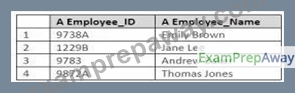
In the Learner Data TBL, Employee ID is numeric.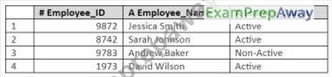
How can you prepare to join these tables, without the potential loss of data?
- A. Change the field type of Employee ID directly on the Learner Data TBL from Numeric to Text.
- B. Import the Employee Data TBL into a DDS and change the field type of Employee ID from text to numeric using a Manage Fields stage.
- C. Import the Learner Data TBL into a DDS and change the field type of Employee ID from numeric to text using a Manage Fields stage.
- D. Change the field type of Employee ID directly on the Employee Data TBL from text to numeric.
Answer: C
Explanation:
In Workday Prism Analytics, joining two tables requires that the fields used in the join condition have compatible data types to avoid data mismatches or loss. The Employee Data TBL has an Employee ID field as text, while the Learner Data TBL has an Employee ID field as numeric. According to the official Workday Prism Analytics study path documents, to join these tables without potential data loss, the best approach is to convert the numeric Employee ID in the Learner Data TBL to text, as text fields can safely store numeric values as strings, but converting text to numeric risks data loss if the text field contains non-numeric characters (e.g., leading zeros or special characters).
The correct method is to import the Learner Data TBL into a Derived Dataset (DDS) and use a Manage Fields stage to change the field type of Employee ID from numeric to text (option D). This ensures that the Employee ID field in both tables is text, enabling a safe and accurate join without losing data. The Manage Fields stage in a DDS allows for field type transformations, which is the recommended approach for preparing data for joins in Prism Analytics.
The other options are less suitable:
* A. Import the Employee Data TBL into a DDS and change the field type of Employee ID from text to numeric using a Manage Fields stage: Converting text to numeric risks data loss if the text field contains non-numeric values, which could lead to errors or missing records during the join.
* B. Change the field type of Employee ID directly on the Employee Data TBL from text to numeric:
Direct field type changes on tables are not supported in Prism Analytics, and even if possible, this approach risks data loss for the same reason as option A.
* C. Change the field type of Employee ID directly on the Learner Data TBL from Numeric to Text:
Direct field type changes on tables are not supported; field type transformations must be done in a DDS using a Manage Fields stage.
By converting the numeric Employee ID to text in a DDS, the join can be performed safely, preserving all data from both tables.
References:
Workday Prism Analytics Study Path Documents, Section: Data Prep and Transformation, Topic: Preparing Data for Joins in Prism Analytics Workday Prism Analytics Training Guide, Module: Data Prep and Transformation, Subtopic: Field Type Transformations Using Manage Fields Stage
NEW QUESTION # 48
You accidentally delete a Prism calculated field that is used in other Prism calculated fields or conditions.
What is a possible outcome?
- A. Any calculated field referencing the deleted field defaults to zero.
- B. The system will automatically reverse the deletion because the field is referenced elsewhere.
- C. Errors will result in any stage or calculated field that references the field.
- D. The system will automatically adjust any dependencies accordingly.
Answer: C
Explanation:
Comprehensive and Detailed Explanation From Exact Extract:
In Workday Prism Analytics, calculated fields are often interdependent, with one calculated field referencing another in its expression or being used in conditions within a dataset's transformation stages. According to the official Workday Prism Analytics study path documents, if a calculated field is deleted while other calculated fields or conditions depend on it, the system does not automatically handle the dependency. Instead, this deletion will cause errors in any stage or calculated field that references the deleted field. These errors occur because the dependent calculations or conditions can no longer resolve the reference to the deleted field, leading to failures in the dataset's transformation pipeline or when the dataset is processed or published.
The other options are incorrect:
A: The system will automatically reverse the deletion because the field is referenced elsewhere: Prism Analytics does not have an automatic reversal mechanism for deletions; users must manually restore the field if needed.
B: Any calculated field referencing the deleted field defaults to zero: The system does not default to zero; it will instead throw an error due to the unresolved reference.
D: The system will automatically adjust any dependencies accordingly: Prism does not automatically adjust dependencies; the user must manually update the dependent fields or conditions to resolve the issue.
The resulting errors highlight the importance of carefully managing dependencies when deleting calculated fields, ensuring that all references are updated or removed to avoid disruptions in the dataset's transformation logic.
References:
Workday Prism Analytics Study Path Documents, Section: Data Prep and Transformation, Topic: Managing Calculated Fields and Dependencies Workday Prism Analytics Training Guide, Module: Data Prep and Transformation, Subtopic: Impact of Deleting Calculated Fields on Dataset Transformations
NEW QUESTION # 49
Why should you include Workday instance field types in the Workday report that you use to import data into Prism?
- A. Unions are more easily performed with instance field types.
- B. Joins are more easily performed with instance field types.
- C. The final Prism datasource can support drilling into Workday objects.
- D. Performance is improved in the final Prism datasource when published.
Answer: C
Explanation:
Comprehensive and Detailed Explanation From Exact Extract:
When importing data into Workday Prism Analytics from a Workday report, including Workday instance field types in the report is critical for enabling specific functionality in the resulting Prism data source.
According to the official Workday Prism Analytics study path documents, including instance field types allows the final Prism data source to support drilling into Workday objects. Instance field types represent references to Workday business objects (e.g., Worker, Position, or Organization), and including them in the report ensures that the Prism data source retains the ability to navigate to these objects within Workday's reporting and analytics framework. This enables users to perform drill-down actions, such as accessing detailed object data directly from Prism visualizations or reports.
The other options do not accurately reflect the primary benefit of including instance field types:
* B. Performance is improved in the final Prism datasource when published: Instance field types do not directly impact the performance of the published data source; performance is more influenced by data volume and indexing.
* C. Unions are more easily performed with instance field types: Unions depend on schema compatibility, not instance field types, which are specific to Workday object references.
* D. Joins are more easily performed with instance field types: While instance field types can be used in joins, their primary purpose is to enable object navigation, not to simplify join operations.
By including instance field types, the Prism data source gains enhanced interactivity, allowing users to leverage Workday's object model for deeper analysis and navigation.
References:
Workday Prism Analytics Study Path Documents, Section: Integrating Prism with Workday Reports, Topic:
Workday Report Field Types and Prism Integration
Workday Prism Analytics Training Guide, Module: Publishing and Visualizing Data, Subtopic: Enabling Drill-Down Capabilities in Prism Data Sources
NEW QUESTION # 50
......
Workday Workday-Prism-Analytics Pre-Exam Practice Tests | ExamPrepAway: https://www.examprepaway.com/Workday/braindumps.Workday-Prism-Analytics.ete.file.html
Workday-Prism-Analytics practice test questions, answers, explanations: https://drive.google.com/open?id=1OlIui7XnYsihQ7wJOun506gAKCE7jRSG