

[Apr 26, 2024] DP-100 Exam Dumps PDF Guaranteed Success with Accurate & Updated Questions
Pass DP-100 Exam - Real Test Engine PDF with 410 Questions
Microsoft DP-100 certification exam is an excellent opportunity for data scientists to validate their skills in designing and implementing data science solutions on Azure. Designing and Implementing a Data Science Solution on Azure certification demonstrates your proficiency in Azure tools and services, which are in high demand in the industry. It is a valuable asset to have on your resume and can help you advance your career in the field of data science.
Microsoft DP-100: Designing and Implementing a Data Science Solution on Azure is a valuable certification for data professionals who want to demonstrate their skills in designing and implementing data science solutions on Azure. It covers a wide range of topics and requires candidates to demonstrate their ability to apply these skills to real-world scenarios. Becoming certified in Microsoft DP-100 can lead to career advancement and increased opportunities in the field of data science.
NEW QUESTION # 115
You create a multi-class image classification deep learning model.
The model must be retrained monthly with the new image data fetched from a public web portal. You create an Azure Machine Learning pipeline to fetch new data, standardize the size of images, and retrain the model.
You need to use the Azure Machine Learning SDK to configure the schedule for the pipeline.
Which four actions should you perform in sequence? To answer, move the appropriate actions from the list of actions to the answer area and arrange them in the correct order.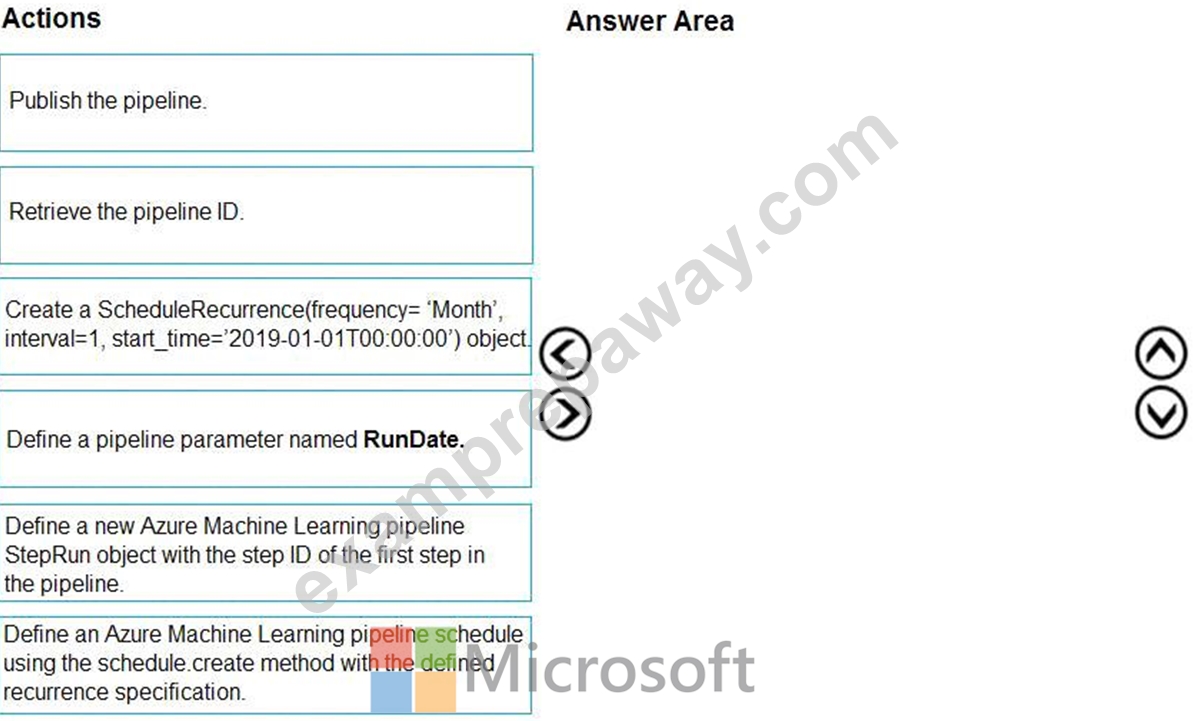
Answer:
Explanation: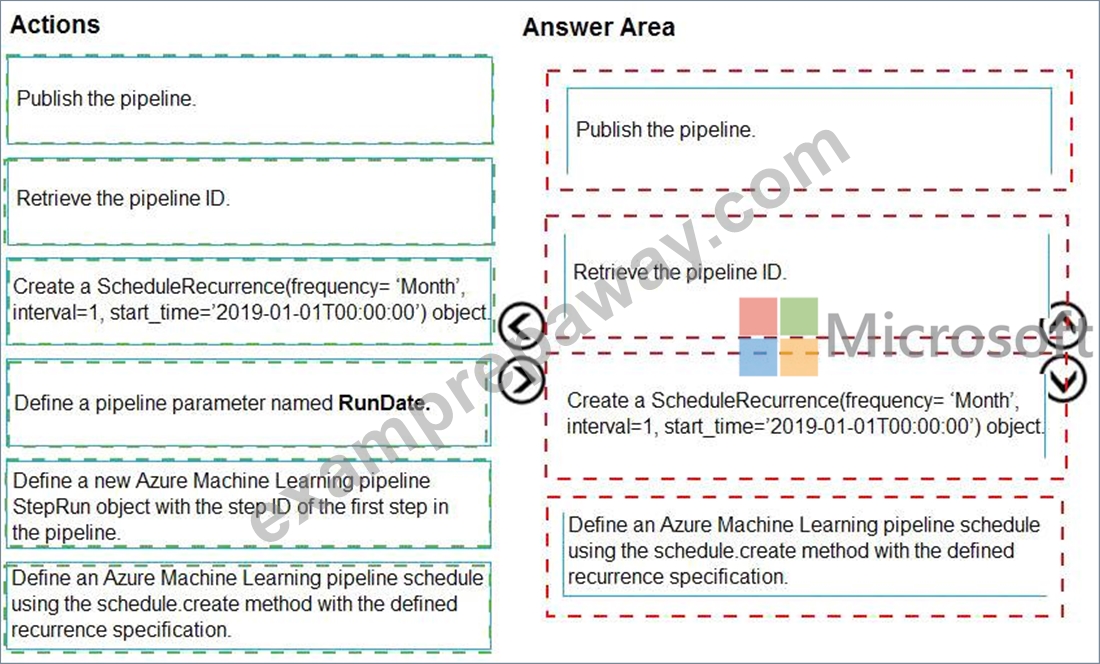
Explanation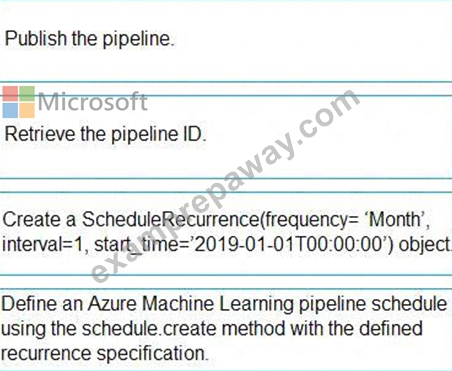
Step 1: Publish the pipeline.
To schedule a pipeline, you'll need a reference to your workspace, the identifier of your published pipeline, and the name of the experiment in which you wish to create the schedule.
Step 2: Retrieve the pipeline ID.
Needed for the schedule.
Step 3: Create a ScheduleRecurrence..
To run a pipeline on a recurring basis, you'll create a schedule. A Schedule associates a pipeline, an experiment, and a trigger.
First create a schedule. Example: Create a Schedule that begins a run every 15 minutes:
recurrence = ScheduleRecurrence(frequency="Minute", interval=15)
Step 4: Define an Azure Machine Learning pipeline schedule..
Example, continued:
recurring_schedule = Schedule.create(ws, name="MyRecurringSchedule",
description="Based on time",
pipeline_id=pipeline_id,
experiment_name=experiment_name,
recurrence=recurrence)
Reference:
https://docs.microsoft.com/en-us/azure/machine-learning/how-to-schedule-pipelines
NEW QUESTION # 116
You need to produce a visualization for the diagnostic test evaluation according to the data visualization requirements.
Which three modules should you recommend be used in sequence? To answer, move the appropriate modules from the list of modules to the answer area and arrange them in the correct order.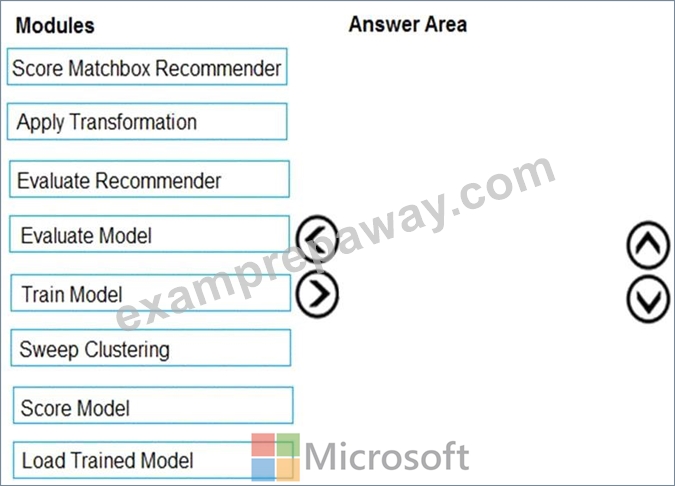
Answer:
Explanation: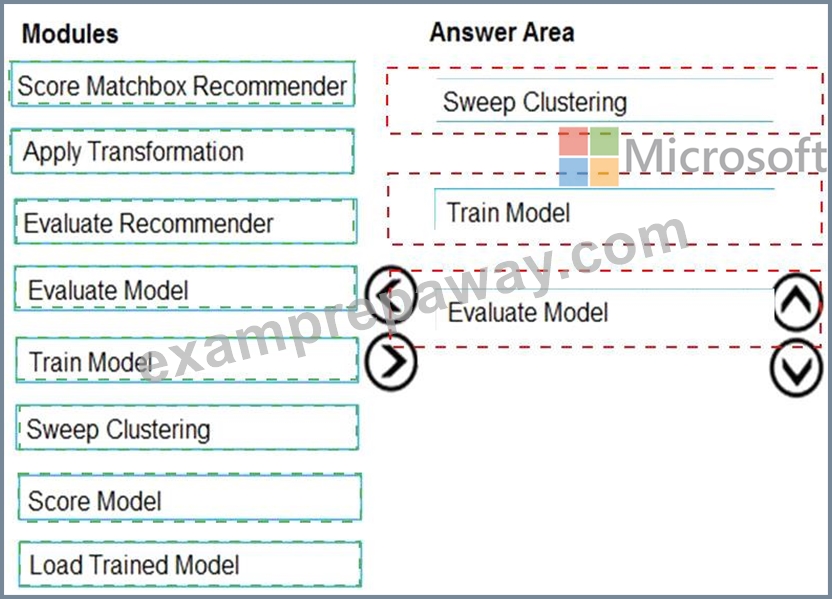
Explanation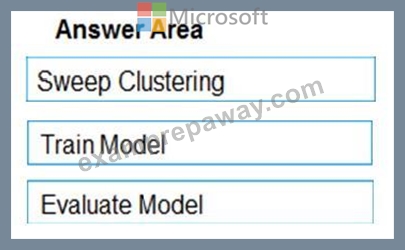
Step 1: Sweep Clustering
Start by using the "Tune Model Hyperparameters" module to select the best sets of parameters for each of the models we're considering.
One of the interesting things about the "Tune Model Hyperparameters" module is that it not only outputs the results from the Tuning, it also outputs the Trained Model.
Step 2: Train Model
Step 3: Evaluate Model
Scenario: You need to provide the test results to the Fabrikam Residences team. You create data visualizations to aid in presenting the results.
You must produce a Receiver Operating Characteristic (ROC) curve to conduct a diagnostic test evaluation of the model. You need to select appropriate methods for producing the ROC curve in Azure Machine Learning Studio to compare the Two-Class Decision Forest and the Two-Class Decision Jungle modules with one another.
References:
http://breaking-bi.blogspot.com/2017/01/azure-machine-learning-model-evaluation.html
NEW QUESTION # 117
You arc I mating a deep learning model to identify cats and dogs. You have 25,000 color images.
You must meet the following requirements:
* Reduce the number of training epochs.
* Reduce the size of the neural network.
* Reduce over-fitting of the neural network.
You need to select the image modification values.
Which value should you use? To answer, select the appropriate Options in the answer area.
NOTE: Each correct selection is worth one point.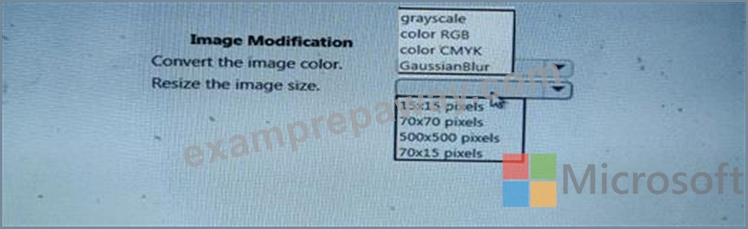
Answer:
Explanation: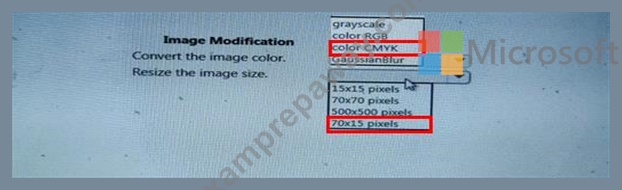
NEW QUESTION # 118
You are performing feature scaling by using the scikit-learn Python library for x.1 x2, and x3 features.
Original and scaled data is shown in the following image.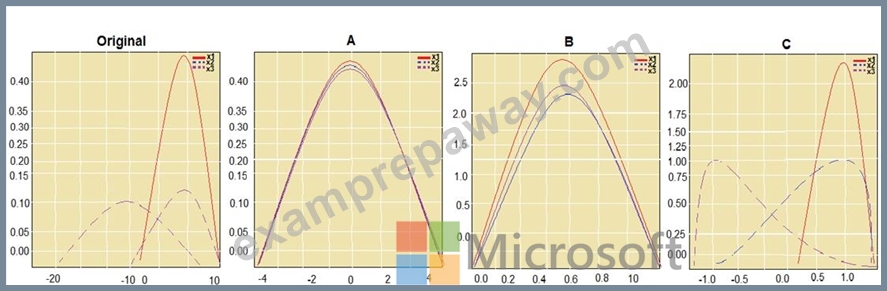
Use the drop-down menus to select the answer choice that answers each question based on the information presented in the graphic.
NOTE: Each correct selection is worth one point.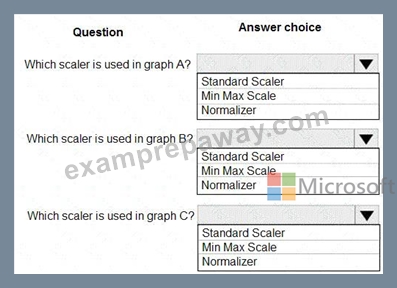
Answer:
Explanation: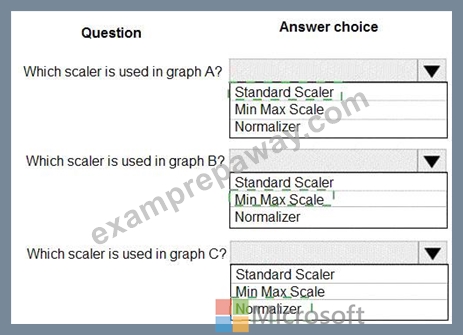
Explanation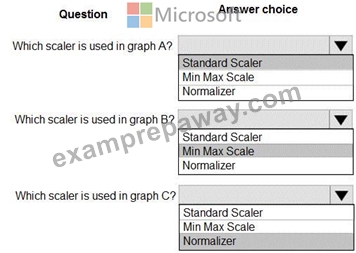
Box 1: StandardScaler
The StandardScaler assumes your data is normally distributed within each feature and will scale them such that the distribution is now centred around 0, with a standard deviation of 1.
Example:
All features are now on the same scale relative to one another.
Box 2: Min Max Scaler
Notice that the skewness of the distribution is maintained but the 3 distributions are brought into the same scale so that they overlap.
Box 3: Normalizer
References:
http://benalexkeen.com/feature-scaling-with-scikit-learn/
NEW QUESTION # 119
You plan to implement a two-step pipeline by using the Azure Machine Learning SDK for Python.
The pipeline will pass temporary data from the first step to the second step.
You need to identify the class and the corresponding method that should be used in the second step to access temporary data generated by the first step in the pipeline.
Which class and method should you identify? To answer, select the appropriate options in the answer area.
NOTE: Each correct selection is worth one point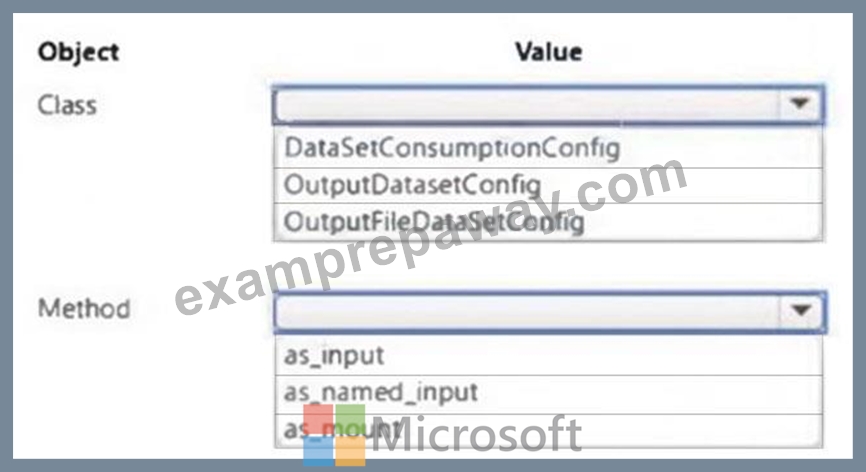
Answer:
Explanation: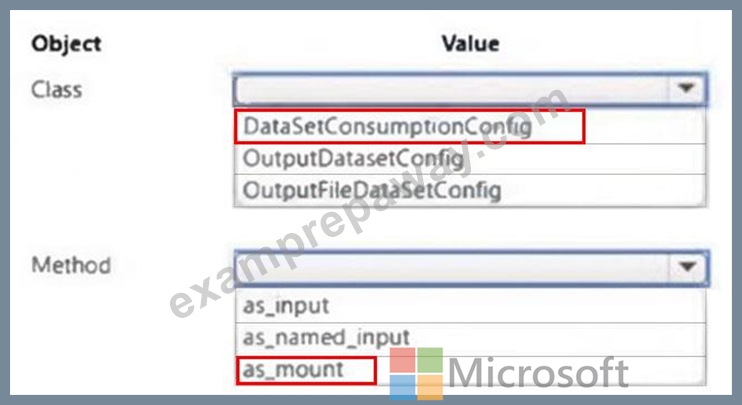
NEW QUESTION # 120
You use an Azure Machine Learning workspace.
You create the following Python code:
For each of the following statements, select Yes if the statement is true. Otherwise, select No.
NOTE: Each correct selection is worth one point.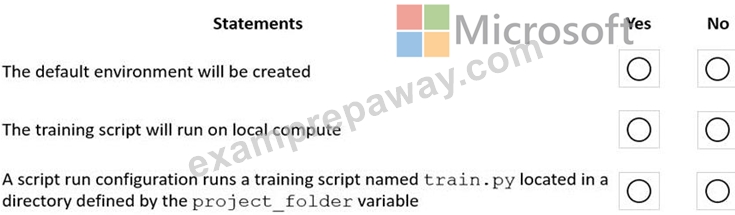
Answer:
Explanation: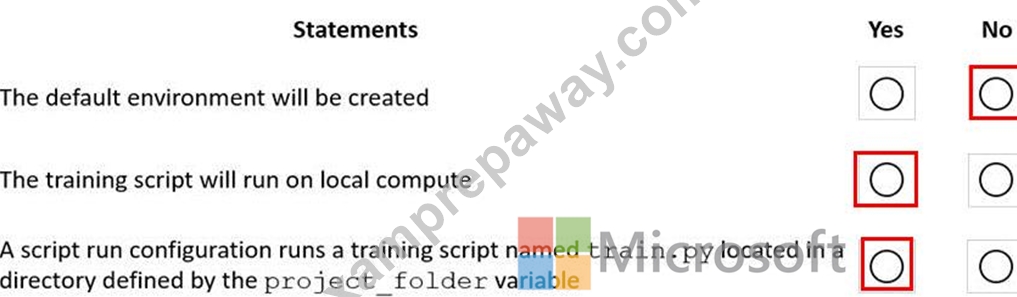
Reference:
https://docs.microsoft.com/en-us/python/api/azureml-core/azureml.core.scriptrunconfig
https://docs.microsoft.com/en-us/python/api/azureml-core/azureml.core.environment.environment
NEW QUESTION # 121
You are preparing to use the Azure ML SDK to run an experiment and need to create compute. You run the following code: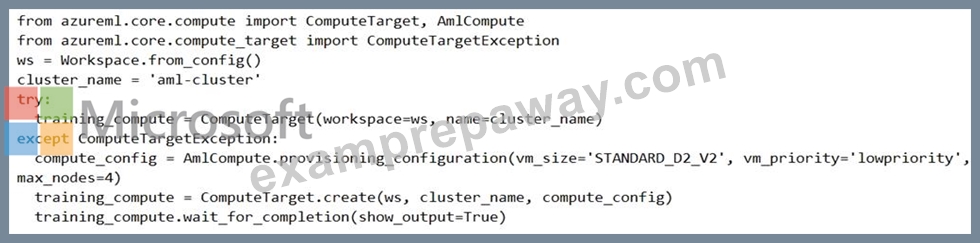
For each of the following statements, select Yes if the statement is true. Otherwise, select No.
NOTE: Each correct selection is worth one point.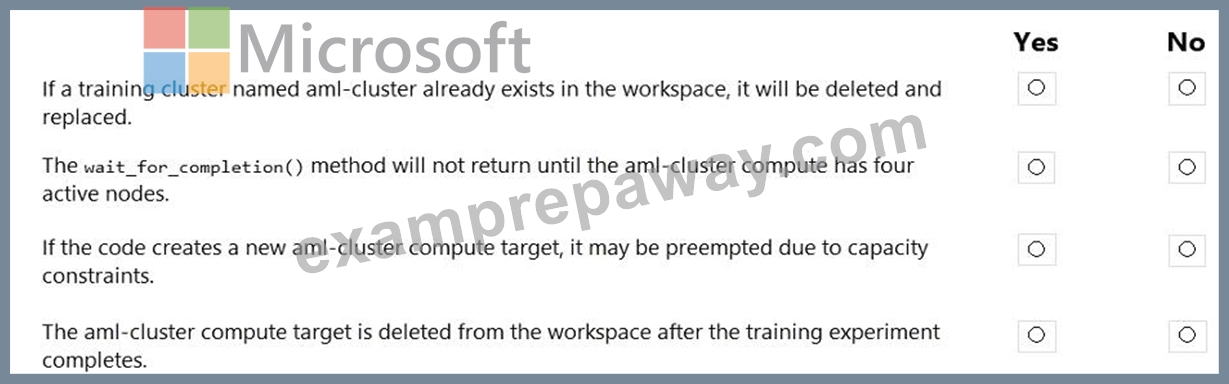
Answer:
Explanation: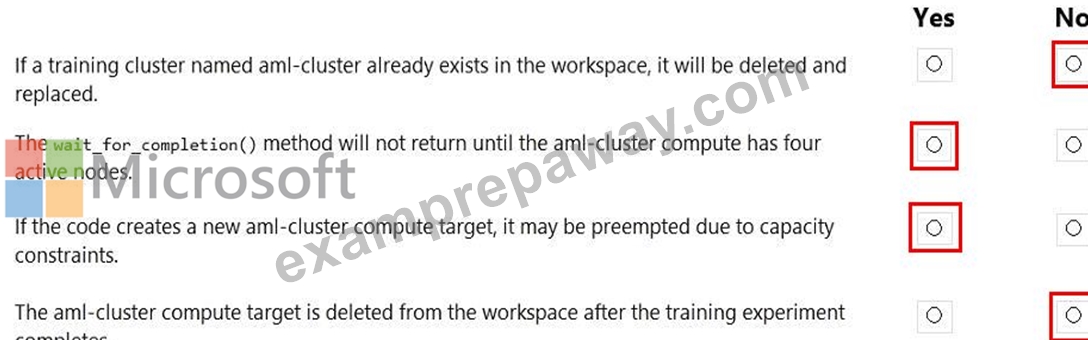
Explanation:
Box 1: No
If a training cluster already exists it will be used.
Box 2: Yes
The wait_for_completion method waits for the current provisioning operation to finish on the cluster.
Box 3: Yes
Low Priority VMs use Azure's excess capacity and are thus cheaper but risk your run being pre-empted.
Box 4: No
Need to use training_compute.delete() to deprovision and delete the AmlCompute target.
Reference:
https://notebooks.azure.com/azureml/projects/azureml-getting-started/html/how-to-use-azureml/training/train-on-amlcompute/train-on-amlcompute.ipynb
https://docs.microsoft.com/en-us/python/api/azureml-core/azureml.core.compute.computetarget
NEW QUESTION # 122
You are performing a classification task in Azure Machine Learning Studio.
You must prepare balanced testing and training samples based on a provided data set.
You need to split the data with a 0.75:0.25 ratio.
Which value should you use for each parameter? To answer, select the appropriate options in the answer area.
NOTE: Each correct selection is worth one point.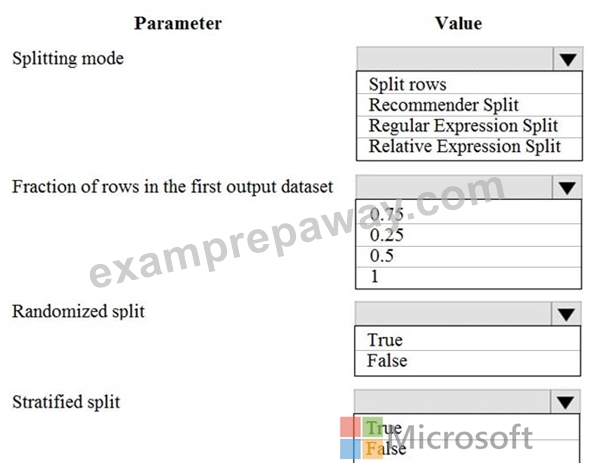
Answer:
Explanation: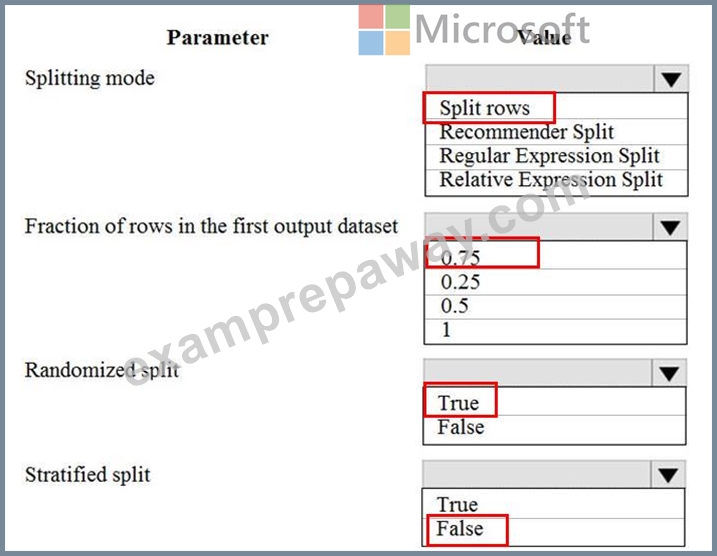
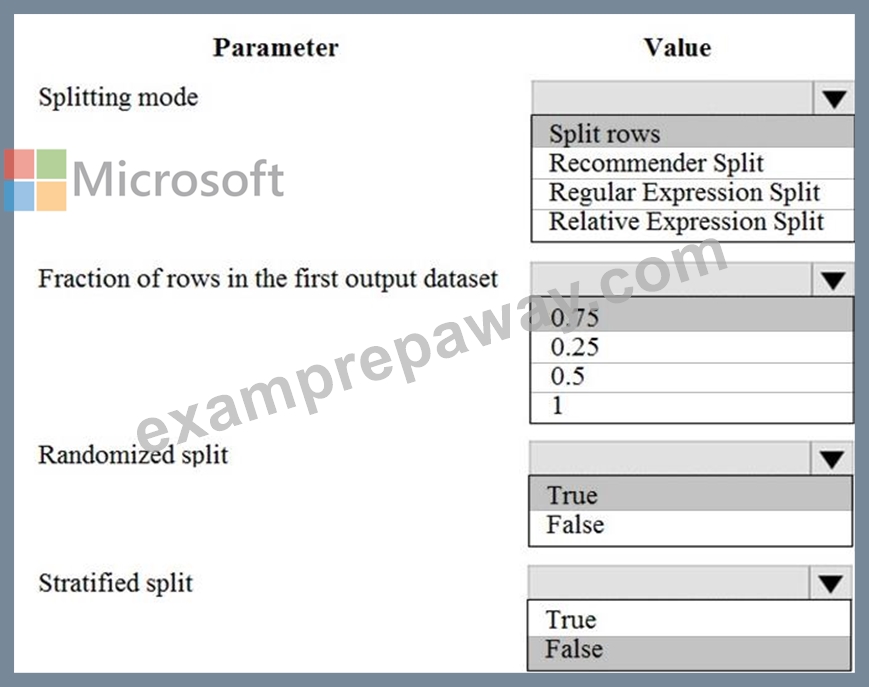
Reference:
https://docs.microsoft.com/en-us/azure/machine-learning/studio-module-reference/split-data
NEW QUESTION # 123
You use Data Science Virtual Machines (DSVMs) for Windows and Linux in Azure.
You need to access the DSVMs.
Which utilities should you use? To answer, select the appropriate options in the answer area.
NOTE: Each correct selection is worth one point.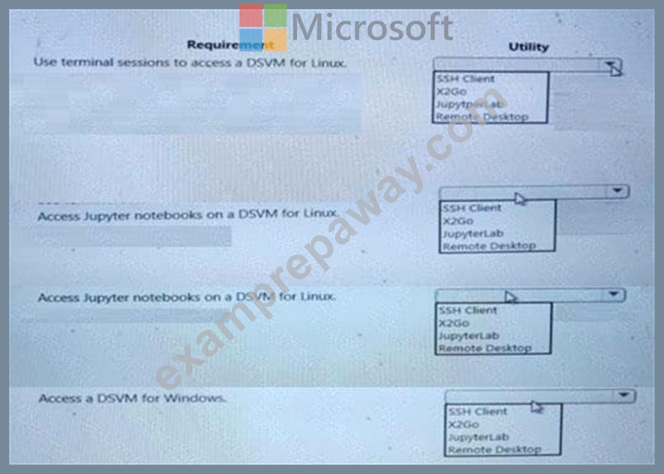
Answer:
Explanation: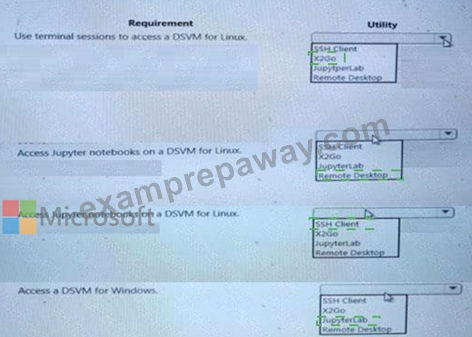
NEW QUESTION # 124
You create an Azure Machine Learning workspace.
You need to use the shared file system of the workspace to store a clone of a private Git repository.
Which four actions should you perform in sequence? To answer, move the appropriate actions from the list of actions to the answer area and arrange them in the correct order.
Answer:
Explanation: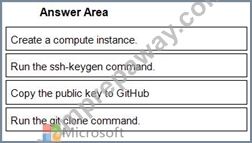
1 - Create a compute instance.
2 - Run the ssh-keygen command.
3 - Copy the public key to GitHub
4 - Run the git clone command.
NEW QUESTION # 125
Note: This question is part of a series of questions that present the same scenario. Each question in the series contains a unique solution that might meet the stated goals. Some question sets might have more than one correct solution, while others might not have a correct solution.
After you answer a question in this section, you will NOT be able to return to it. As a result, these questions will not appear in the review screen.
You are creating a new experiment in Azure Machine Learning Studio.
One class has a much smaller number of observations than the other classes in the training set.
You need to select an appropriate data sampling strategy to compensate for the class imbalance.
Solution: You use the Principal Components Analysis (PCA) sampling mode.
Does the solution meet the goal?
- A. No
- B. Yes
Answer: A
Explanation:
Instead use the Synthetic Minority Oversampling Technique (SMOTE) sampling mode.
Note: SMOTE is used to increase the number of underepresented cases in a dataset used for machine learning. SMOTE is a better way of increasing the number of rare cases than simply duplicating existing cases.
Incorrect Answers:
The Principal Component Analysis module in Azure Machine Learning Studio (classic) is used to reduce the dimensionality of your training data. The module analyzes your data and creates a reduced feature set that captures all the information contained in the dataset, but in a smaller number of features.
References:
https://docs.microsoft.com/en-us/azure/machine-learning/studio-module-reference/smote
https://docs.microsoft.com/en-us/azure/machine-learning/studio-module-reference/principal-component- analysis
NEW QUESTION # 126
You create an Azure Machine Learning workspace.
You must use the Python SDK v2 to implement an experiment from a Jupyter notebook in the workspace. The experiment must log a table in the following format: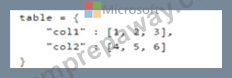
You need to complete the Python code to log the table.
How should you complete the code? To answer, select the appropriate options in the answer area.
NOTE: Each correct selection is worth one point.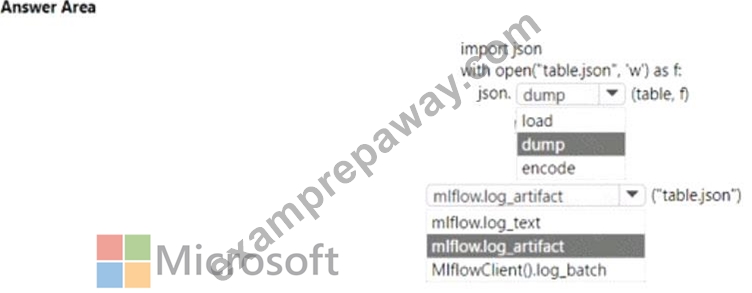
Answer:
Explanation: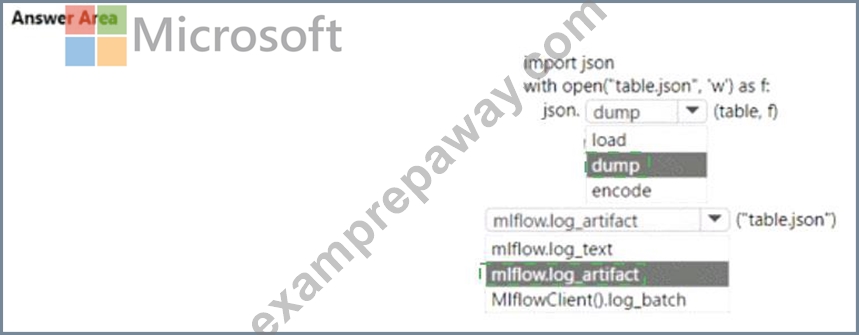
Explanation
NEW QUESTION # 127
You are building an intelligent solution using machine learning models.
The environment must support the following requirements:
Data scientists must build notebooks in a cloud environment
Data scientists must use automatic feature engineering and model building in machine learning pipelines.
Notebooks must be deployed to retrain using Spark instances with dynamic worker allocation.
Notebooks must be exportable to be version controlled locally.
You need to create the environment.
Which four actions should you perform in sequence? To answer, move the appropriate actions from the list of actions to the answer area and arrange them in the correct order.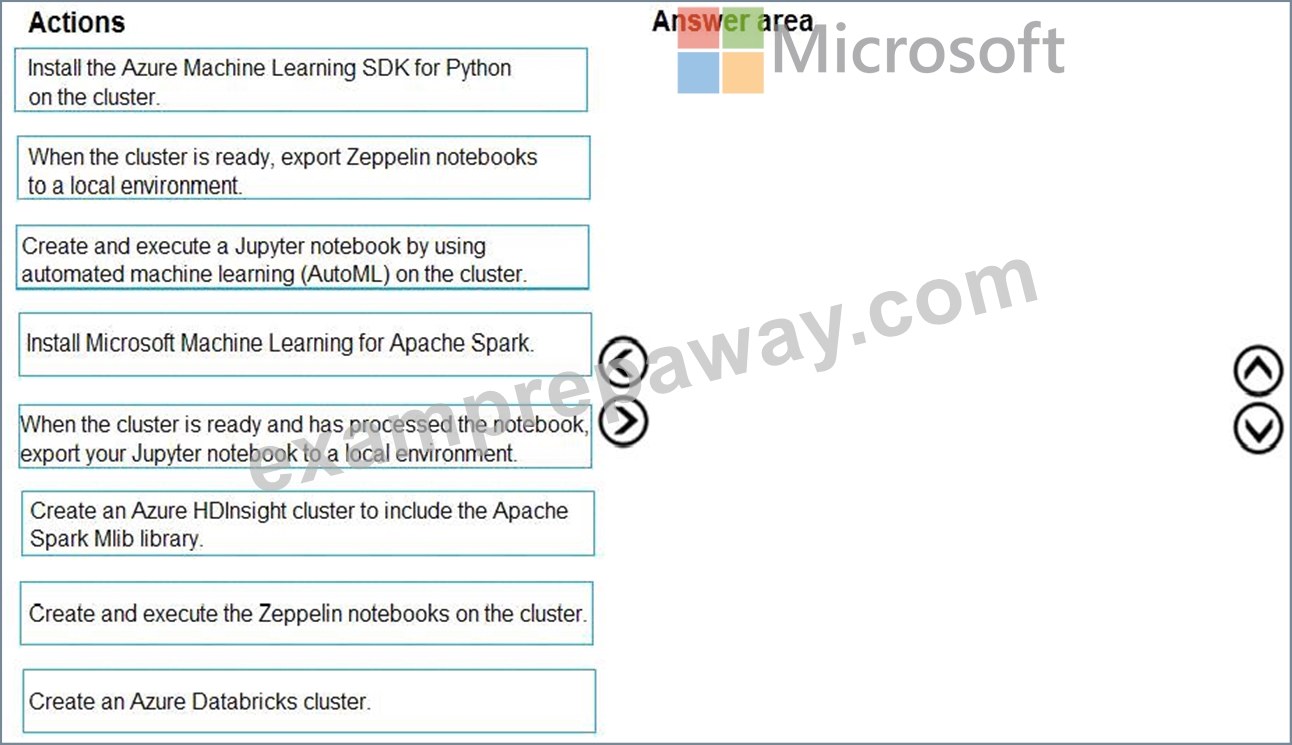
Answer:
Explanation: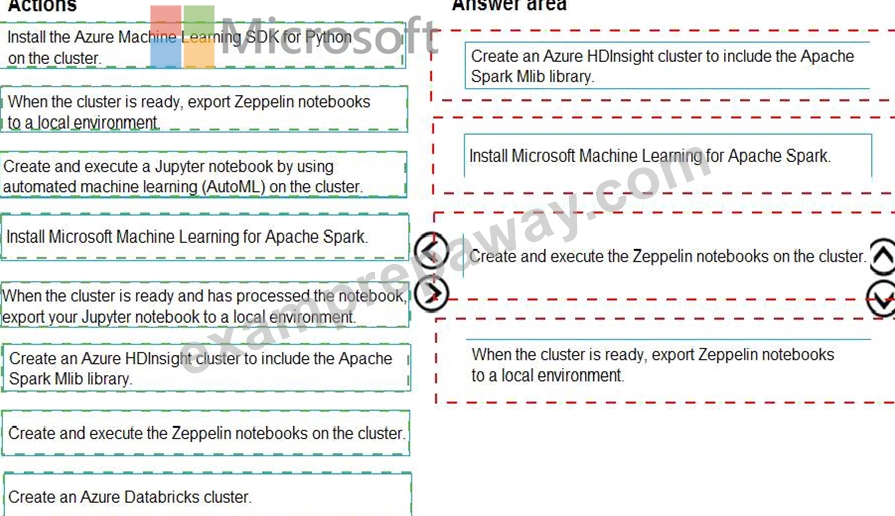
Explanation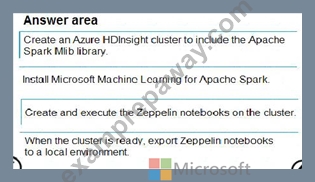
Step 1: Create an Azure HDInsight cluster to include the Apache Spark Mlib library Step 2: Install Microsot Machine Learning for Apache Spark You install AzureML on your Azure HDInsight cluster.
Microsoft Machine Learning for Apache Spark (MMLSpark) provides a number of deep learning and data science tools for Apache Spark, including seamless integration of Spark Machine Learning pipelines with Microsoft Cognitive Toolkit (CNTK) and OpenCV, enabling you to quickly create powerful, highly-scalable predictive and analytical models for large image and text datasets.
Step 3: Create and execute the Zeppelin notebooks on the cluster
Step 4: When the cluster is ready, export Zeppelin notebooks to a local environment.
Notebooks must be exportable to be version controlled locally.
References:
https://docs.microsoft.com/en-us/azure/hdinsight/spark/apache-spark-zeppelin-notebook
https://azuremlbuild.blob.core.windows.net/pysparkapi/intro.html
NEW QUESTION # 128
You train a machine learning model.
You must deploy the model as a real-time inference service for testing. The service requires low CPU utilization and less than 48 MB of RAM. The compute target for the deployed service must initialize automatically while minimizing cost and administrative overhead.
Which compute target should you use?
- A. Azure Kubernetes Service (AKS) inference cluster
- B. Azure Machine Learning compute cluster
- C. Azure Container Instance (ACI)
- D. attached Azure Databricks cluster
Answer: C
Explanation:
Explanation
Azure Container Instances (ACI) are suitable only for small models less than 1 GB in size.
Use it for low-scale CPU-based workloads that require less than 48 GB of RAM.
Note: Microsoft recommends using single-node Azure Kubernetes Service (AKS) clusters for dev-test of larger models.
Reference:
https://docs.microsoft.com/id-id/azure/machine-learning/how-to-deploy-and-where
NEW QUESTION # 129
You have an Azure blob container that contains a set of TSV files. The Azure blob container is registered as a datastore for an Azure Machine Learning service workspace. Each TSV file uses the same data schema.
You plan to aggregate data for all of the TSV files together and then register the aggregated data as a dataset in an Azure Machine Learning workspace by using the Azure Machine Learning SDK for Python.
You run the following code.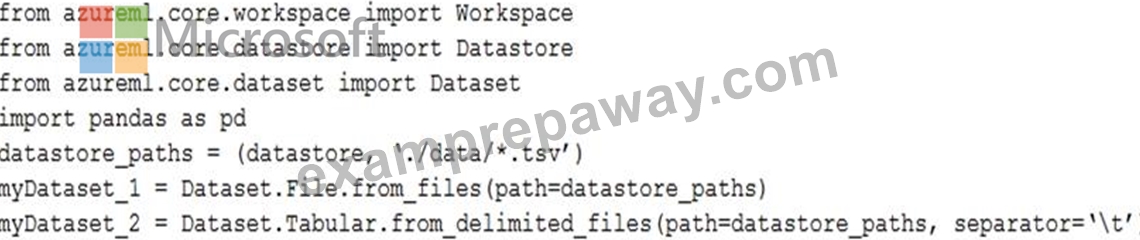
For each of the following statements, select Yes if the statement is true. Otherwise, select No.
NOTE: Each correct selection is worth one point.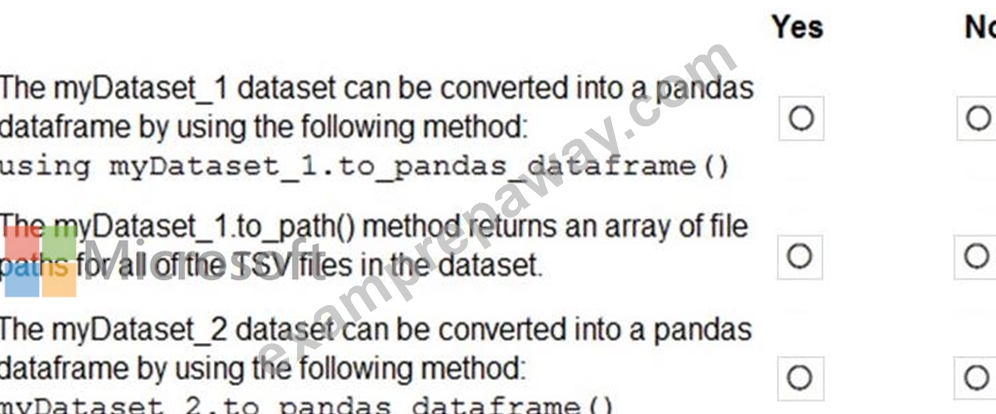
Answer:
Explanation: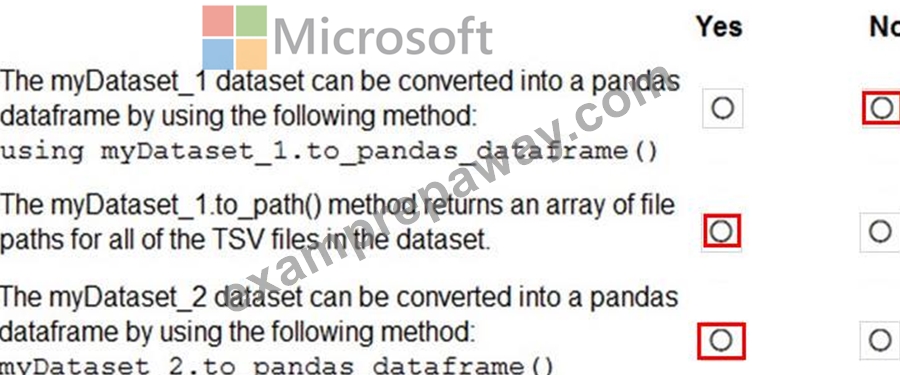
Reference:
https://docs.microsoft.com/en-us/python/api/azureml-core/azureml.data.tabulardataset
NEW QUESTION # 130
You have a model with a large difference between the training and validation error values.
You must create a new model and perform cross-validation.
You need to identify a parameter set for the new model using Azure Machine Learning Studio.
Which module you should use for each step? To answer, drag the appropriate modules to the correct steps. Each module may be used once or more than once, or not at all. You may need to drag the split bar between panes or scroll to view content.
NOTE: Each correct selection is worth one point.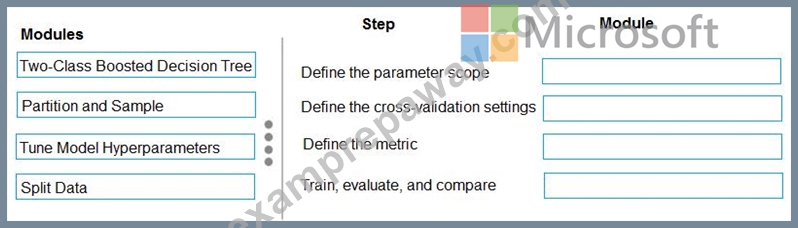
Answer:
Explanation: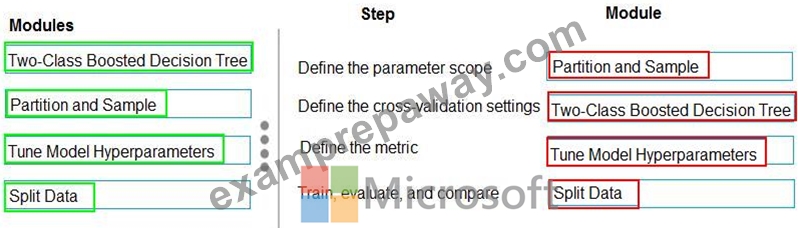
Reference:
https://docs.microsoft.com/en-us/azure/machine-learning/studio-module-reference/partition-and-sample
NEW QUESTION # 131
You are a lead data scientist for a project that tracks the health and migration of birds. You create a multi-image classification deep learning model that uses a set of labeled bird photos collected by experts. You plan to use the model to develop a cross-platform mobile app that predicts the species of bird captured by app users.
You must test and deploy the trained model as a web service. The deployed model must meet the following requirements:
An authenticated connection must not be required for testing.
The deployed model must perform with low latency during inferencing.
The REST endpoints must be scalable and should have a capacity to handle large number of requests when multiple end users are using the mobile application.
You need to verify that the web service returns predictions in the expected JSON format when a valid REST request is submitted.
Which compute resources should you use? To answer, select the appropriate options in the answer area.
NOTE: Each correct selection is worth one point.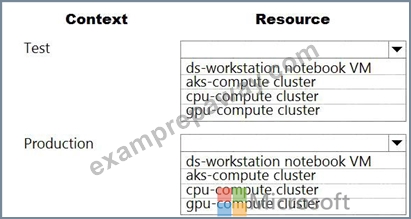
Answer:
Explanation: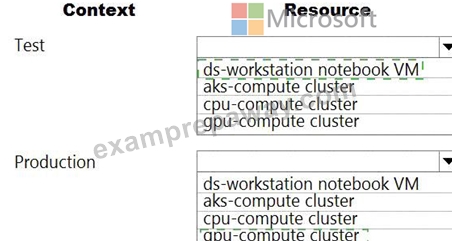
Explanation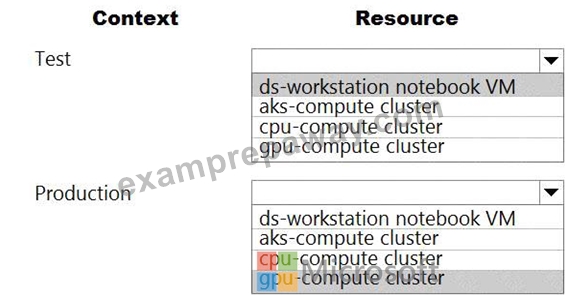
Box 1: ds-workstation notebook VM
An authenticated connection must not be required for testing.
On a Microsoft Azure virtual machine (VM), including a Data Science Virtual Machine (DSVM), you create local user accounts while provisioning the VM. Users then authenticate to the VM by using these credentials.
Box 2: gpu-compute cluster
Image classification is well suited for GPU compute clusters
Reference:
https://docs.microsoft.com/en-us/azure/machine-learning/data-science-virtual-machine/dsvm-common-identity
https://docs.microsoft.com/en-us/azure/architecture/reference-architectures/ai/training-deep-learning
NEW QUESTION # 132
You are analyzing a dataset by using Azure Machine Learning Studio.
YOU need to generate a statistical summary that contains the p value and the unique value count for each feature column.
Which two modules can you users? Each correct answer presents a complete solution.
NOTE: Each correct selection is worth one point.
- A. Summarize Data
- B. Compute linear Correlation
- C. Execute Python Script
- D. Export Count Table
- E. Convert to Indicator Values
Answer: B,D
Explanation:
The Export Count Table module is provided for backward compatibility with experiments that use the Build Count Table (deprecated) and Count Featurizer (deprecated) modules.
E: Summarize Data statistics are useful when you want to understand the characteristics of the complete dataset. For example, you might need to know:
How many missing values are there in each column?
How many unique values are there in a feature column?
What is the mean and standard deviation for each column?
The module calculates the important scores for each column, and returns a row of summary statistics for each variable (data column) provided as input.
References:
https://docs.microsoft.com/en-us/azure/machine-learning/studio-module-reference/export-count-table
https://docs.microsoft.com/en-us/azure/machine-learning/studio-module-reference/summarize-data
NEW QUESTION # 133
You are performing feature scaling by using the scikit-learn Python library for x.1 x2, and x3 features.
Original and scaled data is shown in the following image.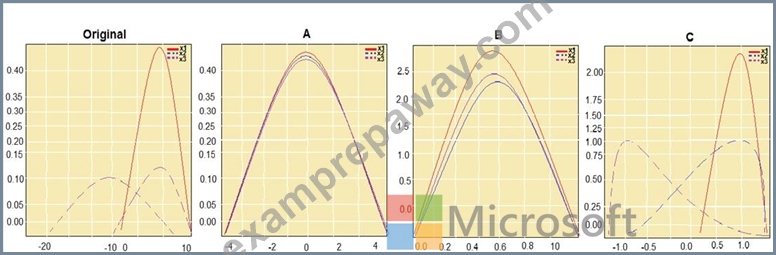
Use the drop-down menus to select the answer choice that answers each question based on the information presented in the graphic.
NOTE: Each correct selection is worth one point.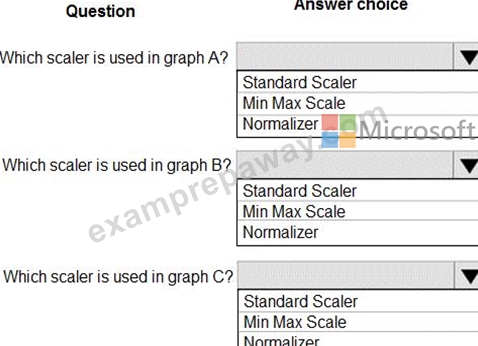
Answer:
Explanation: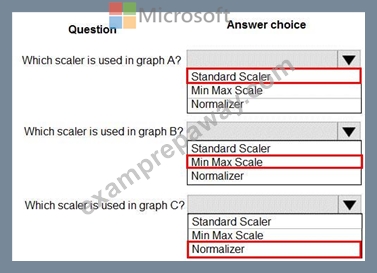
Explanation:
Box 1: StandardScaler
The StandardScaler assumes your data is normally distributed within each feature and will scale them such that the distribution is now centred around 0, with a standard deviation of 1.
Example: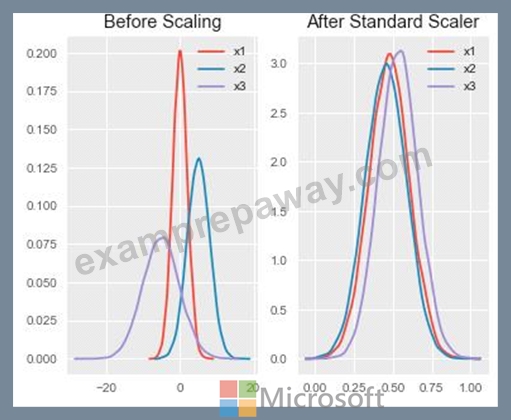
All features are now on the same scale relative to one another.
Box 2: Min Max Scaler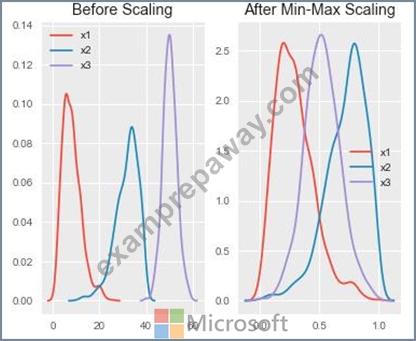
Notice that the skewness of the distribution is maintained but the 3 distributions are brought into the same scale so that they overlap.
Box 3: Normalizer
References:
http://benalexkeen.com/feature-scaling-with-scikit-learn/
NEW QUESTION # 134
You are creating a classification model for a banking company to identify possible instances of credit card fraud. You plan to create the model in Azure Machine Learning by using automated machine learning.
The training dataset that you are using is highly unbalanced.
You need to evaluate the classification model.
Which primary metric should you use?
- A. normalized_mean_absolute_error
- B. [spearman_correlation
- C. accuracy
- D. AUC.weighted
- E. normalized_root_mean_squared_error
Answer: D
Explanation:
AUC_weighted is a Classification metric.
Note: AUC is the Area under the Receiver Operating Characteristic Curve. Weighted is the arithmetic mean of the score for each class, weighted by the number of true instances in each class.
Reference:
https://docs.microsoft.com/en-us/azure/machine-learning/how-to-understand-automated-ml
NEW QUESTION # 135
You are performing a classification task in Azure Machine Learning Studio.
You must prepare balanced testing and training samples based on a provided data set.
You need to split the data with a 0.75:0.25 ratio.
Which value should you use for each parameter? To answer, select the appropriate options in the answer area.
NOTE: Each correct selection is worth one point.
Answer:
Explanation: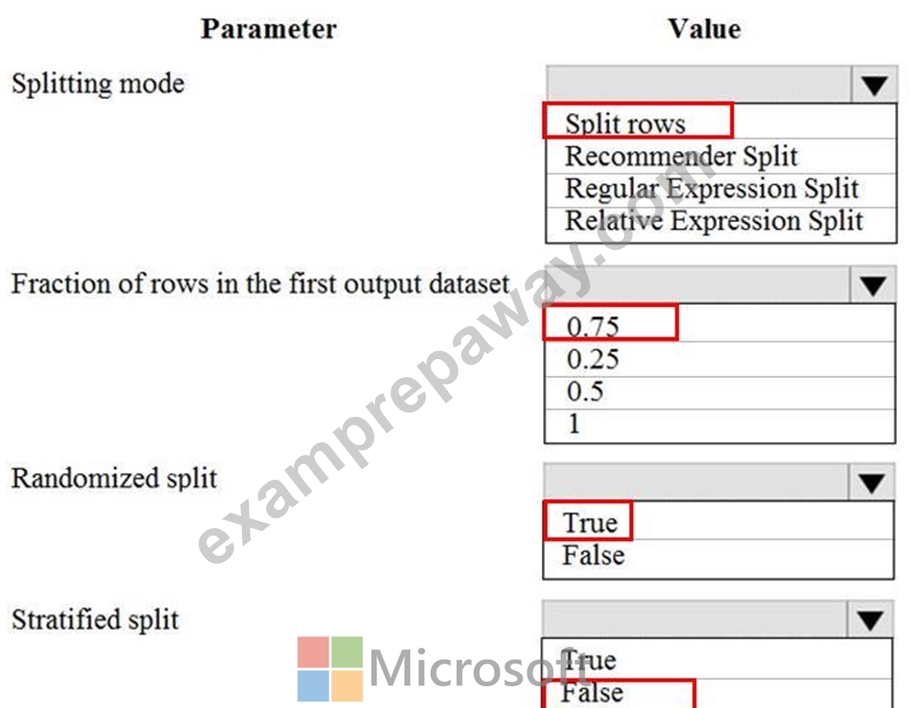
Reference:
https://docs.microsoft.com/en-us/azure/machine-learning/studio-module-reference/split-data
NEW QUESTION # 136
......
Get New DP-100 Certification Practice Test Questions Exam Dumps: https://www.examprepaway.com/Microsoft/braindumps.DP-100.ete.file.html
Real DP-100 Exam Dumps Questions Valid DP-100 Dumps PDF: https://drive.google.com/open?id=1eokeyaPCuk80PfcI_6FqIjyGxYohUING