

Pass Your CIPS Exam with L5M5 Exam Dumps (Updated 91 Questions)
L5M5 Exam Dumps - CIPS Practice Test Questions
NEW QUESTION # 32
In what circumstances is Expert Determination the most suitable method for resolving contract disputes?
- A. high value contracts
- B. personality disputes
- C. technical disputes
- D. international contracts
Answer: C
Explanation:
Choice C- This is the correct answer. Expert Determination is particularly suited for disputes that require specialized technical knowledge, such as issues related to engineering, construction, or IT systems. An independent expert with relevant expertise can assess and resolve the dispute effectively.
Incorrect answer:
Choice A-Expert Determination is not specifically suited to international contracts. While it could be used in such cases, it is more about the nature of the dispute (technical issues) rather than the geographic scope of the contract.
Choice B- The value of the contract does not determine the suitability of Expert Determination. Other methods like arbitration or litigation are often more common for resolving high-value disputes.
Choice D- Expert Determination is not designed to handle personality conflicts or disputes rooted in interpersonal disagreements. Mediation or other relationship-focused methods are more appropriate in such cases.
Reference:
LO-2.4; Page 236; Escalating non-compliance and making exit arrangements
NEW QUESTION # 33
Which of the following is an example where long-term availability of supplies is prioritized over short-term gains?
- A. Choosing a new supplier that is initially more expensive than others in the market to expand the supply base and develop market capacity
- B. Reducing quality standards in the short term, accepting that customer rejections will increase in the long term
- C. Cutting costs in the short term, ultimately leading to a reduced range and variety of suppliers in the market
- D. Selling products manufactured to lower quality standards, resulting in lower unit prices
Answer: A
Explanation:
Choice C- Using a new supplier that is more expensive in the short-term than others in the market, to expand the supply base and to develop capacity in the market is an example of where long-term availability of supplies would be more important than short-term gains. This decision focuses on building relationships and capacity for the future, prioritizing sustainability over immediate cost savings. This is the correct answer.
Incorrect answer:
It is important to consider the broader concept of supply chain management when weighing up short term commercial benefits vs long term availability.
Choice A and B- Lowering quality in every aspect leads to a customer rejects and negative brand publicity. There will be no long term supplies required as customers won't buy the product.
Choice D- Variety reduction involves reducing the number of different solutions used to fulfil the same need. When considering developing a procurement strategy for a new category, it is common to find that there is a variety of different standards and solutions employed across an organization to fulfil broadly the same need. The solution is not sustainable.
Reference:
LO-1.4; Page 114-116; Short term commercial gains and long term availability
NEW QUESTION # 34
What types of organisations is the UN Global Compact aimed at?
- A. NGOs
- B. Charities
- C. Governments
- D. Businesses
Answer: D
Explanation:
Comprehensive and Detailed Explanation From Exact Extract of Documents:
The UN Global Compact is primarily aimed at businesses. The L5M5 study guide (p.258) clarifies that while NGOs and other organisations can engage, the Compact is designed to encourage corporate responsibility in human rights, labour, environment, and anti-corruption. Since 2003, cities and public sector organisations can also join under different frameworks, but businesses remain the main focus. For procurement, this means suppliers aligned with the UN Global Compact are more likely to demonstrate compliance with global ethical standards.
Reference: Managing Ethical Procurement and Supply (L5M5) Study Guide, p.258
NEW QUESTION # 35
How do Fair Trade organisations protect producers of raw materials from poor economic conditions?
- A. A standard for working conditions is set
- B. Final products are marketed as Fair Trade
- C. Money is provided to communal funds
- D. A minimum price is set for purchase of items
Answer: D
Explanation:
Comprehensive and Detailed Explanation From Exact Extract of Documents:
Fair Trade organisations protect producers economically by ensuring a minimum price for raw materials, regardless of market fluctuations. The L5M5 study guide (old p.224, new p.303) explains that this stabilises producer incomes against volatile commodity prices, tariffs, or currency risks. While Fair Trade also involves better working conditions and community investment, the primary economic safeguard is the guaranteed minimum price. Procurement professionals should recognise how Fair Trade contributes to supply chain stability and resilience.
Reference: Managing Ethical Procurement and Supply (L5M5) Study Guide, p.303
NEW QUESTION # 36
When developing an ESG policy, which of the following steps should be taken first?
- A. Identify the need
- B. Gather Information
- C. Draft the policy
- D. Consult with stakeholders
Answer: A
Explanation:
Steps to take to develop an ESG policy:
1) Identify the need
2) Identify who will take lead responsibility
3) Gather information
4) Draft the policy
5) Consult with stakeholders
6) Approve the policy
7) Procedures
8) Implement the policy
9) Monitor
So the correct answer is D.
Reference:
LO-1.1; Page 32-33; The development of ESG focused procurement and supply policies in securing ethical and sustainable procurement and supply arrangements
NEW QUESTION # 37
GlobalTechManufacturing (GTM), a multinational company, operates a complex supply chain spanning multiple countries and stakeholders. Recognizing this complexity as a major risk, the Chief Supply Chain Officer (CSCO) has launched a supply chain mapping project. The objective is to analyze GTM's supply chain structure and develop risk mitigation strategies. The initial phase of this project will primarily focus on understanding which of the following aspects within GTM's supply chains?
1. Branding
2. Tiers
3. Complexity
4. Innovation
- A. 3 and 4 only
- B. 2 and 3 only
- C. 1 and 4 only
- D. 1 and 2 only
Answer: B
Explanation:
Option 2 - Supply chain mapping involves a detailed analysis of supplier layers, including Tier 1, Tier 2, and Tier 3 suppliers. Identifying these tiers allows GTM to trace the flow of materials, information, and services throughout the supply chain. This visibility is crucial for assessing supplier relationships, dependencies, and risks at each level, helping to mitigate potential disruptions. Therefore, this is a correct answer.
Option 3 - GTM's supply chain is extensive and intricate, spanning multiple countries with interconnected layers. Understanding this complexity helps identify risks, inefficiencies, and bottlenecks. Mapping the network enables GTM to manage interdependencies and enhance supply chain resilience, making this another correct answer.
Incorrect answer:
Option 1- While branding is important for market presence and customer perception, it is not directly related to supply chain mapping or risk mitigation in this context.
Option 4- Innovation is valuable for driving competitive advantage and improving processes, but the focus here is on understanding the current structure of the supply chain to address risks, not on developing new innovations.
By focusing on tiers and complexity, GTM can lay a strong foundation for managing its global supply chain risks effectively thus the answer is Choice A.
Reference:
LO-2.1; Page 145-148; Mapping supply chains to achieve supply chain transparency
NEW QUESTION # 38
Which of the following is not a fraud risk in a procurement function?
- A. Accepting presents
- B. Duplicating payments
- C. Phantom suppliers
- D. Bid rigging
Answer: A
Explanation:
Comprehensive and Detailed Explanation From Exact Extract of Documents:
Fraud risks in procurement typically include practices such as bid rigging (collusion to manipulate tenders), phantom suppliers (fake companies created to siphon money), and deliberate duplicate payments (processing false or repeated invoices). However, accepting presents is classified as bribery, not fraud. The L5M5 study guide (old p.139, new p.50) explains that fraud involves intentional deception for personal gain, while bribery relates to improper inducements or gifts. Procurement professionals must distinguish between fraud and bribery because both undermine ethical procurement but require different controls. For example, fraud prevention requires audit trails and segregation of duties, while anti-bribery policies require clear rules on gifts and hospitality.
Reference: Managing Ethical Procurement and Supply (L5M5) Study Guide, old p.139, new p.50
NEW QUESTION # 39
In 1999, the UN launched the Global Compact, a principle-based framework for sustainable business. Which of the following areas are covered by the Global Compact? Select THREE
- A. Environment
- B. Human rights
- C. Racism
- D. Minimum wage
- E. Anti-corruption
Answer: A,B,E
Explanation:
Comprehensive and Detailed Explanation From Exact Extract of Documents:
The UN Global Compact is based on ten principles derived from UN declarations. According to the L5M5 study guide (p.249), the areas covered are: human rights (A), labour standards, environment (B), and anti-corruption (C). "Racism" (D) is not listed specifically; instead, the Compact addresses non-discrimination as part of labour rights. "Minimum wage" (E) is not a universal standard in the Compact, though labour standards cover fair conditions of work. Procurement professionals should align supply strategies with these principles to support global sustainability and ethical practice.
Reference: Managing Ethical Procurement and Supply (L5M5) Study Guide, p.249
NEW QUESTION # 40
A Fair Trade-certified coffee cooperative located in a rural area is undergoing an audit to assess its compliance with Fair Trade standards. During the audit, several non-compliance issues are identified, requiring immediate corrective action to align with International Labour Organization (ILO) standards.
For each identified breach, match the corresponding Fair Trade Principle with the most relevant ILO Standard by selecting the appropriate option and placing it in the table below.
Breach 1: Workers in the coffee processing plant are exposed to prolonged noise levels during their shifts. However, many employees do not have or are not using proper hearing protection, raising serious concerns about potential hearing damage.
Breach 2: A significant number of workers, particularly local laborers, receive wages below the living wage threshold. This has resulted in financial hardship for their families, despite the cooperative's Fair Trade certification.
Breach 3: The cooperative is engaged in environmentally harmful waste disposal practices, frequently dumping waste into nearby streams. This has led to increasing concerns among local communities and environmental advocacy groups regarding the negative impact on the local ecosystem.
Breach 4: The cooperative exhibits gender-based employment disparities, where women are not appointed to certain roles, particularly managerial and supervisory positions. Additionally, the required uniforms for these roles fail to accommodate women, further restricting their opportunities due to health and safety regulations.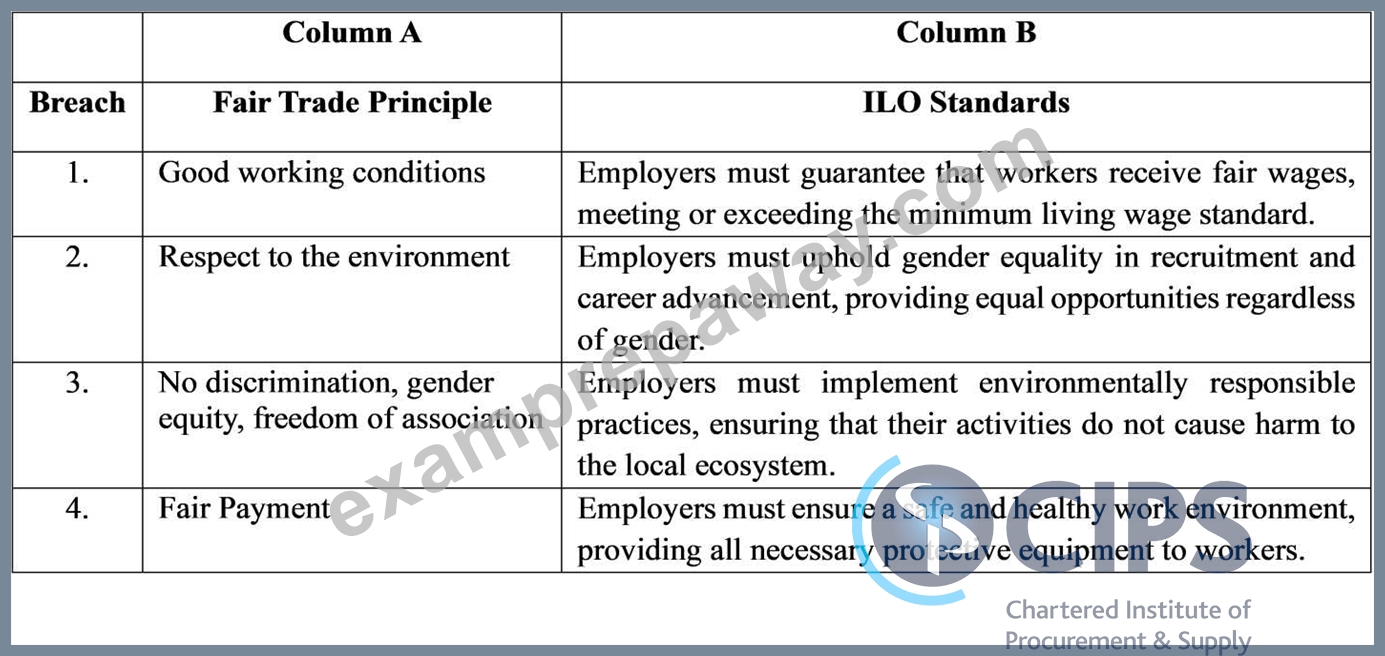
- A. Fair Payment: Workers must receive fair wages that meet the minimum living wage requirements.
- B. Respect to the environment: Employers must adopt practices that reduce environmental impact and ensure that the working environment does not harm the local ecosystem
- C. No discrimination, gender equity, freedom of association: Employers must ensure gender equality in hiring practices and provide equal opportunities for all workers, regardless of gender.
- D. Good working conditions: Workers must be provided with a safe working environment that meets all health and safety standards, including protective equipment
Answer: A,B,C,D
Explanation: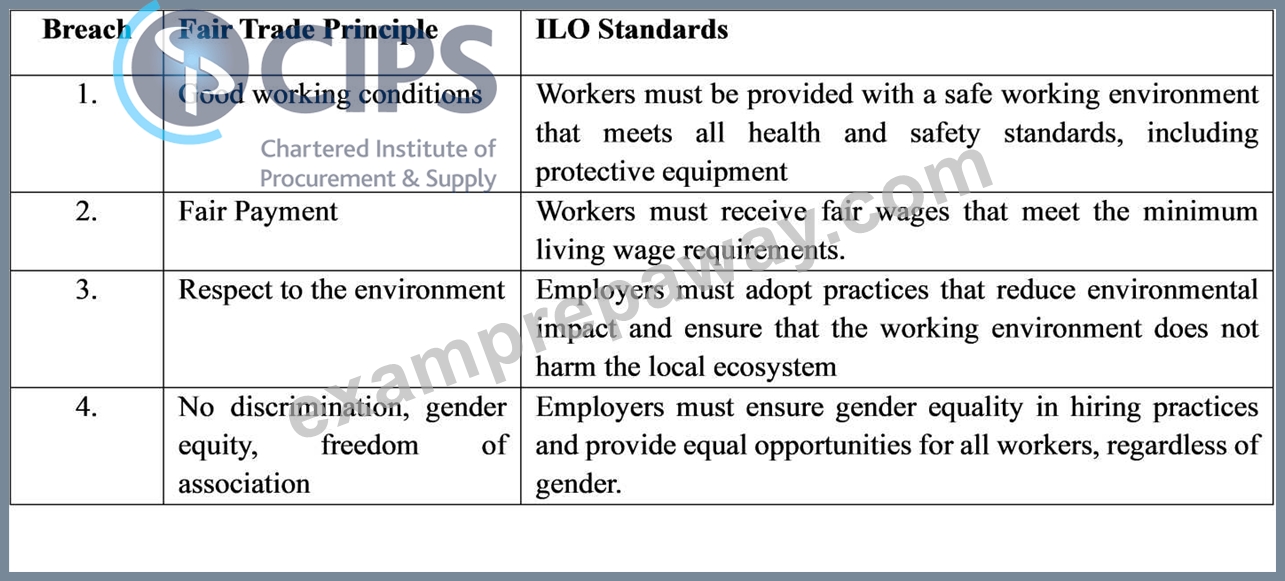
Good Working Conditions → A) Workers must be provided with a safe working environment that meets all health and safety standards, including protective equipment. The Fair-Trade principle of good working conditions emphasizes that workers should have access to a safe, healthy, and supportive work environment. ILO Principle A aligns with this by requiring safety measures such as protective equipment to ensure worker well-being. Fair Payment → C) Workers must receive fair wages that meet the minimum living wage requirements.
NEW QUESTION # 41
Forced labor, including all forms of modern slavery, remains a significant issue affecting many supply chains. Procurement professionals and suppliers must collaborate to effectively eliminate forced labor. Which of the following strategies can procurement professionals use to address forced labor practices?
1. Boycotting the goods produced from modern slavery
2. Inclusion of anti-slavery and human trafficking clauses in contracts
3. Training for employees and suppliers to raise awareness of slavery issues
4. Treat all women and men fairly at work
- A. 2 and 4
- B. 4 and 1
- C. 2 and 3
- D. 1 and 2
Answer: C
Explanation:
Choice 2- Inclusion of anti-slavery and human trafficking clauses in contracts requires a supplier to guarantee that it complies with anti slavery policy and performs due diligence on its own suppliers. Thus is the correct answer.
Choice 3- Providing education on the signs of forced labor and human trafficking can empower both employees and suppliers to recognize and report such practices. This is also an answer.
Incorrect answer:
Choice 1- Boycotting the goods produced from modern slavery is a role of the consumer and not a procurement professional.
Choice 4- Treat all women and men fairly at work is related to equality in a workplace and does not concern forced labor practices.
Reference:
LO-1.3; Page 91; Labor standards and working practices
NEW QUESTION # 42
The UK has introduced several pieces of legislation relevant to CSR. Which legislation ensures that employers keep their workers safe?
- A. Companies Act 2006
- B. Working Time (Amendment) Regulations 2001
- C. Disability Discrimination Act 1995
- D. Health and Safety at Work Act 1974
Answer: D
Explanation:
Comprehensive and Detailed Explanation From Exact Extract of Documents:
The Health and Safety at Work Act 1974 requires UK employers to ensure that working conditions are safe and that risks to health are managed. According to the L5M5 study guide (p.6), this includes duties such as accident prevention, safe use of equipment, and training employees. While the Working Time Regulations (A) relate to working hours, the Companies Act (B) covers corporate governance, and the Disability Discrimination Act (D) focuses on preventing discrimination, only the Health and Safety at Work Act specifically ensures safe conditions. Procurement professionals must be aware of this when selecting and monitoring suppliers, particularly in high-risk industries.
Reference: Managing Ethical Procurement and Supply (L5M5) Study Guide, p.6
NEW QUESTION # 43
A small tech startup (Startup A) is negotiating a partnership with a large corporation (Corp B). Corp B proposes to cover 80% of the development costs but requires Startup A to assume 90% of the risk in the event of product failure.
What is the most significant issue with Corp B's proposal in this negotiation?
- A. Corp B is offering a higher percentage of funding than Startup A
- B. The risk is disproportionately shared, placing an unfair burden on Startup A
- C. The partnership will likely lead to profit-sharing conflicts later
- D. Startup A will have limited control over the development process
Answer: B
Explanation:
Choice C- This is the correct answer. It highlights the main issue: Startup A is being asked to take on a significantly higher level of risk compared to their financial contribution, which is unfair and could lead to negative consequences for the startup.
Incorrect answer:
Choice A- While this statement is true, it doesn't address the core issue of risk distribution. Just because Corp B is contributing more funding doesn't justify imposing a heavier risk burden on Startup A.
Choice B- This option touches on potential control issues in the partnership. However, the primary concern in this scenario is not about control, but rather the fairness of the risk-sharing arrangement.
Choice D- While profit-sharing conflicts could arise from the arrangement, this option does not directly address the unfairness of the risk-sharing proposal. The primary problem lies in the unequal distribution of risk rather than potential future conflicts.
Reference:
LO-1.4; Page 130; Responsible use of power relationships
NEW QUESTION # 44
Which of the following are tools that can be used by procurement professionals to evaluate the sustainability risk of contracts, their relative linkages, complexity and also help to identify potential improvements?
1. Macro environmental audit
2. Supplier preferencing
3. Portfolio analysis
4. Supply chain mapping
- A. 1 and 3 only
- B. 2 and 4 only
- C. 3 and 4 only
- D. 1 and 2 only
Answer: C
Explanation:
Option 3- Portfolio analysis (e.g., Kraljic Matrix) categorizes purchases based on risk and value. It highlights complexity and prioritizes contracts needing attention but is less focused on sustainability unless explicitly incorporated into criteria.
Option 4- Supply chain mapping provides a visual representation of the supply chain, identifying sources of risk, including sustainability challenges. This is a direct and practical tool for assessing the complexity of contracts, linkages, and areas for improvement.
The most relevant tools for assessing sustainability risks and complexities in contracts are portfolio analysis and supply chain mapping. Therefore, the correct answer is Choice C.
Incorrect answer:
Option 1- This tool involves assessing external factors such as political, economic, social, technological, legal, and environmental (PESTLE) influences on procurement activities. It helps identify sustainability risks associated with external conditions, but it is not contract-specific.
Option 2- Supplier preferencing evaluates how suppliers perceive a buyer's business, determining whether the buyer is a core, strategic, nuisance, or exploitable customer. While useful for relationship management, it does not directly assess sustainability risks or contract linkages.
Reference:
LO-2.1; Page 155-163; Assess methods to achieve ESG standards to secure ethical and sustainable supply chains
NEW QUESTION # 45
Which of the following are principles of the Wine and Agricultural Ethical Trade Association (WIETA)? Select THREE
- A. Prohibition of forced labour
- B. Working hours shall not be excessive
- C. Regular employment to be provided
- D. A working environment free from risk
- E. Automatic sick pay
Answer: A,B,C
Explanation:
Comprehensive and Detailed Explanation From Exact Extract of Documents:
The Wine and Agricultural Ethical Trade Association (WIETA) is an organisation promoting fair trade and ethical practices in South Africa's wine industry. The L5M5 study guide (p.262) outlines WIETA's principles, which align with ILO standards. These include prohibition of forced labour, ensuring working hours are not excessive, and providing regular employment rather than temporary or exploitative contracts. Options D and E are not accurate-no workplace can be entirely free of risk, and sick pay is determined by national legislation, not WIETA. Procurement professionals working with agricultural sectors should be aware of such sector-specific ethical trade associations.
Reference: Managing Ethical Procurement and Supply (L5M5) Study Guide, p.262
NEW QUESTION # 46
Several UK-based companies operate in diverse production industries, each facing unique market structures and supplier dynamics when sourcing raw materials and negotiating contracts. The power balance between buyers and suppliers varies based on market conditions, supplier availability, and industry-specific factors.
Case A: GreenPasture Feeds Ltd
GreenPasture Feeds Ltd is one of many manufacturers producing cattle feed, with soybean meal as a key ingredient. However, the supply of soybean meal is controlled by a small number of vendors, giving them significant bargaining power. As a result, GreenPasture Feeds Ltd faces higher procurement costs due to supplier dominance in the market.
Case B: MedTech Biologics Ltd
MedTech Biologics Ltd develops a specialized vaccine that relies on a crucial active ingredient supplied by a single biotechnology firm in Germany. This exclusive dependency creates a strategic interdependence between MedTech Biologics Ltd and its sole supplier, requiring close collaboration to maintain an uninterrupted supply chain.
Case C: PlayMax Toy Manufacturing
PlayMax Toy Manufacturing produces plastic toys using a specialized food-grade plastic sourced from a few manufacturers. However, the plastic resin needed for production is widely available from numerous global suppliers. This abundance of supply options strengthens PlayMax's bargaining position, allowing the company to negotiate favorable procurement terms.
Case D: BrewMaster Coffee Company
BrewMaster Coffee Company specializes in premium instant coffee production. Since high-quality Arabica coffee beans are grown and supplied by producers across various regions worldwide, the company benefits from an extensive supplier base. This widespread availability gives BrewMaster a competitive edge in securing cost-effective and high-quality raw materials.
Using the provided options, complete the table by identifying the market structure for each case and determining the buyer-supplier power dynamic based on their level of dominance.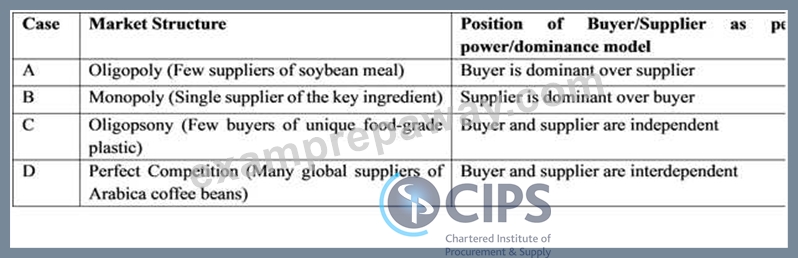
- A. Monopoly (Single supplier of the key ingredient): Buyer and supplier are interdependent
- B. Oligopoly (Few suppliers of soybean meal): Supplier is dominant over buyer
Answer: A,B
Explanation: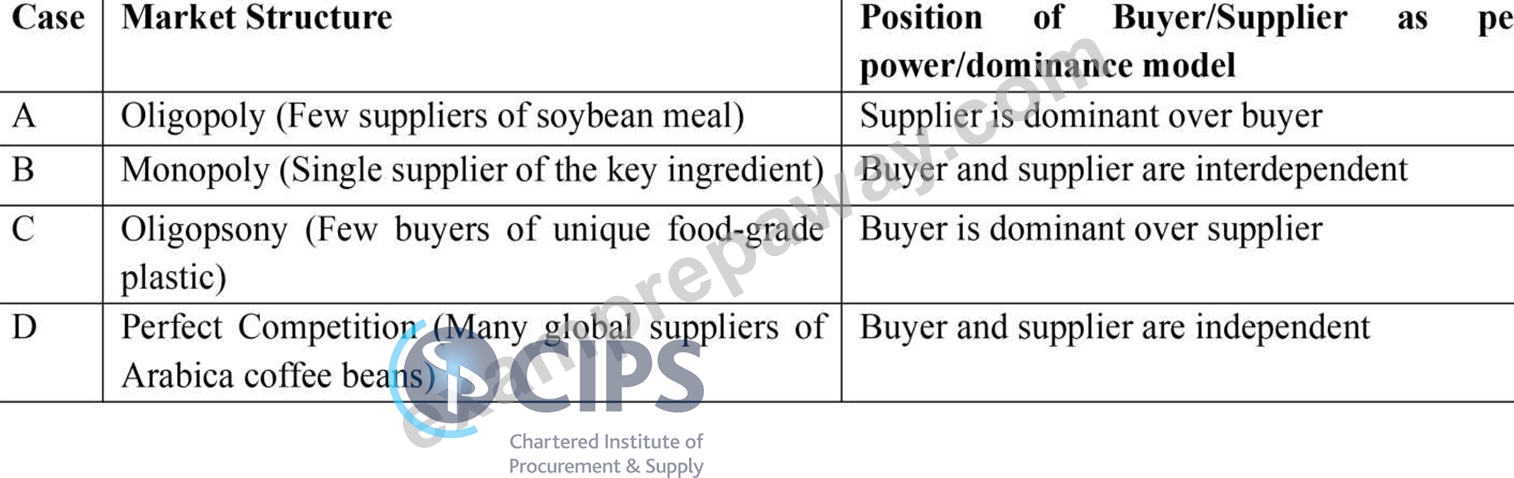
In the competitive world of production and supply chain management, companies must navigate diverse market structures and power dynamics when sourcing raw materials. The availability of suppliers, the number of buyers, and the overall industry landscape influence the negotiation power between buyers and suppliers. Below, we analyze four UK-based companies, exploring their market structures and the inherent power dynamics that shape their procurement strategies. Case A: GreenPasture Feeds Ltd - Supplier Dominance in an Oligopoly GreenPasture Feeds Ltd operates in the cattle feed manufacturing industry, where soybean meal is a critical raw material. Despite the presence of multiple cattle feed producers, the supply of soybean meal is controlled by a limited number of suppliers, creating an oligopoly on the supplier side. Market Structure: Oligopoly (Few suppliers controlling the market) Power Dynamic: Supplier is Dominant Over Buyer Due to the scarcity of suppliers and the high demand for soybean meal, GreenPasture Feeds Ltd has little leverage in price negotiations. Suppliers dictate procurement terms, leading to higher costs for buyers like GreenPasture Feeds Ltd. The limited choice in suppliers forces the company to comply with set conditions, highlighting the imbalance of power in favor of suppliers. Case B: MedTech Biologics Ltd - Mutual Dependence in a Monopoly MedTech Biologics Ltd specializes in manufacturing a rare vaccine, relying on a single biotechnology firm in Germany for a crucial active ingredient. Since this supplier is the sole producer of the required material, it operates as a monopoly on the supplier side. Market Structure: Monopoly (A single supplier dominates the market) Power Dynamic: Buyer and Supplier are Interdependent While the supplier holds significant power by being the only source of the ingredient, MedTech Biologics Ltd is also the exclusive manufacturer of this particular vaccine. This mutual exclusivity fosters interdependence, requiring both parties to collaborate strategically to ensure consistent supply and stable production. The relationship must be carefully managed to maintain operational continuity and mitigate supply chain risks. Case C: PlayMax Toy Manufacturing - Buyer's Advantage in an Oligopsony PlayMax Toy Manufacturing produces children's toys using a specialized food-grade plastic, available from only a few manufacturers. However, there are even fewer buyers for this specialized plastic, giving companies like PlayMax a strong bargaining position. This scenario creates an oligopsony, where a small number of buyers influence supplier behavior. Market Structure: Oligopsony (Few buyers exert influence over suppliers) Power Dynamic: Buyer is Dominant Over Supplier Since there are multiple suppliers but limited buyers for this specific type of plastic, PlayMax can dictate favorable procurement terms, negotiate better prices, and even switch suppliers if needed. The suppliers, reliant on a small customer base, have limited pricing power, placing them at a disadvantage in negotiations. This gives PlayMax a strong upper hand in procurement decisions. Case D: BrewMaster Coffee Company - Balanced Competition in a Perfect Market BrewMaster Coffee Company produces premium instant coffee, sourcing high-quality Arabica coffee beans from multiple global suppliers. With numerous buyers and suppliers operating in this market, no single entity can dominate pricing or supply, making it an example of perfect competition. Market Structure: Perfect Competition (Many buyers and sellers, no market control) Power Dynamic: Buyer and Supplier are Independent Due to the abundance of coffee producers, BrewMaster Coffee Company has flexibility in choosing suppliers based on quality, price, and ethical sourcing. Similarly, coffee bean producers are not reliant on a single buyer, as they can sell their beans to multiple companies. This results in a balanced and competitive relationship, where neither side holds significant power over the other.
NEW QUESTION # 47
Which piece of UK legislation includes a provision for transparency in a company's supply chain?
- A. Modern Slavery Act
- B. Working Time Directive
- C. Companies Act
- D. Health and Safety at Work Act
Answer: A
Explanation:
Comprehensive and Detailed Explanation From Exact Extract of Documents:
The Modern Slavery Act 2015 introduced a requirement for companies with turnover above £36 million to publish annual slavery and human trafficking statements, disclosing actions to ensure transparency in supply chains. The L5M5 study guide (old p.62, new p.90) stresses its role in combating forced labour and human trafficking. While the Companies Act (A) focuses on governance, the Working Time Directive (C) regulates working hours, and the Health and Safety Act (D) ensures workplace safety, only the Modern Slavery Act addresses supply chain transparency.
Reference: Managing Ethical Procurement and Supply (L5M5) Study Guide, p.90
NEW QUESTION # 48
......
CIPS L5M5 Exam Syllabus Topics:
| Topic | Details |
|---|---|
| Topic 1 |
|
| Topic 2 |
|
| Topic 3 |
|
New Real L5M5 Exam Dumps Questions: https://drive.google.com/open?id=1kw0vcRA3tuGq_7vTE6Y3Jnfa0aGRHMVc
Pass Your L5M5 Exam Easily with Accurate PDF Questions: https://www.examprepaway.com/CIPS/braindumps.L5M5.ete.file.html