

OGEA-103 PDF Download Apr-2025 The Open Group Test To Gain Brilliante Result!
Provide Updated The Open Group OGEA-103 Dumps as Practice Test and PDF
The Open Group is a global consortium that focuses on developing standards, certifications, and best practices for enterprise technology architecture. One of their most popular certifications is the TOGAF Enterprise Architecture (EA) certification. The TOGAF EA certification is split into two parts, Part 1 and Part 2. However, for those who want to take both parts in one exam, The Open Group offers the OGEA-103 (TOGAF Enterprise Architecture Combined Part 1 and Part 2) Exam.
The Open Group OGEA-103 (TOGAF Enterprise Architecture Combined Part 1 and Part 2) Certification Exam is a comprehensive certification program designed by the Open Group for professionals who want to develop their skills and knowledge in enterprise architecture. OGEA-103 exam is a combination of Part 1 and Part 2 of the TOGAF certification program, and it is designed to test the candidate's proficiency in the concepts, principles, and practices of enterprise architecture.
NEW QUESTION # 10
What component of the Architecture Repository represents architecture requirements agreed with the Architecture Board?
- A. Architecture Capability
- B. Governance Log
- C. Architecture Requirements Repository
- D. Reference Library
Answer: C
Explanation:
The Architecture Requirements Repository stores all the requirements that are output of the architecture development cycle, as well as the requirements that are input to the architecture development cycle1. The Architecture Requirements Repository includes the following types of requirements1:
* Stakeholder Requirements: These are the high-level requirements and expectations of the stakeholders, derived from the business drivers, goals, and objectives. They are captured and refined in the Architecture Vision phase and the Requirements Management phase.
* Architecture Requirements: These are the detailed requirements that specify what the architecture must do or deliver to meet the stakeholder requirements. They are derived and refined in the Business, Information Systems, and Technology Architecture phases.
* Implementation and Migration Requirements: These are the detailed requirements that specify what the implementation and migration projects must do or deliver to realize the architecture. They are derived and refined in the Opportunities and Solutions and Migration Planning phases.
The Architecture Requirements Repository is used to manage the architecture requirements throughout the architecture lifecycle, ensuring their traceability, consistency, and compliance1. The Architecture Board is the authority that reviews and approves the architecture requirements, as well as the architecture deliverables and artifacts, as part of the architecture governance process2.
NEW QUESTION # 11
Consider the following ADM phases objectives.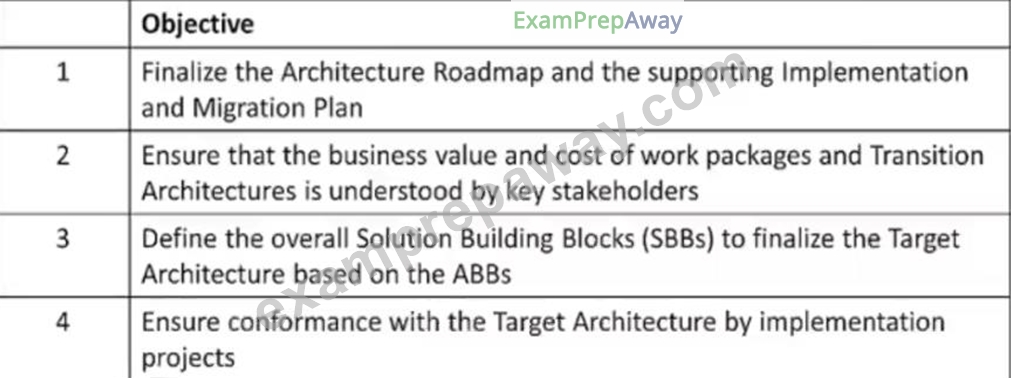
Which phase does each objective match?
- A. 1F-2G-3F-4F
- B. 1F-2F-3E-4G
- C. 1G-2E-3F-4E
- D. 1E-2F-3E-4G
Answer: D
Explanation:
1E: To identify delivery vehicles (projects programs portfolios) that will deliver the Target Architecture 2F: To confirm readiness and ability to undergo change 3E: To determine whether an incremental approach is required and if so identify Transition Architectures that will deliver continuous business value 4G: To perform appropriate governance functions while the solution is being implemented
NEW QUESTION # 12
Consider the image showing basic architectural concepts.
What are items A and B?
- A. A-Architecture Board, B-Architecture Capability
- B. A-Requirement. B-Candidate Architecture
- C. A-Candidate Architecture, B-Trade-off
- D. A-Architecture Viewpoint, B-Architecture View
Answer: D
Explanation:
The image shows a diagram that illustrates the basic concepts of architecture description as defined by the ISO/IEC/IEEE 42010:2011 standard1, which is also adopted by the TOGAF standard2.
According to the ISO/IEC/IEEE 42010:2011 standard, an architecture description is a work product used to express an architecture, and it consists of one or more architecture views1.
An architecture view is a representation of a system from the perspective of a related set of concerns, and it conforms to an architecture viewpoint1.
An architecture viewpoint is a specification of the conventions for constructing and using an architecture view to address specific stakeholder concerns1.
Therefore, the correct answer is option A, which identifies the items labeled as "A" and "B" in the image as an architecture viewpoint and an architecture view, respectively. Reference:
1: ISO/IEC/IEEE 42010:2011 - Systems and software engineering - Architecture description1
2: TOGAF Standard, Version 9.2 - Part IV: Architecture Content Framework - 31. Architectural Artifacts2
NEW QUESTION # 13
Consider the following statement.
According to the TOGAF standard, a governed approach of a particular deliverable will ensure adherence to the principles, standards, and requirements of the existing or developing architectures.
Which deliverable does this refer to?
- A. The Architecture Vision
- B. The Statement of Architecture Work
- C. The Architecture Definition Document
- D. An Architecture Contract
Answer: D
Explanation:
According to the TOGAF Standard, 10th Edition, an architecture contract is "a formal agreement between a service provider and a service consumer that defines the mutual commitments and expectations for the delivery of an architecture" 1. An architecture contract is a governed approach of aparticular deliverable that will ensure adherence to the principles, standards, and requirements of the existing or developing architectures, as it specifies the roles, responsibilities, deliverables, quality criteria, and acceptance criteria for the architecture work 1. The other options are not correct, as they are not governed approaches of a particular deliverable, but rather different types of deliverables within the architecture development process. An architecture vision is "a high-level, aspirational view of the target architecture" 1. A statement of architecture work is "a document that defines the scope and approach that will be used to complete an architecture project"
1. An architecture definition document is "a document that describes the baseline and target architectures for one or more domains" 1. References: 1: TOGAF Standard, 10th Edition, Part I: Introduction, Chapter 3:
Definitions.
NEW QUESTION # 14
Complete the sentence. The architecture domains that are considered by the TOGAF standard as subsets of an overall enterprise architecture are Business, Technology,
- A. Capability and Segment
- B. Application and Data
- C. Information and Data
- D. Logical and Physical
Answer: B
Explanation:
Explanation
These domains provide a consistent way to describe and understand the architecture from different perspectives, such as business, information, and technology12. Each domain has its own set of concepts, models, views, and artifacts that define the structure and behavior of the architecture within that domain12.
The other options are incorrect because:
*Logical and Physical are not architecture domains, but rather levels of abstraction that can be applied to any domain. Logical architecture describes the functionality and behavior of the system, while physical architecture describes the implementation and deployment of the system3.
*Information and Data are not distinct architecture domains, but rather aspects of the same domain.
Information architecture describes the meaning and context of the data, while data architecture describes the structure and format of the data4.
*Capability and Segment are not architecture domains, but rather levels of granularity that can be applied to any domain. Capability architecture describes the current and desired states of a specific business capability, while segment architecture describes a subdivision of the enterprise that has a clear business focus5.
References: 1: The TOGAF Standard, Version 9.2 - Definitions 2: TOGAF Standard - Introduction - Definitions 3: [Logical vs Physical Architecture] 4: [Information Architecture vs Data Architecture] 5: [The TOGAF Standard, Version 9.2 - Applying the ADM Across the Architecture Landscape]
NEW QUESTION # 15
Which section of the TOGAF template for Architecture Principles should describe the relationship to other principles?
- A. Implications
- B. Statement
- C. Name
- D. Rationale
Answer: A
Explanation:
The implications section of the TOGAF template for Architecture Principles should describe the relationship to other principles. Implications are statements that describe how a principle will impact other principles, as well as other aspects of the enterprise such as business processes, organizational structures, roles and responsibilities, standards, etc. Implications help to identify potential conflicts or synergies among principles and to assess their feasibility and applicability. Reference: The TOGAF Standard | The Open Group Website, Section 3.3.7 Architecture Principles.
NEW QUESTION # 16
In which phase of the ADM cycle do building blocks become implementation-specific?
- A. Phase C
- B. Phase B
- C. Phase E
- D. Phase D
Answer: C
Explanation:
Building blocks are reusable components of business, IT, or architectural capability that can be combined to deliver architectures and solutions. Building blocks can be defined at various levels of detail, depending on the stage of architecture development. In the earlier phases of the ADM cycle (A to D), building blocks are defined in generic terms, such as logical or physical, to provide a high-level view of the architecture. In Phase E: Opportunities and Solutions, building blocks become implementation-specific, meaning that they are linked to specific products, standards, technologies, and vendors that are available in the market. This phase also identifies the delivery vehicles, such as projects, programs, or portfolios, that will realize the building blocks12 Reference: 1: The TOGAF Standard, Version 9.2, Part II: Architecture Development Method (ADM), Chapter 23: Phase E: Opportunities and Solutions 2: The TOGAF Standard, Version 9.2, Part IV: Architecture Content Framework, Chapter 36: Building Blocks
NEW QUESTION # 17
Which of the following best describes the purpose of the Gap Analysis technique?
- A. To govern the architecture throughout its implementation process
- B. To allocate resources for architecture projects
- C. To identify items omitted from the Target Architecture
- D. To develop a set of general rules and guidelines for the architecture
Answer: C
Explanation:
Explanation
The purpose of the Gap Analysis technique is similar to the previous question, but with a focus on the Target Architecture. The technique helps to identify the items that are not included or specified in the Target Architecture, such as capabilities, services, components, standards, or technologies. These items may be essential for achieving the vision and goals of the enterprise, or for addressing the stakeholder concerns and requirements. By identifying the items omitted from the Target Architecture, the technique helps to ensure that the architecture is comprehensive, feasible, and realistic.
NEW QUESTION # 18
The_________________ensures that a project transitioning into implementation also smoothly transitions into appropriate Architecture Governance.
- A. Implementation Governance Model
- B. Transition Plan
- C. Implementation Strategy
- D. Migration Plan
Answer: A
Explanation:
The Implementation Governance Model is a framework that defines the roles, responsibilities, processes, and standards for governing the implementation of the target architecture. It ensures that a project transitioning into implementation also smoothly transitions into appropriate Architecture Governance, which is the practice of ensuring compliance with the enterprise architecture and its principles, standards, and goals. The Implementation Governance Model is part of the Implementation and Migration Plan, which is the output of Phase F: Migration Planning of the Architecture Development Method (ADM)12 References: 1: The TOGAF Standard, Version 9.2, Part II: Architecture Development Method (ADM), Chapter 21: Phase F: Migration Planning 2: The TOGAF Standard, Version 9.2, Part VI: Architecture Capability Framework, Chapter 50:
Architecture Governance
NEW QUESTION # 19
Which of the following is a responsibility of an Architecture Board?
- A. Creating the Statement of Architecture Work
- B. Establishing targets for re-use of components
- C. Conducting assessments of the maturity level of architecture discipline within the organization
- D. Allocating resources for architecture projects
Answer: C
Explanation:
Explanation
The Architecture Board is a governance body that oversees and supports the implementation of architectures within an organization. One of its responsibilities is to conduct assessments of the maturity level of architecture discipline within the organization using frameworks such as CMMI or ACMM. This helps to identify areas for improvement and monitor progress towards achieving higher levels of maturity. References:
https://pubs.opengroup.org/architecture/togaf9-doc/arch/chap44.html
NEW QUESTION # 20
Consider the following ADM phases objectives.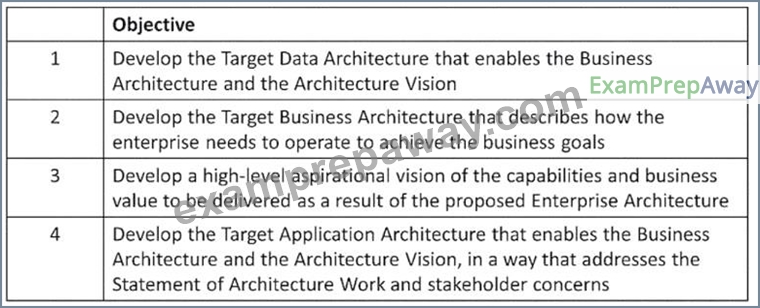
Which phase does each objective match?
- A. 1B-2D-3A-4C
- B. 1C-2D-3B-4A
- C. 1C-2B-3A-4C
- D. 1A-2B-3C-4D
Answer: C
Explanation:
* The objectives listed in the question correspond to the objectives of different phases of the TOGAF ADM (Architecture Development Method), which is a method for developing and managing an enterprise architecture1.
* The ADM consists of nine phases, each with a specific purpose and output. The phases are1:
* Preliminary Phase: To prepare and initiate the architecture development cycle, including defining the architecture framework, principles, and governance.
* Phase A: Architecture Vision: To define the scope, vision, and stakeholders of the architecture initiative, and to obtain approval to proceed.
* Phase B: Business Architecture: To describe the baseline and target business architecture, and to identify the gaps between them.
* Phase C: Information Systems Architectures: To describe the baseline and target data and application architectures, and to identify the gaps between them.
* Phase D: Technology Architecture: To describe the baseline and target technology architecture, and to identify the gaps between them.
* Phase E: Opportunities and Solutions: To identify and evaluate the opportunities and solutions for implementing the target architecture, and to define the work packages and transition architectures.
* Phase F: Migration Planning: To finalize the implementation and migration plan, and to ensure alignment with the enterprise portfolio and project management.
* Phase G: Implementation Governance: To provide architecture oversight and guidance for the implementation projects, and to manage any architecture change requests.
* Phase H: Architecture Change Management: To monitor the changes in the business and technology environment, and to assess the impact and performance of the architecture.
* Based on the above definitions, we can match each objective with the corresponding phase as follows:
* Objective 1: Develop the Target Data Architecture that enables the Business Architecture and the Architecture Vision. This objective is achieved in Phase C: Information Systems Architectures, where the data architecture is defined as a subset of the information systems architecture2.
* Objective 2: Develop the Target Business Architecture that describes how the enterprise needs to operate to achieve the business goals. This objective is achieved in Phase B: Business Architecture, where the business architecture is defined as a subset of the enterprise architecture3.
* Objective 3: Develop a high-level aspirational vision of the capabilities and business value to be delivered as a result of the proposed Enterprise Architecture. This objective is achieved in Phase A: Architecture Vision, where the architecture vision is defined as a high-level description of the target architecture and its benefits4.
* Objective 4: Develop the Target Application Architecture that enables the Business Architecture and the Architecture Vision, in a way that addresses the Statement of Architecture Work and stakeholder concerns. This objective is achieved in Phase C: Information Systems Architectures, where the application architecture is defined as a subset of the information systems architecture2.
References:
* 1: The TOGAF Standard, Version 9.2, Chapter 5: Architecture Development Method (ADM)
* 2: The TOGAF Standard, Version 9.2, Chapter 9: Phase C: Information Systems Architectures
* 3: The TOGAF Standard, Version 9.2, Chapter 8: Phase B: Business Architecture
* 4: The TOGAF Standard, Version 9.2, Chapter 7: Phase A: Architecture Vision
NEW QUESTION # 21
Complete the sentence The purpose of Enterprise Architecture is to_______________.
- A. govern the stakeholders
- B. take major improvement decisions
- C. guide effective change
- D. control the bigger changes
Answer: C
Explanation:
The purpose of Enterprise Architecture is to guide effective change by providing a coherent and consistent view of the enterprise's current and future state, as well as the roadmap and principles for achieving it.
Enterprise Architecture helps to align business and IT strategies, optimize resources and investments, reduce complexity and risks, enhance agility and innovation, and deliver value to stakeholders. Reference: The TOGAF Standard | The Open Group Website, Section 1.3 Executive Overview.
NEW QUESTION # 22
Please read this scenario prior to answering the question
You are the Chief Enterprise Architect at a large food service company specializing in sales to trade and wholesale, for example, restaurants and other food retailers.
One of your company's competitors has launched a revolutionary product range and is running a very aggressive marketing campaign. Your company's resellers are successively announcing that they are not interested in your company's products and will sell your competitor's.
The CEO has stated there must be significant change to address the situation. He has made it clear that new markets must be found for the company's products, and that the business needs to pivot, and address the retail market as well as the existing wholesale market.
A consideration is the company's ability and willingness to change its business model, and if it is a temporary or permanent change. An additional risk factor is one of culture. The company has been used to a stable business with a reasonably well known and settled client base - all with its own local understandings and practices.
The CEO is the sponsor of the EA program within the company. You have been engaged with the sales, logistics, production, and marketing teams, enabling the architecture activity to start. An Architecture Vision, Architecture Principles, and Requirements have all been agreed. As you move forward to develop a possible Target Architecture you have identified that some of the key stakeholders' preferences are incompatible. The incompatibilities are focused primarily on time-to-market, cost savings, and the need to bring out a fully featured product range, but there are additional factors.
Refer to the scenario
You have been asked how you will address the incompatibilities between key stakeholder preferences.
Based on the TOGAF standard which of the following is the best answer?
- A. You recommend that since the CEO has stated that the company must pivot, it is better to compromise on a full product range rather than time-to-market. You would develop just enough of the Target Architecture to demonstrate fitness of the proposed approach. You would limit the description to just where there is a gap between the current baseline. You would seek approval by the stakeholders to move forward with developing the Target Architecture in detail.
- B. You would seek to understand value preferences and priorities of the stakeholders. You would develop alternative Target Architectures, highlighting the gaps between current state and the alternatives. You would consider combining features from one or more alternatives in collaboration with the stakeholders. A formal stakeholder review should then be held to decide which alternative is fit for purpose and should be moved forward with. You will then secure the funding required.
- C. You would use the Architecture Vision, Principles, and Requirements to define a set of criteria for alternatives and create a set of architecture views to illustrate the impact of the alternative Target Architectures. You would identify the impact on planned projects. You would understand the strengths and weaknesses of the alternatives. You would conduct a formal stakeholder review to decide which alternative to move forward with. You will determine the funding required.
- D. You would review the Stakeholder Map and ensure that you have addressed and represented the concerns of all department heads. You will involve them in resolving the incompatibilities. The Communications Plan should include a report that summarizes the key features of the architecture with and how incompatibilities were resolved to reflects the stakeholders' requirements. You will check with each key stakeholder they are satisfied with how the incompatibilities have been resolved.
Answer: C
Explanation:
According to the TOGAF standard, the Target Architecture is the description of a future state of the architecture being developed for an organization. It should be aligned with the Architecture Vision, Principles, and Requirements that have been agreed with the stakeholders. To address the incompatibilities between key stakeholder preferences, the TOGAF standard recommends creating and evaluating multiple alternative Target Architectures that meet different sets of criteria. These criteria should reflect the value preferences and priorities of the stakeholders, as well as the business drivers and objectives. The alternative Target Architectures should be illustrated using a set of architecture views that show the impact of each alternative on the business, data, application, and technology domains. The impact on planned projects should also be identified and analyzed. The strengths and weaknesses of each alternative should be understood and documented. A formal stakeholder review should then be conducted to decide which alternative is the most fit for purpose and should be moved forward with. The funding required for implementing the chosen alternative should also be determined and secured. References:
* The TOGAF Standard, Version 9.2 - Phase B: Business Architecture - The Open Group
* The TOGAF Standard, Version 9.2 - Phase C: Information Systems Architectures - The Open Group
* [The TOGAF Standard, Version 9.2 - Phase D: Technology Architecture - The Open Group]
* [The TOGAF Standard, Version 9.2 - Phase E: Opportunities and Solutions - The Open Group]
* [The TOGAF Standard, Version 9.2 - Phase F: Migration Planning - The Open Group]
NEW QUESTION # 23
Complete the sentence Business Transformation Readiness Assessment is_________________.
- A. a joint effort between corporate staff lines of business and IT planners
- B. a way to put building blocks into context thereby supporting re-usable solutions
- C. widely used to validate an architecture that is being developed
- D. to ensure the active support of powerful stakeholders
Answer: A
Explanation:
Explanation
Business Transformation Readiness Assessment is a joint effort between corporate staff lines of business and IT planners to evaluate the readiness of the organization to undergo change. It involves assessing factors such as vision, commitment, capacity, capability, culture, and motivation that may influence the success of a business transformation initiative. Reference: The TOGAF Standard | The Open Group Website, Section
3.3.2 Business Transformation Readiness Assessment.
NEW QUESTION # 24
When considering the scope of an architecture, what dimension considers to what level of detail the architecting effort should go?
- A. Project
- B. Depth
- C. Breadth
- D. Architecture Domains
Answer: B
Explanation:
The scope of an architecture is the extent and level of detail of the architecture work. The scope of an architecture can be defined along four dimensions: project, breadth, depth, and architecture domains. The project dimension considers the boundaries and objectives of the architecture project, such as the time frame, budget, resources, and deliverables. The breadth dimension considers the coverage and completeness of the architecture across the enterprise, such as the organizational units, business functions, processes, and locations. The depth dimension considers the level of detail and specificity of the architecture, such as the granularity, abstraction, and precision of the architectural elements and relationships. The architecture domains dimension considers the aspects or segments of the architecture, such as the business, data, application, and technology domains.
Therefore, the depth dimension is the one that considers to what level of detail the architecting effort should go.
References: : The TOGAF Standard, Version 9.2, Part III: ADM Guidelines and Techniques, Chapter 25:
Architecture Scope : The TOGAF Standard, Version 9.2, Part III: ADM Guidelines and Techniques, Chapter
25.2: Scope Dimensions : The TOGAF Standard, Version 9.2, Part III: ADM Guidelines and Techniques, Chapter 25.2.1: Project, Breadth, Depth, and Architecture Domains
NEW QUESTION # 25
What is an objective of the ADM Implementation Governance Phase?
- A. To ensure conformance for the target architecture
- B. To finalize the Implementation and Migration Plan
- C. To provide continual monitoring of the governance framework
- D. To establish the resources for architecture governance
Answer: A
Explanation:
Explanation
The objective of the ADM Implementation Governance Phase is to provide an architectural oversight of the implementation and to ensure conformance for the target architecture. This phase involves establishing procedures and processes to monitor and control the implementation projects and to verify that they comply with the defined architecture. Reference: The TOGAF Standard | The Open Group Website, Section 3.2.7 Phase G: Implementation Governance.
NEW QUESTION # 26
Exhibit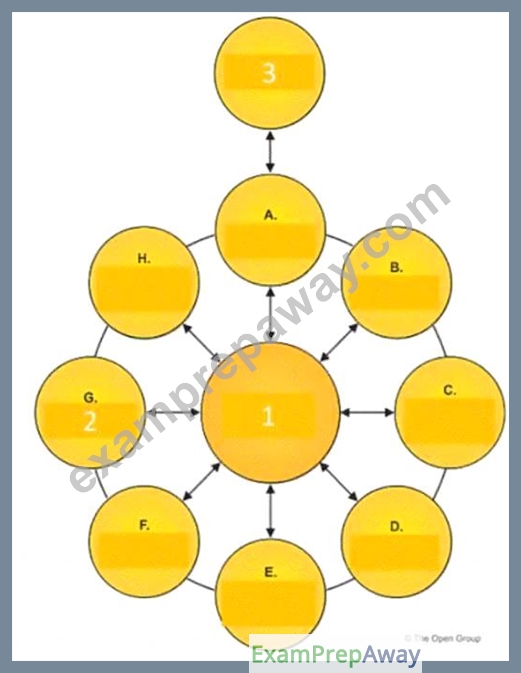
Consider the illustration showing an architecture development cycle Which description matches the phase of the ADM labeled as item 1?
- A. Operates the process of managing architecture requirements
- B. Provides architectural oversight for the implementation
- C. Conducts implementation planning for the architecture defined in previous phases
- D. Establishes procedures for managing change to the new architecture
Answer: A
Explanation:
Explanation
The illustration shows an architecture development cycle based on the TOGAF ADM (Architecture Development Method), which is a method for developing and managing an enterprise architecture1.
The ADM consists of nine phases, each with a specific purpose and output. The phases are1:
Preliminary Phase: To prepare and initiate the architecture development cycle, including defining the architecture framework, principles, and governance.
Phase A: Architecture Vision: To define the scope, vision, and stakeholders of the architecture initiative, and to obtain approval to proceed.
Phase B: Business Architecture: To describe the baseline and target business architecture, and to identify the gaps between them.
Phase C: Information Systems Architectures: To describe the baseline and target data and application architectures, and to identify the gaps between them.
Phase D: Technology Architecture: To describe the baseline and target technology architecture, and to identify the gaps between them.
Phase E: Opportunities and Solutions: To identify and evaluate the opportunities and solutions for implementing the target architecture, and to define the work packages and transition architectures.
Phase F: Migration Planning: To finalize the implementation and migration plan, and to ensure alignment with the enterprise portfolio and project management.
Phase G: Implementation Governance: To provide architecture oversight and guidance for the implementation projects, and to manage any architecture change requests.
Phase H: Architecture Change Management: To monitor the changes in the business and technology environment, and to assess the impact and performance of the architecture.
In addition to these phases, there is a central process called Requirements Management, which is labeled as item 1 in the illustration. This process operates throughout the ADM cycle, and its purpose is to manage the architecture requirements throughout the architecture development, ensuring that they are aligned with the business requirements and the stakeholder concerns2.
Therefore, the description that matches the phase of the ADM labeled as item 1 is C. Operates the process of managing architecture requirements.
References:
1: The TOGAF Standard, Version 9.2, Chapter 5: Architecture Development Method (ADM)
2: The TOGAF Standard, Version 9.2, Chapter 17: Requirements Management
NEW QUESTION # 27
Consider the following statement:
According to the TOGAF Standard a governed approach of a particular deliverable will ensure a system of continuous monitoring to check integrity changes decision-making and audit of all architecture-related activities Which deliverable is being referred to?
- A. The Architecture Vision
- B. The Statement of Architecture Work
- C. The Architecture Definition Document
- D. An Architecture Contract
Answer: D
Explanation:
An Architecture Contract is a deliverable that specifies the responsibilities and obligations of the parties involved in the implementation and governance of an architecture. It ensures a system of continuous monitoring to check integrity changes decision-making and audit of all architecture-related activities. Reference: The TOGAF Standard | The Open Group Website, Section 3.3.4 Architecture Contracts.
NEW QUESTION # 28
Please read this scenario prior to answering the question
You are working as Chief Enterprise Architect at a large Internet company. The company has many divisions, ranging from cloud to logistics. The company has grown rapidly, expanding from initially selling physical books and media to a range of services including an online marketplace, live-streaming. eBooks. and cloud services.
Overall management of the numerous divisions has become challenging. Recent high-profile projects have overrun on budget and under delivered, damaging the company's reputation, and adversely impacting its share price. There is a widely held view within the executive management that the organization structure has played a major role in these project failures.
The company has an established Enterprise Architecture program based on the TOGAF standard, sponsored jointly by the Chief Executive Officer (CEO) and Chief Information Officer (CIO). The CEO has decided that the company needs to reorganize its divisions around artificial intelligence and machine learning with a focus on automation. The CEO has worked with the Enterprise Architects to create a strategic architecture for the reorganization, including an Architecture Vision, together with definitions for the four domain architectures.
This sets out an ambitious vision of the future of the company over a three-year period. This includes a set of work packages and includes three distinct transformations.
The CIO has made it clear that prior to the approval of the detailed Implementation and Migration plan, the EAteam will need to assess the risks associated with the proposed architecture. He has received concerns from key stakeholders across the company that the proposed reorganization may be too ambitious and there is doubt whether it can produce sufficient value to warrant the risks.
Refer to the scenario
You have been asked to recommend an approach to satisfy these concerns. Based on the TOGAF Standard, which of the following is the best answer?
- A. Establishing interoperability in alignment with the corporate operating model will ensure risks are minimized. The Enterprise Architects should apply an interoperability analysis to evaluate any potential issues across the architecture. This should include the development of a matrix showing the interoperability requirements. These can then be included within the transformation strategy embedded in the target transition architectures. The Enterprise Architects should then finalize the Architecture Roadmap and the Implementation and Migration Plan.
- B. Before preparing the detailed Implementation and Migration plan, the Enterprise....
- C. The Enterprise Architects should evaluate the organization's readiness to undergo change. This will allow the risks associated with the transformations to be identified, classified, and mitigated for. This should include identifying dependencies between the set of changes, including gaps and work packages.
It will also identify improvement actions to be worked into the Implementation and Migration Plan. The business value, effort, and risk associated for each transformation should be determined. - D. The Enterprise Architects should bring together information about potential approaches and produce several alternative target transition architectures. They should then investigate the different architecture alternatives and discuss these with stakeholders using the Architecture Alternatives and Trade-offs technique. Once the target architecture has been selected, it should be analyzed using a state evolution table to determine the Transition Architectures. A value realization process should then be established to ensure that the concerns raised are addressed.
Answer: C
Explanation:
Explanation
The Business Transformation Readiness Assessment is a technique that can be used to evaluate the readiness of the organization to undergo change and to identify the actions needed to increase the likelihood of a successful business transformation. This technique can help to address the concerns of the key stakeholders about the risks and value of the proposed reorganization. The technique involves assessing the following aspects of the organization: vision, commitment, capacity, capability, culture, and communication. Based on the assessment, the risks associated with the transformations can be identified, classified, and mitigated for.
The technique also helps to identify the dependencies between the set of changes, including gaps and work packages, and the improvement actions to be worked into the Implementation and Migration Plan. The technique also supports the determination of the business value, effort, and risk associated for each transformation, which can be used to prioritize and sequence the work packages and the Transition Architectures1 References: 1: The TOGAF Standard, Version 9.2, Part III: ADM Guidelines and Techniques, Chapter 27: Business Transformation Readiness Assessment
NEW QUESTION # 29
Consider the following statement.
Projects may cycle between ADM phases, in planned cycles covering multiple phases.
What does it illustrate?
- A. Iteration
- B. Requirements management
- C. Enterprise Architecture
- D. Implementation governance
Answer: A
Explanation:
The statement "Projects may cycle between ADM phases, in planned cycles covering multiple phases" illustrates the concept of iteration, which is the process of repeating the ADM phases or steps within a phase to refine the architecture outputs and address the changing requirements and stakeholder concerns. Iteration can occur at different levels of granularity and scope, such as within a single phase, across multiple phases, or across the entire ADM cycle. Iteration can also be applied to different architecture domains, such as business, data, application, and technology. Iteration is a key feature of the ADM that enables the development of architectures that are fit for purpose, adaptable, and responsive to change. References: : The TOGAF Standard, Version 9.2, Part III: ADM Guidelines and Techniques, Chapter 24: Applying Iteration to the ADM
NEW QUESTION # 30
Which of the following best describes the purpose of the Architecture Roadmap?
- A. It is sent from the sponsor and triggers the start of an architecture development cycle
- B. It provides for effective communication of the end architecture project to the stakeholders
- C. It forms the basis of a contractual agreement between the sponsor and the architecture organization
- D. It lists work packages on a timeline showing progress towards the Target Architecture
Answer: D
Explanation:
The purpose of the Architecture Roadmap is to provide a high-level view of how the Baseline Architecture will transition to the Target Architecture over time. It lists work packages on a timeline showing progress towards the Target Architecture, as well as dependencies, risks, and benefits. The Architecture Roadmap forms part of the Implementation and Migration Plan and guides the execution of the architecture projects.References:https://pubs.opengroup.org/architecture/togaf9-doc/arch/chap20.html
NEW QUESTION # 31
Please read this scenario prior to answering the question
You have been appointed as Chief Enterprise Architect (CEA). reporting to the Chief Technical Officer (CTO), of a company established as a separate operating entity by a major automotive manufacturer. The mission of the company is to build a new industry leading unified technology and software platform for electric vehicles.
The company uses the TOGAF Standard as the basis for its Enterprise Architecture (EA) framework, and architecture development follows the purpose-based EA Capability model as described in the TOGAF Series Guide: A Practitioners'Approach to Developing Enterprise Architecture Following the TOGAF ADM.
An end-to-end Target Architecture has been completed with a roadmap for change over a five-year period.
The new platform will be a cross-functional effort between hardware and software teams, with significant changes over the old platform. It is expected to be developed in several stages over three years. The EA team has inherited the architecture for the previous generation hardware and software automotive platform, some of which can be carried over to the new unified platform. The EA team has started to define the new platform, including defining which parts of the architecture to carry forward.
Enough of the Business Architecture has been defined, so that work can commence on the Information Systems and Technology Architectures. Those need to be defined to support the core business services that the company plans to provide. The core services will feature an innovative approach with swarm data generated by vehicles, paving the way for autonomous driving in the future.
The presentation and access to different variations of data that the company plans to offer through its platform pose an architecture challenge. The application portfolio and supporting infrastructure need to interact with various existing cloud services and data- Refer to the scenario You have been asked what approach should be taken to determine and organize the work to deliver the requested architectures?
Based on the TOGAF standard which of the following is the best answer?
- A. You would look outside the enterprise to research data models and application portfolios of leading big data businesses. You would develop just enough applications, data, and technology architecture to identify options. For each project this should include identification of candidate architecture and solution building blocks. You will identify solution providers, perform a readiness assessment, and assess the viability and fitness of the solution options. You will then document the draft Implementation and Migration plan.
- B. You will revisit ADM Phase A. identifying the stakeholders and creating a new Architecture Vision.
You will update the Stakeholder map produced for the strategic architecture so it reflects the stakeholders who are now the most relevant to the projects that are to be developed. You would then ask the CTO to make some decisions about the Architecture Roadmap, and update the Implementation and Migration Plan to reflect the decisions. - C. You would refer to the end-to-end Target Architecture for guidance and direction. The first objective should be to identify projects, dependencies and synergies, then prioritize before initiating the projects.
You will develop high-level architecture descriptions. For each project you would estimate effort size, identify reference architectures, and candidate building blocks. You will identify the resource needs considering cost and value. You will document options, risks, and controls to enable viability analysis and trade-off with the stakeholders. - D. You will research leading data businesses, developing high-level Target Data, Application and Technology Architectures. You would review the Architecture Vision in order to estimate the level of detail, time, and breadth of the ADM cycle phases that will be needed to develop the architecture. You will identify and cost major work packages, and then develop an Architecture Roadmap. You would then seek approval by the Architecture Board and initiate the project.
Answer: C
Explanation:
The Target Architecture is a description of the future state of the architecture that addresses the business goals and drivers, and satisfies the stakeholder requirements and concerns. The Target Architecture is developed through the Architecture Development Method (ADM), which is the core process of the TOGAF standard that guides the development and management of the enterprise architecture. The Target Architecture is typically divided into four domains: Business, Data, Application, and Technology. The Target Architecture also includes a roadmap for change, which defines the Transition Architectures, the Capability Increments, and the work packages that enable the transition from the Baseline Architecture to the Target Architecture12 The best answer is B, because it describes the approach that should be taken to determine and organize the work to deliver the requested architectures, which are the Information Systems and Technology Architectures.
The answer covers the following steps:
* Refer to the end-to-end Target Architecture for guidance and direction. The end-to-end Target Architecture provides the overall vision, scope, and objectives of the architecture work, and the alignment with the business strategy and goals. The end-to-end Target Architecture also provides the high-level definitions and principles for the four architecture domains, and the roadmap for change that outlines the major milestones and deliverables.
* Identify projects, dependencies and synergies, then prioritize before initiating the projects. Projects are the units of work that implement the architecture work packages, which are the sets of actions or tasks that are required to implement a specific part of the architecture. Dependencies are the relationships and constraints that affect the order or priority of the projects, such as logical, temporal, or resource dependencies. Synergies are the benefits or advantages that result from the combination or coordination of the projects, such as cost savings, efficiency gains, or innovation opportunities. Prioritization is the process of ranking the projects according to their importance, urgency, or value, and assigning resources and schedules accordingly.
* Develop high-level architecture descriptions. High-level architecture descriptions are the outputs of the architecture development phases (B, C, and D) of the ADM cycle, which describe the Business, Data, Application, and Technology Architectures in terms of the Architecture Building Blocks (ABBs) and the Solution Building Blocks (SBBs), which are reusable components of business, IT, or architectural capability. High-level architecture descriptions also include the Architecture Views, which are representations of the system of interest from the perspective of one or more stakeholders and their concerns.
* For each project, estimate effort size, identify reference architectures, and candidate building blocks.
Effort size is the measure of the amount of work, time, or resources required to complete a project.
Effort size can be estimated using various techniques, such as analogy, expert judgment, parametric, or bottom-up. Reference architectures are standardized architectures that provide a common framework and vocabulary for a specific domain or industry. Reference architectures can be used as a source of best practices, patterns, and models for the architecture development. Candidate building blocks are the potential ABBs or SBBs that can be used to implement the architecture. Candidate building blocks can be identified from the Architecture Repository, which is a collection of architecture assets, such as models, patterns, principles, standards, and guidelines.
* Identify the resource needs considering cost and value. Resource needs are the specifications and criteria that define the acceptable level and quality of the resources required to complete the project, such as human, financial, physical, or technological resources. Resource needs can be identified by analyzing the scope, complexity, and dependencies of the project, and the availability, capability, and suitability of the resources. Cost and value are the factors that influence the allocation and utilization of the resources, such as the budget, the return on investment, the benefits, or the risks.
* Document options, risks, and controls to enable viability analysis and trade-off with the stakeholders.
Options are the alternative ways of achieving the project objectives, such as different solutions, technologies, vendors, or approaches. Risks are the effects of uncertainty on the project objectives, such as threats or opportunities. Controls are the measures or actions that are taken to prevent, reduce, or mitigate the risks, such as policies, procedures, or standards. Viability analysis is the process of evaluating and comparing the options, risks, and controls, and determining the feasibility, suitability, and desirability of each option. Trade-off is the decision outcome that balances and reconciles the multiple, often conflicting, requirements and concerns of the stakeholders, and ensures alignment with the Architecture Vision and the Architecture Principles.
References: 1: The TOGAF Standard, Version 9.2, Part II: Architecture Development Method (ADM), Chapter 5: Introduction to the ADM 2: The TOGAF Standard, Version 9.2, Part IV: Architecture Content Framework, Chapter 36: Building Blocks : The TOGAF Standard, Version 9.2, Part II: Architecture Development Method (ADM), Chapter 18: Phase A: Architecture Vision : The TOGAF Standard, Version
9.2, Part II: Architecture Development Method (ADM), Chapter 19: Phase B: Business Architecture : The TOGAF Standard, Version 9.2, Part II: Architecture Development Method (ADM), Chapter 20: Phase C:
Information Systems Architectures : The TOGAF Standard, Version 9.2, Part II: Architecture Development Method (ADM), Chapter 21: Phase F: Migration Planning : The TOGAF Standard, Version 9.2, Part III:
ADM Guidelines and Techniques, Chapter 23: Architecture Principles : The TOGAF Standard, Version 9.2, Part III: ADM Guidelines and Techniques, Chapter 30: Trade-Off Analysis : The TOGAF Standard, Version
9.2, Part VI: Architecture Capability Framework, Chapter 46: Tools for Architecture Development : The TOGAF Standard, Version 9.2, Part VI: Architecture Capability Framework, Chapter 47: Architecture Board :
The TOGAF Standard, Version 9.2, Part VI: Architecture Capability Framework, Chapter 48: Architecture Compliance : The TOGAF Standard, Version 9.2, Part VI: Architecture Capability Framework, Chapter 49:
Architecture Contract : The TOGAF Standard, Version 9.2, Part VI: Architecture Capability Framework, Chapter 50: Architecture Governance : The TOGAF Standard, Version 9.2, Part VI: Architecture Capability Framework, Chapter 51: Architecture Maturity Models : The TOGAF Standard, Version 9.2, Part VI:
Architecture Capability Framework, Chapter 52: Architecture Skills Framework
NEW QUESTION # 32
What are the four architecture domains that the TOGAF standard deals with?
- A. Application, Data, Information, Knowledge
- B. Capability, Segment, Enterprise, Federated
- C. Baseline, Candidate, Transition, Target
- D. Business, Data, Application, Technology
Answer: D
Explanation:
The TOGAF standard divides Enterprise Architecture into four primary architecture domains: business, data, application, and technology. These domains represent different aspects of an enterprise and how they relate to each other. The business domain defines the business strategy, governance, organization, and key business processes. The data domain describes the structure of the logical and physical data assets and data management resources. The application domain provides a blueprint for the individual applications to be deployed, their interactions, and their relationships to the core business processes. The technology domain describes the logical software and hardware capabilities that are required to support the deployment of business, data, and application services. Other domains, such as motivation, security, or governance, may span across these four primary domains. Reference:
The TOGAF Standard, Version 9.2 - Core Concepts
Domains - The Open Group
TOGAF Standard - Introduction - Definitions - The Open Group
The TOGAF Standard, Version 9.2 - Definitions - The Open Group
TOGAF and the history of enterprise architecture | Enable Architect
NEW QUESTION # 33
......
The format of the OGEA-103 exam is a closed-book, multiple-choice exam that lasts for four hours. OGEA-103 exam is split into two sections, and the passing score for each section is 60%. OGEA-103 exam can be taken at authorized test centers or online. Upon passing the exam, individuals will receive their TOGAF Enterprise Architecture certification, which is globally recognized and highly regarded in the industry.
OGEA-103 Dumps are Available for Instant Access: https://www.examprepaway.com/TheOpenGroup/braindumps.OGEA-103.ete.file.html
Valid OGEA-103 Dumps for Helping Passing OGEA-103 Exam!: https://drive.google.com/open?id=1wgJx2e1IKKZGuFrVBSDhrnRsxTUdEFe-