

[May 23, 2024] Latest MS-102 Exam with Accurate Microsoft 365 Administrator PDF Questions
Practice To MS-102 - ExamPrepAway Remarkable Practice On your Microsoft 365 Administrator Exam
Microsoft MS-102 Exam Syllabus Topics:
| Topic | Details |
|---|---|
| Topic 1 |
|
| Topic 2 |
|
| Topic 3 |
|
| Topic 4 |
|
| Topic 5 |
|
| Topic 6 |
|
| Topic 7 |
|
| Topic 8 |
|
| Topic 9 |
|
| Topic 10 |
|
| Topic 11 |
|
| Topic 12 |
|
NEW QUESTION # 174
You have a Microsoft 365 E5 subscription that includes the following active eDiscovery case:
Name: Case1
Included content: Group1, User1, Site1
Hold location: Exchange mailboxes, SharePoint sites, Exchange public folders The investigation for Case1 completes, and you close the case.
What occurs after you close Case1? To answer, select the appropriate options in the answer area.
NOTE: Each correct selection is worth one point.
Answer:
Explanation:
Explanation
Graphical user interface, text, application Description automatically generated
Reference:
https://docs.microsoft.com/en-us/microsoft-365/compliance/close-or-delete-case?view=o365-worldwide
NEW QUESTION # 175
Note: This question is part of a series of questions that present the same scenario. Each question in the series contains a unique solution that might meet the stated goals. Some question sets might have more than one correct solution, while others might not have a correct solution.
After you answer a question in this section, you will NOT be able to return to it. As a result, these questions will not appear in the review screen.
Your network contains an on-premises Active Directory domain named contoso.com. The domain contains the users shown in the following table.
The domain syncs to an Azure AD tenant named contoso.com as shown in the exhibit. (Click the Exhibit tab.)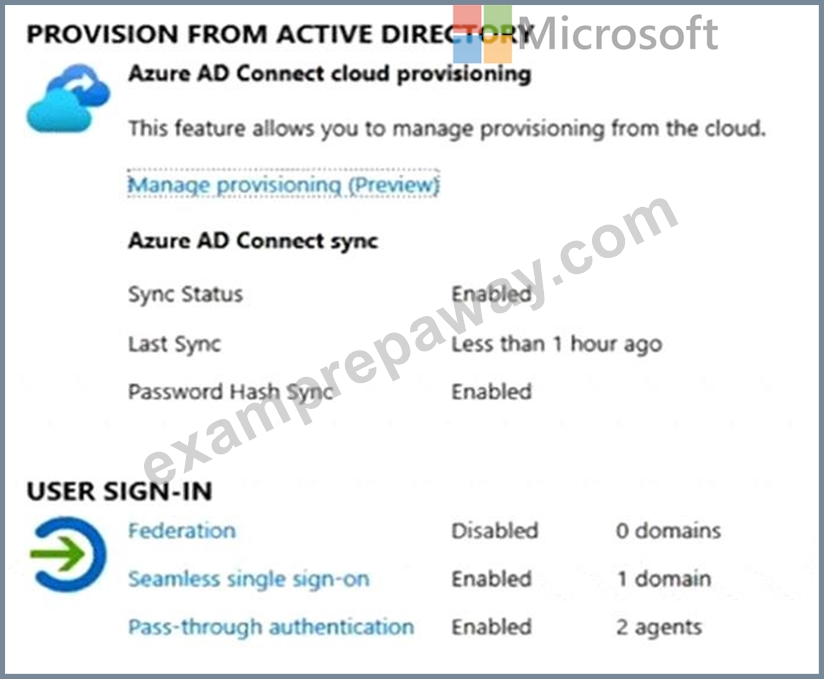
User2 fails to authenticate to Azure AD when signing in as [email protected].
You need to ensure that User2 can access the resources in Azure AD.
Solution: From the on-premises Active Directory domain, you set the UPN suffix for User2 to @contoso.com.
You instruct User2 to sign in as [email protected].
Does this meet the goal?
- A. Yes
- B. No
Answer: A
Explanation:
Explanation
The on-premises Active Directory domain is named contoso.com. You can enable users to sign on using a different UPN (different domain), by adding the domain to Microsoft 365 as a custom domain. Alternatively, you can configure the user account to use the existing domain (contoso.com).
NEW QUESTION # 176
HOTSPOT
Your company has a Microsoft 365 E5 subscription.
You need to perform the following tasks:
View the Adoption Score of the company.
Create a new service request to Microsoft.
Which two options should you use in the Microsoft 365 admin center? To answer, select the appropriate options in the answer area.
NOTE: Each correct selection is worth one point.
Answer:
Explanation:
Explanation
Box 1: Reports
View the Adoption Score of the company.
How to enable Adoption Score
To enable Adoption Score:
Sign in to the Microsoft 365 admin center as a Global Administrator and go to Reports > Adoption Score Select enable Adoption Score. It can take up to 24 hours for insights to become available.
Box 2: Support
Create a new service request to Microsoft.
Sign in to Microsoft 365 with your Microsoft 365 admin account, and select Support > New service request. If you're in the admin center, select Support > New service request.
Reference:
https://learn.microsoft.com/en-us/microsoft-365/admin/adoption/adoption-score
https://support.microsoft.com/en-us/topic/contact-microsoft-office-support-fd6bb40e-75b7-6f43-d6f9-c13d10850
NEW QUESTION # 177
HOTSPOT
You have a Microsoft 365 tenant.
You plan to create a retention policy as shown in the following exhibit.
Use the drop-down menus to select the answer choice that completes each statement based on the information presented in the graphic.
NOTE: Each correct selection is worth one point.
Answer:
Explanation:
Explanation
Box 1: Deleted seven years after they were created.
From the exhibit:
The retention policy applies to SharePoint sites.
Delete items that are older than 7 years based on when they were created.
Box 2: data will retained for a minimum of seven years
The longest retention period wins. If content is subject to multiple retention settings that retain content for different periods of time, the content will be retained until the end of the longest retention period for the item.
Note: Use a retention policy to assign the same retention settings for content at a site or mailbox level, and use a retention label to assign retention settings at an item level (folder, document, email).
For example, if all documents in a SharePoint site should be retained for 5 years, it's more efficient to do this with a retention policy than apply the same retention label to all documents in that site. However, if some documents in that site should be retained for 5 years and others retained for 10 years, a retention policy wouldn't be able to do this. When you need to specify retention settings at the item level, use retention labels.
Reference:
https://learn.microsoft.com/en-us/microsoft-365/compliance/retention
NEW QUESTION # 178
You have a Microsoft 365 subscription that uses Microsoft Defender for Office 365.
You need to configure policies to meet the following requirements:
* Customize the common attachments filter.
* Enable impersonation protection for sender domains.
Which type of policy should you configure for each requirement? To answer, drag the appropriate policy types to the correct requirements. Each policy type may be used once, more than once, or not at all. You may need to drag the split bar between panes or scroll to view content.
NOTE: Each correct selection is worth one point.
Answer:
Explanation:
Explanation
A close-up of a question Description automatically generated
Box 1: Anti-malware
Customize the common attachments filter.
See step 5 below.
1. Use the Microsoft 365 Defender portal to create anti-malware policies In the Microsoft 365 Defender portal at https://security.microsoft.com, go to Email & Collaboration > Policies
& Rules > Threat policies > Anti-Malware in the Policies section. To go directly to the Anti-malware page, use https://security.microsoft.com/antimalwarev2
2. On the Anti-malware page, select Create to open the new anti-malware policy wizard.
On the Name your policy page, configure these settings:
Name: Enter a unique, descriptive name for the policy.
Description: Enter an optional description for the policy.
3. When you're finished on the Name your policy page, select Next.
4. On the Users and domains page, identify the internal recipients that the policy applies to (recipient conditions)
5. On the Protection settings page, configure the following settings:
Protection settings section:
Enable the common attachments filter: If you select this option, messages with the specified attachments are treated as malware and are automatically quarantined. You can modify the list by clicking Customize file types and selecting or deselecting values in the list.
6. Etc.
Box 2: Anti-phishing
Enable impersonation protection for sender domains.
Anti-phishing policies in Microsoft 365
The high-level differences between anti-phishing policies in EOP and anti-phishing policies in Defender for Office 365 are described in the following table:
Reference:
https://learn.microsoft.com/en-us/microsoft-365/security/office-365-security/anti-malware-policies-configure
https://learn.microsoft.com/en-us/microsoft-365/security/office-365-security/anti-phishing-policies-about
NEW QUESTION # 179
You have a Microsoft 365 E5 subscription that contains the groups shown in the following table.
All the groups are deleted.
Which groups can be restored, and what is the retention period? To answer, select the appropriate options in the answer area.
NOTE: Each correct selection is worth one point.
Answer:
Explanation:
Reference:
https://learn.microsoft.com/en-us/microsoft-365/admin/create-groups/restore-deleted-group
NEW QUESTION # 180
You have a Microsoft 365 E5 subscription that contains the resources shown in the following table.
You create a sensitivity label named Label1.
To which resource can you apply Label1?
- A. Sitel only
- B. Groupl and Group2 only
- C. Group1 only
- D. Group2 only
- E. Group1, Group2, and Sitel
Answer: E
Explanation:
Assign sensitivity labels to Microsoft 365 groups in Azure Active Directory Azure Active Directory (Azure AD), part of Microsoft Entra, supports applying sensitivity labels published by the Microsoft Purview compliance portal to Microsoft 365 groups.
In addition to using sensitivity labels to protect documents and emails, you can also use sensitivity labels to protect content in the following containers: Microsoft Teams sites, Microsoft 365 groups (formerly Office 365 groups), and SharePoint sites.
When you configure a label policy, you can:
Choose which users and groups see the labels. Labels can be published to any specific user or email-enabled security group, distribution group, or Microsoft 365 group (which can have dynamic membership) in Azure AD.
Reference:
https://learn.microsoft.com/en-us/microsoft-365/compliance/sensitivity-labels-teams-groups-sites
https://learn.microsoft.com/en-us/microsoft-365/compliance/sensitivity-labels?view=o365-worldwide
NEW QUESTION # 181
You need to configure the Office 365 service status notifications and limit access to the service and feature updates. The solution must meet the technical requirements.
What should you configure in the Microsoft 365 admin center? To answer, select the appropriate options in the answer area.
NOTE: Each correct selection is worth one point.
Answer:
Explanation:
Explanation
NEW QUESTION # 182
Your on-premises network contains an Active Directory domain and a Microsoft Endpoint Configuration Manager site.
You have a Microsoft 365 E5 subscription that uses Microsoft Intune.
You use Azure AD Connect to sync user objects and group objects to Azure Directory (Azure AD) Password hash synchronization is disabled.
You plan to implement co-management.
You need to configure Azure AD Connect and the domain to support co-management.
What should you do? To answer, select the appropriate options in the answer area.
NOTE: Each correct selection is worth one point.
Answer:
Explanation:
Explanation
NEW QUESTION # 183
You have a Microsoft 365 subscription.
You need to create two groups named Group! and Group2. The solution must meet the following requirements:
* Group1 must be mail-enabled and have an associated Microsoft SharePoint Online site.
* Group2 must support dynamic membership and role assignments but must NOT be mail-enabled.
Which types of groups should you create? To answer, select the appropriate options in the answer are a. NOTE: Each correct selection is worth one point.
Answer:
Explanation:
NEW QUESTION # 184
You have a Microsoft 365 subscription.
You have a data loss prevention (DLP) policy that blocks sensitive data from being shared in email messages.
You need to modify the policy so that when an email message containing sensitive data is sent to both external and internal recipients, the message is only prevented from being delivered to the external recipients.
What should you modify?
- A. the DLP policy locations
- B. the policy rule exceptions
- C. the policy rule actions
- D. the policy rule conditions
Answer: D
NEW QUESTION # 185
You have a Microsoft 365 tenant that contains the groups shown in the following table.
You plan to create a compliance policy named Compliance1.
You need to identify the groups that meet the following requirements:
* Can be added to Compliance1 as recipients of noncompliance notifications
* Can be assigned to Compliance1
To answer, select the appropriate options in the answer area.
NOTE: Each correct selection is worth one point.
Answer:
Explanation:
Explanation
Graphical user interface, text, application, chat or text message Description automatically generated
Reference:
https://www.itpromentor.com/devices-or-users-when-to-target-which-policy-type-in-microsoft-endpoint-manage
NEW QUESTION # 186
Note: This question is part of a series of questions that present the same scenario. Each question in the series contains a unique solution that might meet the stated goals. Some question sets might have more than one correct solution, while others might not have a correct solution.
After you answer a question in this section, you will NOT be able to return to it. As a result, these questions will not appear in the review screen.
Your network contains an on-premises Active Directory domain. The domain contains domain controllers that run Windows Server 2019. The functional level of the forest and the domain is Windows Server 2012 R2.
The domain contains 100 computers that run Windows 10 and a member server named Server1 that runs Windows Server 2012 R2.
You plan to use Server1 to manage the domain and to configure Windows 10 Group Policy settings.
You install the Group Policy Management Console (GPMC) on Server1.
You need to configure the Windows Update for Business Group Policy settings on Server1.
Solution: You raise the forest functional level to Windows Server 2016. You copy the Group Policy Administrative Templates from a Windows 10 computer to the Netlogon share on all the domain controllers.
Does this meet the goal?
- A. No
- B. yes
Answer: A
NEW QUESTION # 187
Your company has an Azure AD tenant named contoso.com that includes the users shown in the following table.
Group2isa member of Group1.
You assign an Office 365 Enterprise E3 license to Group1.
How many Office 365 E3 licenses are assigned?
- A. 0
- B. 1
- C. 2
- D. 3
Answer: D
NEW QUESTION # 188
You have a Microsoft 365 tenant.
You need to retain Azure Active Directory (Azure AD) audit logs for two years. Administrators must be able to query the audit log information by using the Azure Active Directory admin center.
What should you do? To answer, select the appropriate options in the answer area.
NOTE: Each correct selection is worth one point.
Answer:
Explanation:
NEW QUESTION # 189
You have a Microsoft 365 E5 subscription that contains the devices shown in the following table.
All the devices are onboarded To Microsoft Defender for Endpoint
You plan to use Microsoft Defender Vulnerability Management to meet the following requirements:
* Detect operating system vulnerabilities.
Answer:
Explanation:
Explanation
NEW QUESTION # 190
You have a Microsoft 365 E5 subscription.
You need to implement identity protection. The solution must meet the following requirements:
Identify when a user's credentials are compromised and shared on the dark web.
Provide users that have compromised credentials with the ability to self-remediate.
What should you do? To answer, select the appropriate options in the answer area.
NOTE: Each correct selection is worth one point.
Answer:
Explanation:
Reference:
https://learn.microsoft.com/en-us/azure/active-directory/identity-protection/concept-identity-protection-policies#user-risk-based-conditional-access-policy
NEW QUESTION # 191
You have a Microsoft 365 subscription.
You have the devices shown in the following table.
You plan to join the devices to Azure Active Directory (Azure AD)
What should you do on each device to support Azure AU join? To answer, drag the appropriate actions to the collect devices, Each action may be used once, more than once, of not at all. You may need to drag the split bar between panes or scroll to view content.
NOTE: Each correct selection is worth one point.
Answer:
Explanation:
NEW QUESTION # 192
Your company uses Microsoft Defender for Endpoint. Microsoft Defender for Endpoint contains the device groups shown in the following table.
You onboard computers to Microsoft Defender for Endpoint as shown in the following table.
Of which groups are Computer! and Computed members? To answer, select the appropriate options in The answer area.
NOTE: Each correct selection is worth one point.
Answer:
Explanation:
NEW QUESTION # 193
......
Exam Questions and Answers for MS-102 Study Guide Questions and Answers!: https://www.examprepaway.com/Microsoft/braindumps.MS-102.ete.file.html
Practice To MS-102 - ExamPrepAway Remarkable Practice On your Microsoft 365 Administrator Exam: https://drive.google.com/open?id=1CN9X8GxLbIc04OdPoQ6TIqrXkQJ3-3sy