

Latest Fortinet NSE6_FAZ-7.2 PDF and Dumps (2024) Free Exam Questions Answers
Pass Your NSE 6 Network Security Specialist NSE6_FAZ-7.2 Exam on Apr 04, 2024 with 32 Questions
NEW QUESTION # 14
Which statement is true when you areupgrading the firmware on an HA cluster made up of throe FortiAnalyzer devices?
- A. All FortiAnalyzer devices will be upgraded at the same time.
- B. You can perform thefirmware upgrade using only a console connection.
- C. First, upgrade the secondary devices, and then upgrade the primary device.
- D. Enabling uninterruptible-upgrade prevents normal operations from being interrupted during the upgrade.
Answer: C
Explanation:
In an HA cluster, the firmware upgrade process involves upgrading the secondary devices first. This approach ensures that the primary device can continue to handle traffic and maintain the operational stability of the network while the secondary devices are being upgraded. Once the secondary devices have successfully upgraded their firmware and are operational, the primary device can then be upgraded. This method minimizes downtime and maintains network integrity during the upgrade process.
When upgrading firmware in a High Availability (HA) cluster of FortiAnalyzer units, the recommended practice is to first upgrade the secondary devices before upgrading the primary device. This approach ensures that the primary device, which coordinates the cluster's operations, remains functional for as long as possible, minimizing the impact on log collection and analysis. Once the secondary devices are successfully upgraded and operational, the primary device can be upgraded, ensuring a smooth transition and maintaining continuous operation of the cluster.References:FortiAnalyzer 7.2 Administrator Guide - "System Administration" and
"High Availability" sections.
NEW QUESTION # 15
Which two statements about FortiAnalyzer operating modes are true? (Choose two.)
- A. When in collector mode. FortiAnalyzer offloads the log receiving task to the analyzer.
- B. For the collector, you should allocate most of the disk space to analytics logs.
- C. When in analyzer mode. FortiAnalyzer supports event management and reporting features.
- D. Analyzer mode is the default operating mode.
Answer: C,D
Explanation:
The default operating mode for FortiAnalyzer is analyzer mode. In this mode, FortiAnalyzer provides full functionality for event management and reporting features. This mode is intended for environments where comprehensive analysis and reporting are required. It allows FortiAnalyzer to collect, analyze, and store logs, as well as generate reports and manage events.References:FortiAnalyzer 7.4.1 Administration Guide,
"Operating modes" section.
NEW QUESTION # 16
Which two statements are true regarding fabric connectors? (Choose two.)
- A. The storage connector service does not require a separate license to send logs to the cloud platform.
- B. Cloud-out connectors allow you to send real-time logs to public cloud accounts like Amazon S3.
- C. Fabric connectors allow you to save storage costs and improve redundancy.
- D. Using fabric connectors is more efficient than third-party polling information from the FortiAnalyzer API
Answer: A,D
Explanation:
Fabric connectors in FortiAnalyzer, such as security fabric connectors (e.g., FortiClient EMS, FortiMail, FortiCASB) and storage connectors (e.g., Amazon S3, Azure Blob Container, Google Cloud Storage), provide efficient integration and data sharing capabilities. Using fabricconnectors for direct integration with FortiAnalyzer is more efficient and reliable than relying on third-party applications to poll information through the FortiAnalyzer API. Additionally, the ability to send logs to cloud storage platforms like Amazon S3, Azure Blob, and Google Cloud directly through storage connectors is a built-in feature that does not require an additional license, thus saving on storage costs and improving redundancy without incurring extra licensing fees.References:FortiAnalyzer 7.4.1 Administration Guide, "Fabric Connectors" and "Storage connectors" sections.
NEW QUESTION # 17
Which statement is true about ADOMs?
- A. When a FortiAnalyzer Fabric is implemented, the default ADOM mode is set to advanced.
- B. A fabric ADOM can include all the device types supported by FortiAnalyzer.
- C. You can change the ADOM mode only through the GUI.
- D. In normal mode, you cannot change the disk quota of the ADOM after its creation.
Answer: B
Explanation:
Regarding ADOMs (Administrative Domains) in FortiAnalyzer, a fabric ADOM is capable of including all device types that FortiAnalyzer supports. This is part of the flexibility offered by ADOMs to manage and report on logs from various devices within a Fortinet security fabric. ADOMs can be enabled to support non-FortiGate devices as well, and the root ADOM in Fabric ADOMs provides visibility into all Security Fabric devices. Additionally, it should be noted that in normal mode, you cannot assign different FortiGate VDOMs to different ADOMs, while in advanced mode, you can, which provides a more granular control over the log data from individual VDOMs.References:FortiAnalyzer 7.4.1 Administration Guide, "ADOMs" and
"ADOM device modes" sections.
NEW QUESTION # 18
Refer to the exhibit.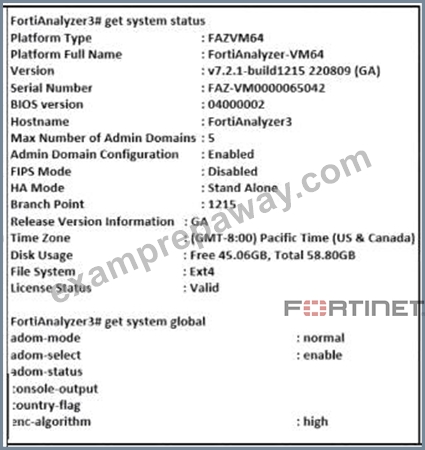
Based on the partial outputs displayed in the exhibit, which devices are ready to be configured as peers in an HA cluster?
- A. FortiAnalyzer1 and FortiAnalyzer3
- B. FortiAnalyzer2 and FortiAnalyzer3
- C. FortiAnalyzer1 and FortiAnalyzer2
- D. These devices cannot participate in the same cluster.
Answer: D
Explanation:
Based on the provided exhibit, which shows partial outputs of the system status and global settings for FortiAnalyzer devices, the devices cannot be configured as peers in an HA (High Availability) cluster. This is indicated by the HA Mode status being set to 'Stand Alone' for the displayed FortiAnalyzer device. For devices to be part of an HA cluster, they would need to havecompatible HA configurations, and usually, they should not be in 'Stand Alone' mode. Additionally, the exhibit only shows information for one FortiAnalyzer, so it cannot be determined if there is another device ready to form an HA cluster with it.
NEW QUESTION # 19
Which two methods can you use to restrict administrative access on FortiAnalyzer? (Choose two.)
- A. Limit access to specific virtual domains.
- B. Use administrator profiles.
- C. Fabric connectors to external LDAP servers.
- D. Configure trusted hosts.
Answer: B,D
Explanation:
To restrict administrative access on FortiAnalyzer, two effective methods are using administrator profiles and configuring trusted hosts. Administrator profiles allow for defining the level of access and permissions for different administrators, controlling what each administrator can seeand do within the FortiAnalyzer unit.
Configuring trusted hosts enhances security by limiting administrative access to specified IP addresses, ensuring that administrators can only connect from approved locations or networks, thus preventing unauthorized access from outside specified subnets or IP addresses.References:FortiAnalyzer 7.4.1 Administration Guide, "Administrators" and "Trusted hosts" sections.
NEW QUESTION # 20
Which feature can you configure to add redundancy to FortiAnalyzer?
- A. IPv6 administrative access
- B. VLAN interfaces
- C. Primary and secondary DNS
- D. Link aggregation
Answer: D
Explanation:
Link aggregation is a method used to combine multiple network connections in parallel to increase throughput and provide redundancy in case one of the links fail. This feature is used in network appliances, including FortiAnalyzer, to add redundancy to the network connections, ensuring that there is a backup path for traffic if the primary path becomes unavailable.References:The FortiAnalyzer 7.4.1 Administration Guide explains the concept of link aggregation and its relevance to
NEW QUESTION # 21
What is true about a FortiAnalyzer Fabric?
- A. Members events can be raised from the supervisor.
- B. The members send their logs to the supervisor.
- C. Supervisors support HA.
- D. The supervisor and members cannot be in different time zones
Answer: B
Explanation:
In a FortiAnalyzer Fabric, the FortiAnalyzer can recognize a Security Fabric group of devices, and it supports the Security Fabric by storing and analyzing logs from these units as if they were from a single device. The members of the Security Fabric group send their logs to the FortiAnalyzer, which acts as a supervisor for log storage and analysis, providing a centralized point of visibility and control over the logs.References:FortiAnalyzer 7.4.1 Administration Guide, "Security Fabric" section.
NEW QUESTION # 22
An administrator has configured the following settings: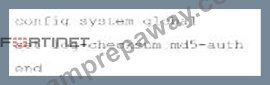
What is the purpose of executing these commands?
- A. To encrypt log transfer between FortiAnalyzer and other devices.
- B. To record the hash value and authentication code of log files.
- C. To verify the integrity of the log files received.
- D. To create the secure channel used by the OFTP process.
Answer: C
Explanation:
The purpose of executing the provided CLI commands, which include setting thelog-checksumtomd5-auth, is to ensure the integrity of the log files. This setting is used to record the MD5 hash value of log files, which is a widely used cryptographic hash function that produces a 128-bit (16-byte) hash value. By using MD5 authentication, FortiAnalyzer ensures that the log files have not been altered or tampered with during transit, thereby verifying their integrity upon receipt.This is not related to encrypting log transfers, scheduling reports, or creating secure channels for OFTP (Over-the-FortiGate Protocol) processes.
NEW QUESTION # 23
After you have moved a registered logging device out of one ADOM and into a new ADOM, you run the following command: execute sql-local rebuild-adom <new-ADOM-name> What is the purpose of running this CLI command?
- A. To migrate the archive logs to the new ADOM
- B. To reset the ADOM disk quota enforcement to its default value
- C. To populate the new ADOM with analytical logs for the moved device, so you can run reports
- D. To remove the analytics logs of the device from the old database
Answer: C
Explanation:
When you move a registered logging device from one ADOM (Administrative Domain) to another in FortiAnalyzer, it's essential to ensure that the analytical logs for the moved device are available in the new ADOM to maintain continuity in reporting and log analysis. The commandexecute sql-local rebuild-adom < new-ADOM-name>is used specifically for this purpose. Running this command populates the new ADOM with the analytical logs of the moved device, enabling you to generate accurate and comprehensive reports based on the historical data of the device in its new ADOM context. This process ensures that the transition of devices between ADOMs does not lead to a loss of analytical insight or reporting capabilities for the device's traffic and events.
NEW QUESTION # 24
In a Fortinet Security Fabric, what can make an upstream FortiGate create traffic logs associated with sessions initiated on downstream FortiGate devices?
- A. The upstream FortiGate is configured to do NAT.
- B. The traffic destination is another FoitiGate in the fabric.
- C. The downstream device cannot connect to FortiAnalyzer.
- D. Log redundancy is configured in the fabric.
Answer: C
Explanation:
In a Fortinet Security Fabric, an upstream FortiGate may create traffic logs for sessions initiated on downstream FortiGate devices if the downstream device is unable to connect to FortiAnalyzer. This allows for continuity of logging and ensures that session logs are captured and stored even if the downstream device loses its connection to the log management system.References:FortiAnalyzer 7.4.1 Administration Guide, "Fortinet Security Fabric" section.
NEW QUESTION # 25
What areanalytics logs on FortiAnalyzer?
- A. Logs that roll over when the log file reaches a specific size
- B. Logs classified as type Traffic, or type Security
- C. Logs that are compressed and saved to a log file
- D. Logs thatare indexed and stored in the SQL
Answer: D
Explanation:
On FortiAnalyzer, analytics logs refer to the logs that have been processed, indexed, and then stored in the SQL database. This process allows for efficient data retrieval and analytics. Unlike basic log storage, which might involve simple compression and storage in a file system, analytics logs in FortiAnalyzer undergo an indexing process. This enables advanced features such as quick search, report generation, and detailed analysis, making it easier for administrators to gain insights into network activities and security incidents.References:FortiAnalyzer 7.2 Administrator Guide - "Log Management" and "Data Analytics" sections.
NEW QUESTION # 26
Which two parameters impact the amount of reserved disk space required by FortiAnalyzer? (Choose two.)
- A. Total quota
- B. Disk size
- C. RAID level
- D. License type
Answer: B,C
Explanation:
The amount of reserved disk space required by FortiAnalyzer is influenced by the disk size and the RAID level. The system reserves a portion of the disk space for system use and unexpected quota overflow, with the rest available for device allocation. The RAID level determines the disk size and the reserved disk quota level, with different RAID configurations leading to variations in the reserved space.References:FortiAnalyzer 7.2 Administrator Guide, "Disk Space Allocation" and "RAID Level Impact" sections.
NEW QUESTION # 27
......
Fortinet NSE6_FAZ-7.2 certification is designed for network administrators who are responsible for managing and administering Fortinet FortiAnalyzer 7.2. Fortinet NSE 6 - FortiAnalyzer 7.2 Administrator certification validates the skills and knowledge required to install, configure, and maintain FortiAnalyzer 7.2, as well as troubleshoot any issues that may arise.
NSE6_FAZ-7.2 Dumps for NSE 6 Network Security Specialist Certified Exam Questions and Answer: https://www.examprepaway.com/Fortinet/braindumps.NSE6_FAZ-7.2.ete.file.html
NSE6_FAZ-7.2 Free Exam Study Guide! (Updated 32 Questions): https://drive.google.com/open?id=1jDI4vlCxvuXbFdyo8vzdcdfxK7XwT2a0